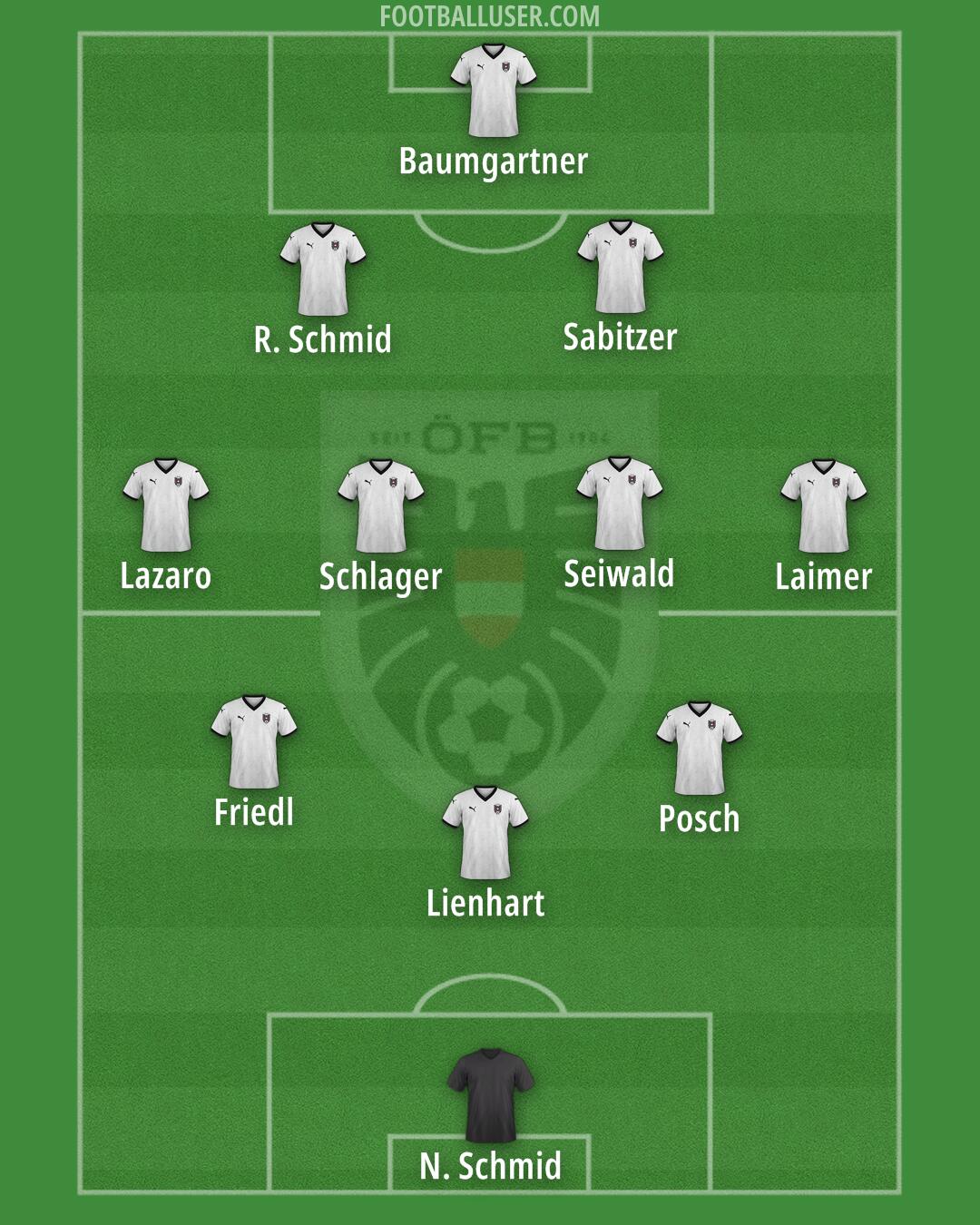

Austria National Football Team Formation
 March 18, 2026


Starting Lineup
Friedl · Lienhart · Posch · Laimer · Lazaro · Schlager · Seiwald · Baumgartner · R. Schmid · Sabitzer · N. SchmidA high pressing identity drives the Austria lineup in this 3-4-3 formation. The team seeks to win the ball back high up the pitch and move the play forward with verticality. This formation is built to overwhelm opponents in transition and dominate the central areas of the field.
N. Schmid guards the goal while the back three maintains a disciplined presence. Lienhart acts as the central figure in the defense, while Posch and Friedl provide cover on either side. The back line can step up to compress the space between the lines or drop deep to protect the goal. Posch and Friedl often track back to assist the midfield when the team loses possession, ensuring the defensive unit remains compact.
The midfield operates in a central block to control the tempo and bridge the gaps. Seiwald and Schlager sit in the middle to shield the back three, with Seiwald often breaking lines with his passing. Laimer and Lazaro provide the width, acting as wing backs who push high to support the attack. These wide players must track back to help the defense, creating a mobile midfield that can shift from a flat bank of four into a more aggressive attacking front.
Three attackers lead the front line to pin the opposition defense. Baumgartner leads the way as the lone striker, tasked to hold up the ball and lead the press. R. Schmid and Sabitzer operate as wide attackers, looking to cut inside or stretch the play. The movements of R. Schmid and Sabitzer create space for the wing backs to overlap, while Baumgartner makes runs to break the defensive line.
One major advantage is the ability to press high in coordinated waves, using the front three and the wide midfielders to suffocate the opponent. The team also finds success through wide overloads, as Laimer and Lazaro join the wingers to create two on one situations. This allows Austria to switch play quickly and find pockets of space in the final third.
This 3-4-3 formation relies on high intensity and rapid transitions to disrupt the opposition. It is best suited for matches where the team can exploit space behind a high defensive line.