
India National Football Team Formation
 March 19, 2026


Starting Lineup
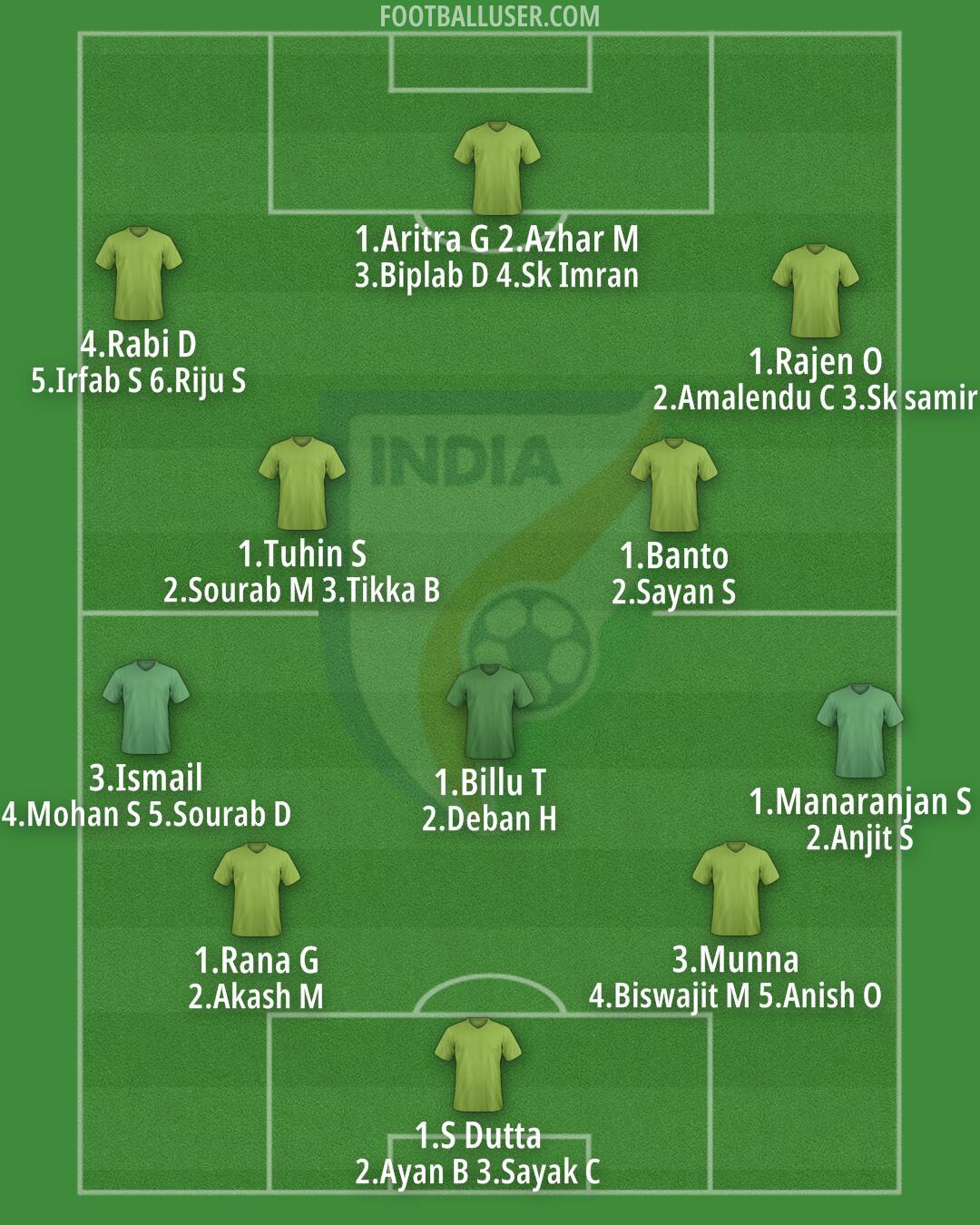
1.S Dutta (2.Ayan B 3.Sayak C)1.Rana G (2.Akash M)
3.Munna (4.Biswajit M 5.Anish O)
1.Billu T (2.Deban H)
1.Manaranjan S (2.Anjit S)
3.Ismail (4.Mohan S 5.Sourab D)
1.Banto (2.Sayan S)
1.Tuhin S (2.Sourab M 3.Tikka B)
1.Rajen O (2.Amalendu C 3.Sk samir)
4.Rabi D (5.Irfab S 6.Riju S)
1.Aritra G 2.Azhar M (3.Biplab D 4.Sk Imran)
A high press and aggressive verticality define the India lineup in a 5-2-3. This formation aims to win the ball high up the pitch and strike quickly through the channels. The team focuses on rapid transitions to catch opponents out of position before they can settle.
S Dutta guards the goal as the last line of defense. The back five consists of three central defenders where Billu T leads the unit while Rana G and Munna provide cover. These central defenders must stay compact to block passing lanes. The wide players, Manaranjan S and Ismail, act as wing backs who push high to provide width. They need to track back quickly to form a flat five when the opposition holds possession.
The midfield relies on a double pivot to control the center of the pitch. Banto and Tuhin S operate in the middle, with Tuhin S and Banto tasked with breaking the lines through vertical passes. They must shield the defense when the wing backs push forward and work to intercept play before it reaches the final third. This duo connects the deep defense to the front three, ensuring the ball moves from the back to the attackers without losing momentum.
In the final third, India uses three attackers to stretch the opposition. Aritra G and Azhar M work as a central pairing to occupy defenders, with Azhar M acting as the focal point to hold up the ball. Rabi D and Rajen O operate as wide attackers, cutting inside to create space for the wing backs. They press the opposition full backs intensely to force mistakes near the goal.
India gains a tactical advantage through the width provided by Manaranjan S and Ismail, which creates overloads on the flanks. The ability to press high in coordinated waves allows the team to win the ball in dangerous areas. Another strength lies in the compactness of the back three, making it difficult for opponents to find gaps in the central zone.
This formation is built for teams that want to dominate through intensity and quick transitions. It is best suited for matches where India can exploit space behind a high defensive line.