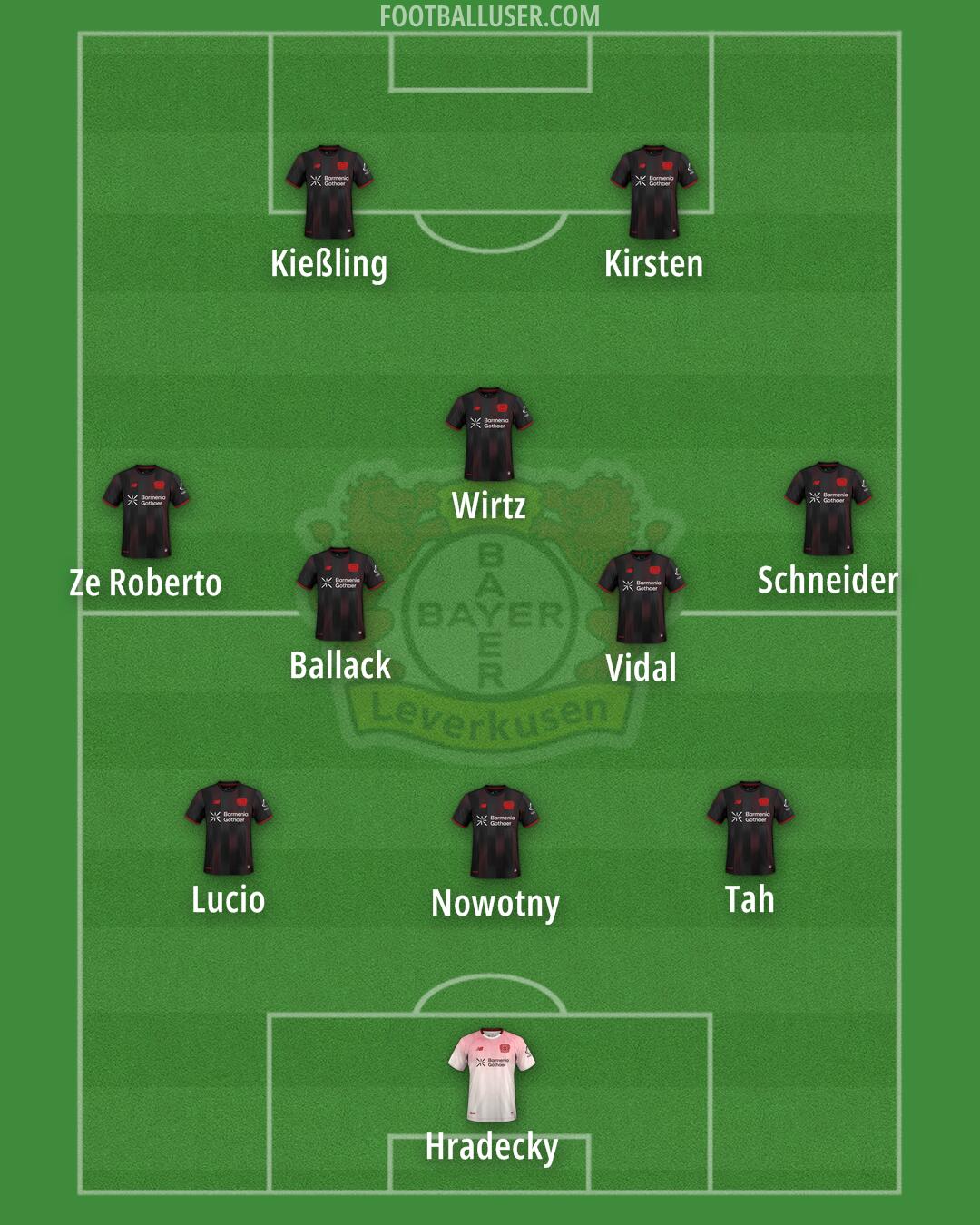

Bayer Leverkusen Football Formation
 March 20, 2026


Starting Lineup
Hradecky · Tah · Nowotny · Lucio · Schneider · Vidal · Ballack · Ze Roberto · Wirtz · Kirsten · KießlingA high pressing and heavy possession style defines Bayer Leverkusen in this 3-5-2 formation. This lineup aims to dominate the ball and control the tempo of the match through a central engine room. By keeping the ball in advanced areas, the team forces the opposition into errors and maintains constant pressure.
Hradecky acts as the last line of defense, providing stability from the goal. The back three consists of Nowotny, Lucio, and Tah, who sit in a compact block to protect the central zone. Nowotny provides leadership in the heart of the defense, while Lucio and Tah use their strength to win aerial duels and intercept passes. This defensive unit stays narrow to deny space between the lines, requiring constant communication to hold the line or drop back during transitions.
Controlling the center of the pitch is the primary objective for the midfield unit. Vidal and Ballack sit in a double pivot to shield the back three and win second balls. Ballack uses his powerful running and passing range to drive the team forward, while Vidal focuses on his high pressing intensity to disrupt the opponent. Ze Roberto and Schneider occupy the central spaces to connect the defense to the attack, with Wirtz operating in the hole as an attacking ten. Wirtz creates chances by finding pockets of space and breaking the lines with clever passes.
The attacking front features two forwards working in tandem to pressure the opposition defense. Kießling acts as the primary worker, using his relentless movement to press defenders and hold up the ball. Kirsten plays alongside him, looking to exploit the gaps created by the movement of the midfielders. This duo uses constant runs to stretch the defensive line, creating space for Wirtz to operate effectively in the final third.
Bayer Leverkusen gains a significant advantage through numerical superiority in the middle of the pitch. Having five players capable of controlling the ball allows the team to switch play quickly and find free men. The coordination between the midfield and the front two allows for coordinated waves of pressure that can overwhelm opponents. Additionally, the central density makes it difficult for the opposition to play through the middle, forcing them into wide areas where they are less dangerous.
This formation provides a heavy central presence that is ideal for dominating possession against mid-block teams. It is most effective when facing opponents that struggle to handle high intensity pressing and rapid central transitions.