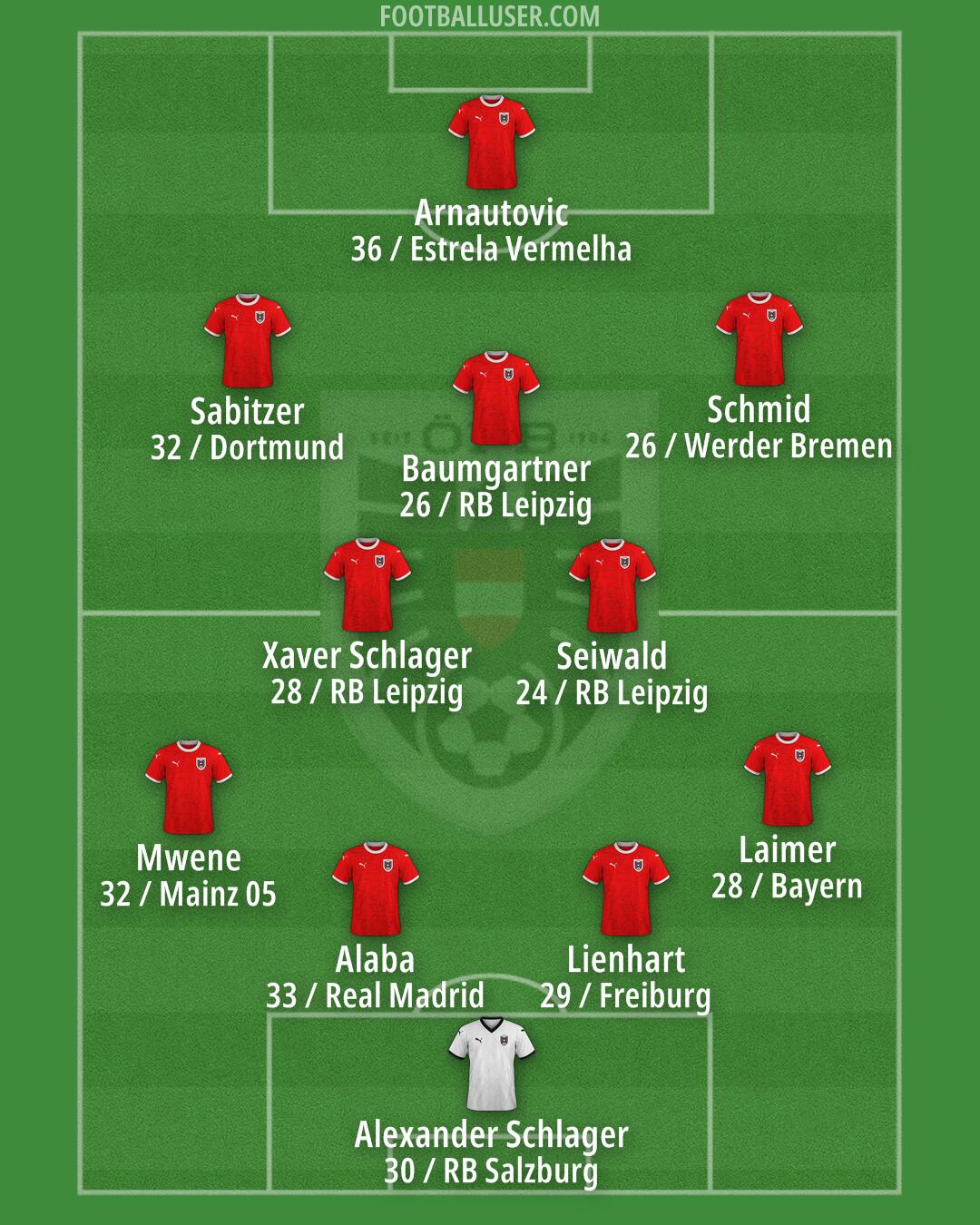

Austria National Football Team Formation
 March 21, 2026


Starting Lineup
Alexander Schlager (30 / RB Salzburg) · Laimer (28 / Bayern) · Lienhart (29 / Freiburg) · Alaba (33 / Real Madrid) · Mwene (32 / Mainz 05) · Seiwald (24 / RB Leipzig) · Xaver Schlager (28 / RB Leipzig) · Baumgartner (26 / RB Leipzig) · Schmid (26 / Werder Bremen) · Sabitzer (32 / Dortmund) · Arnautovic (36 / Estrela Vermelha)A high pressing and vertical style defines Austria in this 4-5-1 formation. The team looks to win the ball high up the pitch and quickly break forward to catch the opposition out of position. This lineup focuses on heavy work rates across the pitch to sustain pressure and close down passing lanes.
Alexander Schlager stays between the posts to organize the back line. The defensive unit consists of a flat back four where Lienhart acts as a ball playing defender to start attacks from the deep. Beside him, Alaba uses his passing range and experience to cover space and intercept passes. Laimer provides energy at right back to track back and defend wide areas, while Mwene pushes up to offer width on the left.
The midfield functions as a central block designed to dominate the middle of the pitch. Seiwald and Xaver Schlager act as a double pivot to shield the defense and break up play. Ahead of them, Sabitzer and Schmid occupy the half spaces to drive forward and connect the lines. Baumgartner operates in the central pocket to help the transition from defense to attack by finding pockets of space between the opponent lines.
Arnautovic acts as a lone striker to lead the line. He must hold up the ball to allow the five midfielders to push forward. The attack relies on the movement of the wide midfielders to create overloads. While Arnautovic occupies the central defenders, Sabitzer and Baumgartner make runs to support him. The forwards press hard to force turnovers in the final third.
Austria gains a clear advantage through their ability to press high in coordinated waves. The midfield numbers allow them to create numerical superiority in the center, making it difficult for opponents to play through them. This formation also allows for quick transitions where the team can shift from a compact defensive block to a vertical attacking unit in seconds.
This 4-5-1 formation relies on intense running and central compactness to disrupt the opponent. It is best suited for matches against teams that prefer possession, as the heavy pressing can force errors in the build up phase.