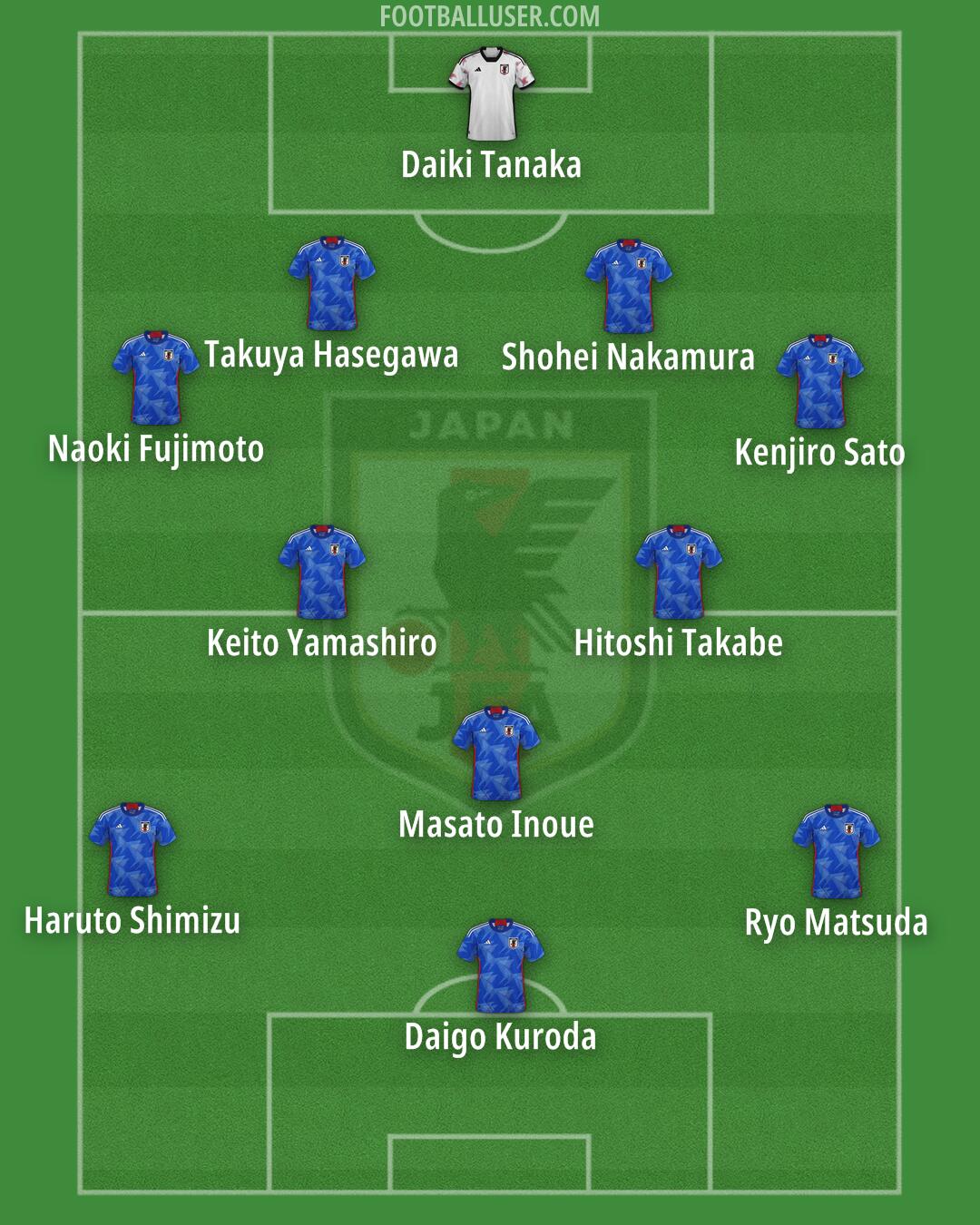

Japan National Football Team Formation
 March 24, 2026


Starting Lineup
Daiki Tanaka · Naoki Fujimoto · Takuya Hasegawa · Shohei Nakamura · Kenjiro Sato · Keito Yamashiro · Hitoshi Takabe · Masato Inoue · Haruto Shimizu · Ryo Matsuda · Daigo KurodaJapan utilizes a 4-3-3 formation that focuses on a high press and quick vertical play. This lineup is built to win the ball high up the pitch and move it rapidly toward the final third. The goal is to use the width of the pitch to stretch the opposition and create gaps for runners to exploit.
Daiki Tanaka stands between the posts to command his area. The defense operates with a flat back four where Naoki Fujimoto and Kenjiro Sato act as full backs to provide width. Takuya Hasegawa and Shohei Nakamura form the central pairing, with one player tasked to step up while the other provides cover. This unit must hold a high line to keep the team compact and squeeze the space available to the opponent.
The midfield works through a central trio that connects the defense to the attack. Hitoshi Takabe and Keito Yamashiro operate in the central roles to shield the back four and break the lines with their passing. Masato Inoue plays as an attacking midfielder, sitting just behind the front three to drive forward and create chances. This grouping allows the team to control the center of the pitch and transition quickly from defense to attack.
In the final third, Japan employs three attackers to stretch the play. Daigo Kuroda leads the line as a lone striker to hold up the ball and pin the opposition defenders. Haruto Shimizu and Ryo Matsuda occupy the wings as wide attackers, looking to cut inside or deliver crosses. These forwards must press high in coordination to force turnovers near the opponent goal.
This formation offers several tactical advantages, particularly the ability to press high in coordinated waves. By having the front three and the attacking midfielder Masato Inoue close down the ball, the team can force mistakes in the build up phase. Additionally, the movement of Naoki Fujimoto and Kenjiro Sato allows for wide overloads, creating extra passing lanes in the attacking half.
The 4-3-3 formation provides a balanced way to attack with width while maintaining a solid presence in the center. It is best suited for matches against teams that play a high line or struggle to play out from the back under pressure.