England National Football Team Formation
 March 25, 2026


Starting Lineup
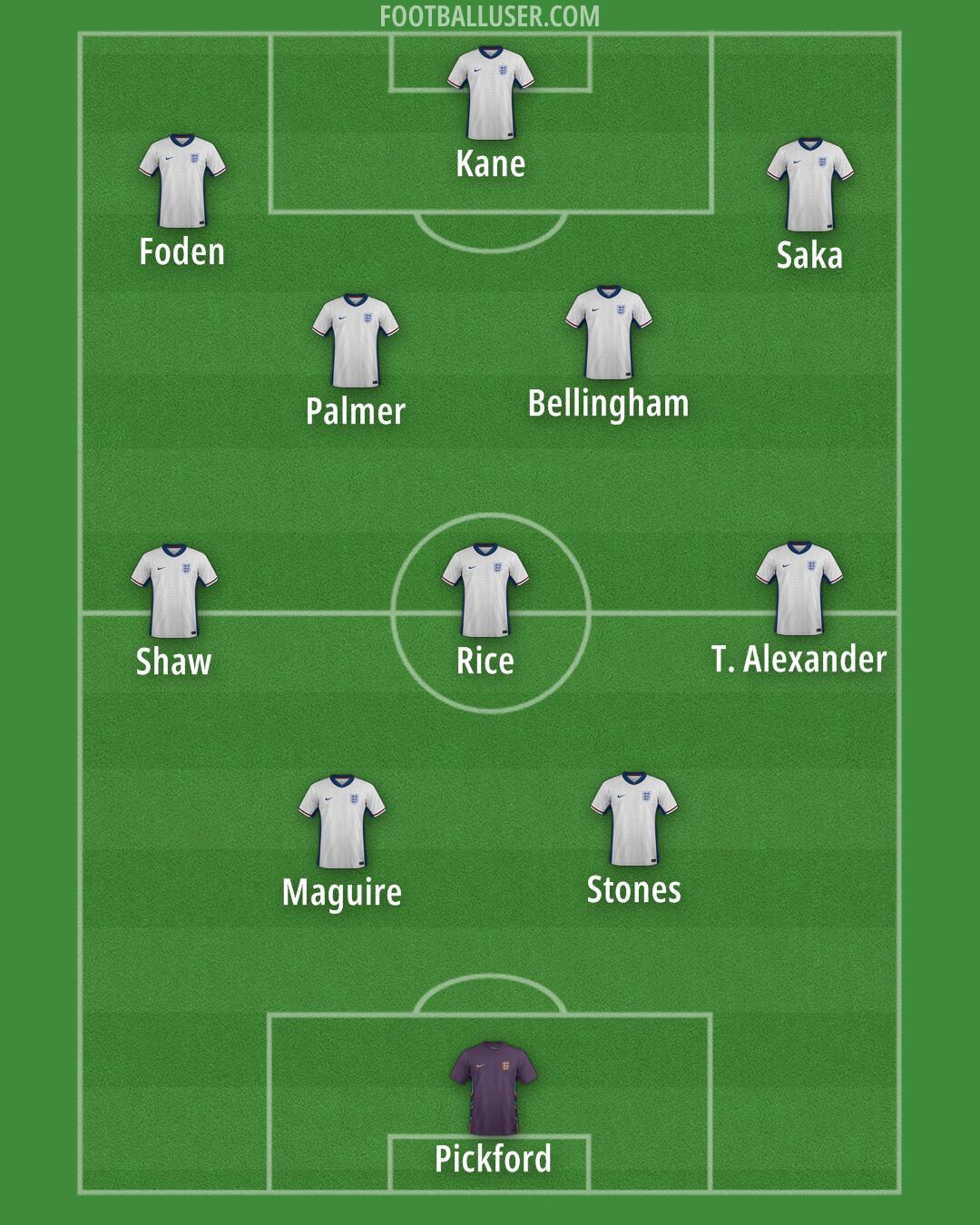
Kane · Rice · Palmer · Bellingham · Saka · Foden · Shaw · T. Alexander · Stones · Maguire · PickfordEngland uses a 5-2-3 formation to control matches. This lineup is built to play a high press and use rapid transitions. The goal is to win the ball high up the pitch and use the width of the field to stretch the opponent. By using five defenders, the team stays solid while looking to strike fast.
Pickford works as the goalkeeper to command his box. The defense operates with a back three of Maguire, Stones, and Rice. Maguire uses his aerial strength to win headers. Stones acts as a ball playing defender to distribute from the back. Rice stays central to cover ground and intercept passes. Shaw acts as the left wing back to overlap and push high. T. Alexander serves as the right wing back to provide width and track back when the team loses possession.
The midfield is a double pivot with Palmer and Bellingham. Bellingham uses his driving runs to push the line forward. Palmer uses his passing range to connect the defense and the attack. They work to shield the back three and break the line of the opponent's midfield. This duo is vital to move the ball from the defensive block into the attacking third.
The front line features three attackers. Kane plays as the striker and knows how to hold up the ball to involve others. Saka acts as an inverted winger on the right to cut inside and find goals. Foden operates on the left to move into space and create chances. This formation uses the width of the pitch to pull defenders out of position.
This formation allows England to create wide overloads when the wing backs join the wingers in the final third. The team can also press high in coordinated waves to win the ball back quickly. Compactness when defending is another strength, as the players can sit deep and block passing lanes effectively.
The 5-2-3 formation provides England with a strong base to attack both through the center and the flanks. It is best suited for matches against teams that play with wide players or struggle to play out from the back under pressure.