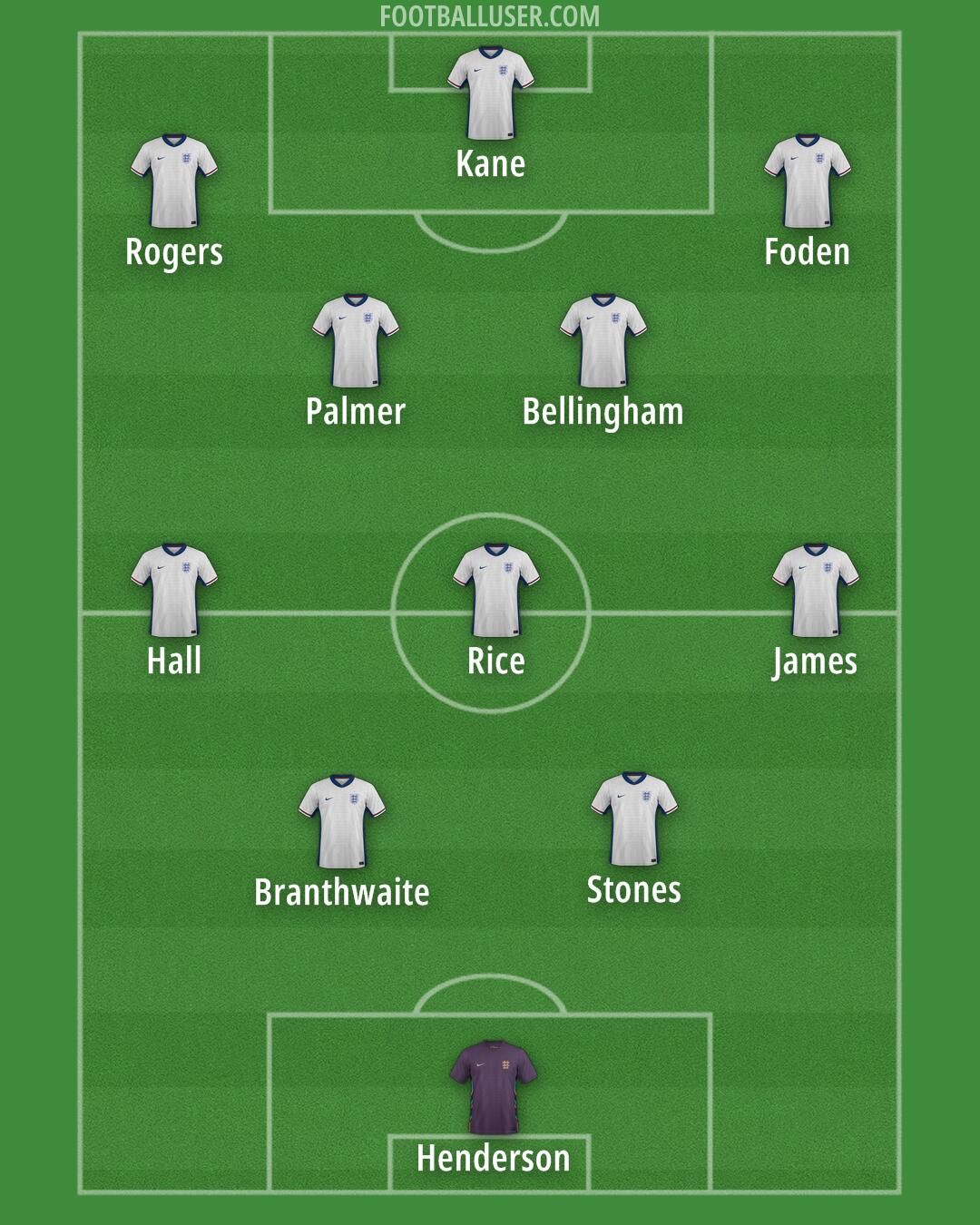
England National Football Team Formation
 March 25, 2026


Starting Lineup
Kane · Rice · Palmer · Bellingham · Rogers · Foden · Hall · James · Stones · Branthwaite · HendersonEngland competes in a 5-2-3 formation. The identity of this lineup relies on a heavy high press and quick verticality to unsettle opponents. This formation is built to win the ball high up the pitch and exploit gaps through rapid transitions.
Henderson stays behind a back five to command the area and organize the unit. Rice sits as the central defender to anchor the group, with Branthwaite and Stones acting as the two ball playing defenders on the left and right. Stones uses his passing range to help build play from the back and find teammates in advanced positions. Hall and James act as wing backs, tasked to push high and provide extreme width. The entire defensive unit can shift as one to block passing lanes or drop deep to protect the goal when under pressure.
The midfield relies on a two man unit featuring Palmer and Bellingham. Bellingham uses his physical presence to drive forward into the attacking third, while Palmer connects the middle to the attack by looking to break the line with his passing. They must work to shield the defense and intercept play in the center of the pitch. This pairing allows England to transition from defense to attack with incredible speed and control.
The attack features three players in a front three. Rogers works the left flank, while Foden operates on the right and looks to cut inside using his dribbling skills. Kane leads the line as a lone striker, using his ability to hold up the ball, his movement, and his clinical finishing to create space. To force errors in the opposition buildup, the front three press together in unison. The width provided by the wingers helps to stretch the opposing defense.
A key advantage of this formation is the ability to create wide overloads when Hall and James overlap the attackers. This forces the opposition to track runs and can lead to many crosses into the box. The team also benefits from the ability to press high in coordinated waves. This forces the opponent into mistakes and allows the midfield to win the ball back in dangerous areas to keep the pressure on.
This 5-2-3 formation provides a strong balance of defensive cover and attacking width. It is ideally suited for games where the opponent defends in a low block and leaves space to exploit on the flanks.