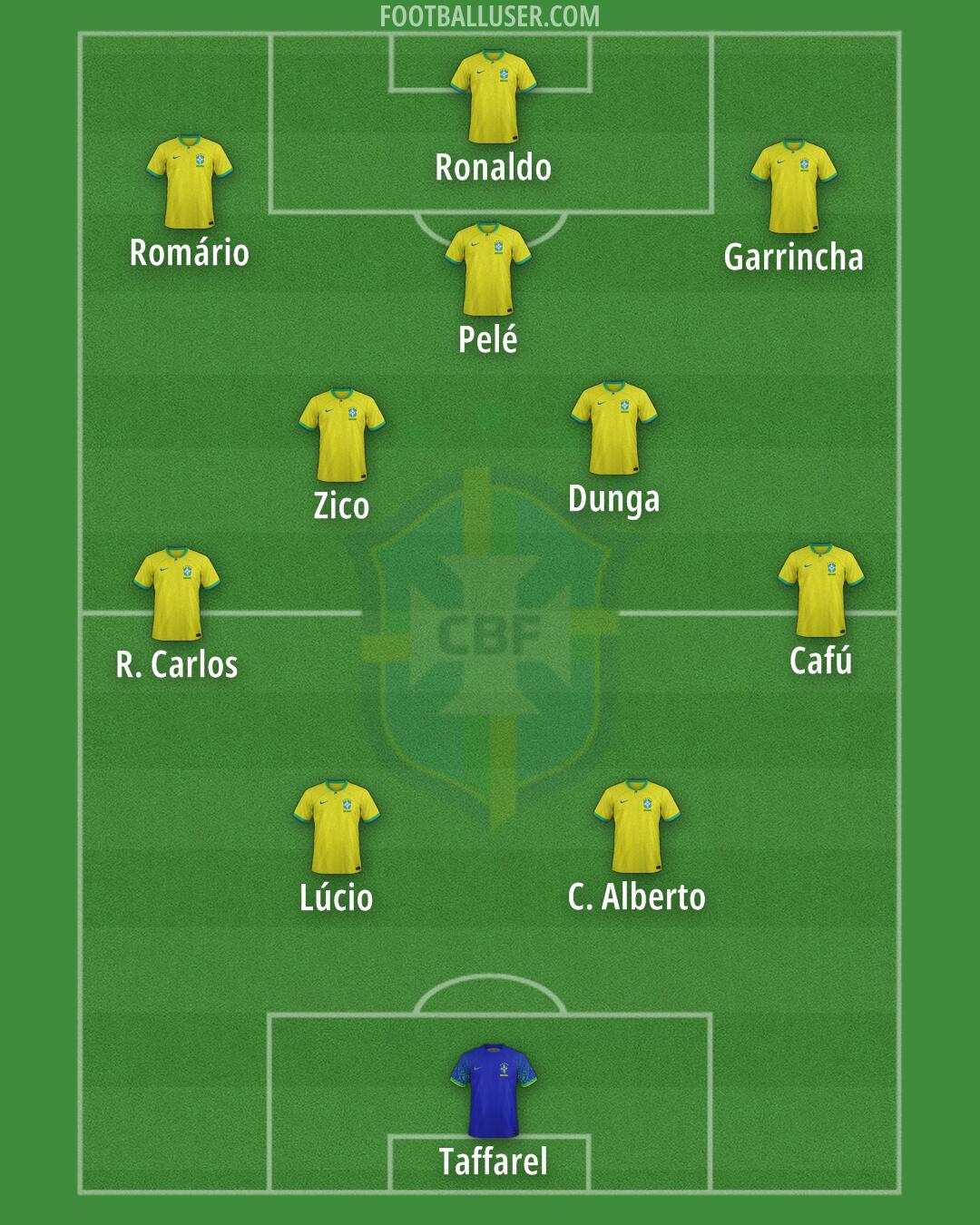

Brazil National Football Team Formation
 March 25, 2026


Starting Lineup
Garrincha · Ronaldo · Pelé · Zico · Dunga · R. Carlos · Lúcio · Cafú · C. Alberto · Romário · TaffarelBrazil plays with a 2-5-3 formation that focuses on overwhelming the opposition with attacking numbers. This lineup is built to play a high octane brand of football where the team seeks to control the ball and push forward rapidly. The identity of Brazil revolves around constant pressure and technical mastery in the final third, making them a heavy offensive force.
Taffarel acts as the lone goalkeeper behind a back two. Lúcio and C. Alberto form the central defensive pair, where Lúcio provides aerial strength and C. Alberto acts as a ball playing defender to start moves. Because there are only two players in the deep line, they must step up to intercept passes and prevent long balls. The wide players in the midfield must track back to cover the flanks, or the central defenders will be left isolated.
The midfield functions as a massive five man engine room designed to dominate the center of the pitch. Dunga sits deep to shield the defense and break up play, while Cafú and R. Carlos occupy the wider roles to act as driving forces. Zico operates in the left central space to create chances with his passing range and vision, while Pelé pushes into the attacking midfield role to link the lines. This midfield block allows Brazil to control the tempo and move the ball from deep to the attackers.
The attacking line uses three forwards to stretch the opposition defense. Garrincha stays wide on the right to use his dribbling style to beat defenders, while Romário occupies the left side to cut inside and find space. Ronaldo leads the line as the striker, using his pace and strength to hold up the ball and run behind the defensive line. This front three stays high to keep the opposition defenders pinned back, creating space for the attacking midfielders to run into.
Brazil offers several tactical advantages with this formation. The primary strength is the numerical superiority in midfield, which allows them to intercept play and control possession. The wide players like Cafú and R. Carlos provide wide overloads, which forces the opposition to pull defenders out of position. This creates space for the creative players to break the line and isolate defenders in one on one situations.
This 2-5-3 formation represents a high risk, high reward way to play football. It is best suited for games where Brazil needs to break down a parked bus or when they want to completely dominate an opponent through sheer attacking volume.