
Denmark National Football Team Formation
 March 28, 2026


Starting Lineup
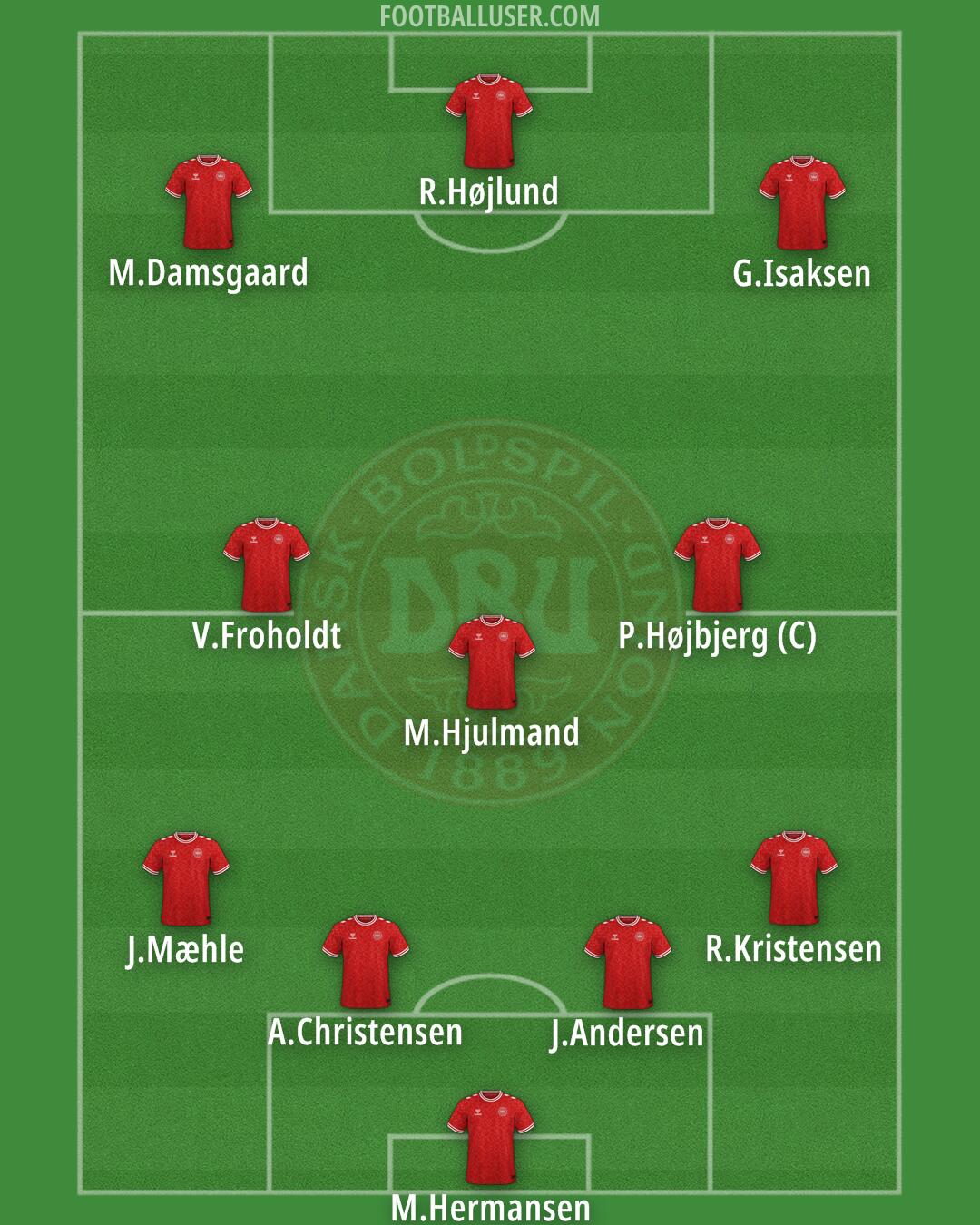
M.Hermansen · A.Christensen · J.Mæhle · J.Andersen · R.Kristensen · M.Hjulmand · V.Froholdt · P.Højbjerg (C) · M.Damsgaard · R.Højlund · G.IsaksenDenmark operates with a 4-3-3 formation. The lineup is built to play a high press and use rapid transitions to catch opponents out of position. This team wants to control the tempo through a strong central core and use the width of the pitch to stretch the opposition. It is a formation designed for aggressive, vertical football that seeks to recover the ball in high areas.
M.Hermansen starts in goal to organize the back line. The defense sits in a flat back four where J.Andersen and A.Christensen act as the central pairing. A.Christensen is a ball playing defender who can step up and pass out of the back with composure. J.Andersen provides cover and dominance in the air when defending crosses. On the flanks, R.Kristensen and J.Mæhle act as full backs. J.Mæhle will push up and overlap to provide width, while R.Kristensen must track back to cover the space behind him. The defensive unit works as a compact block to prevent through balls.
The midfield uses a single pivot to control the center of the pitch. M.Hjulmand sits in front of the defense to shield the back four, using his tactical positioning to intercept the ball. Beside him, P.Højbjerg (C) acts as a central midfielder with a wide passing range and high work rate. P.Højbjerg (C) drives the team forward and connects the defensive unit to the attackers. V.Froholdt plays on the left side to help shift play and keep possession in tight areas. This midfield trio ensures the team can transition from defense to attack with speed.
The attack features three players in a front three. R.Højlund acts as a lone striker who uses his physical strength to hold up the ball and press the opposition defenders. On the wings, G.Isaksen and M.Damsgaard provide the width. G.Isaksen prefers to cut inside to create shooting opportunities, while M.Damsgaard works to stretch the play on the left. The movement of these three forwards is designed to pull the opposition defenders out of their positions and create space in the channels.
This 4-3-3 formation offers several tactical advantages for Denmark. The team can create wide overloads when the full backs overlap the wingers. They also possess the ability to press high in coordinated waves to win the ball back quickly. The presence of P.Højbjerg (C) allows for quick vertical passes that break the line of the opponent midfield. This makes them very dangerous during the transition phase.
This lineup is built for high intensity football and quick transitions. It is best suited for matches where the team can exploit spaces left by an attacking opponent.