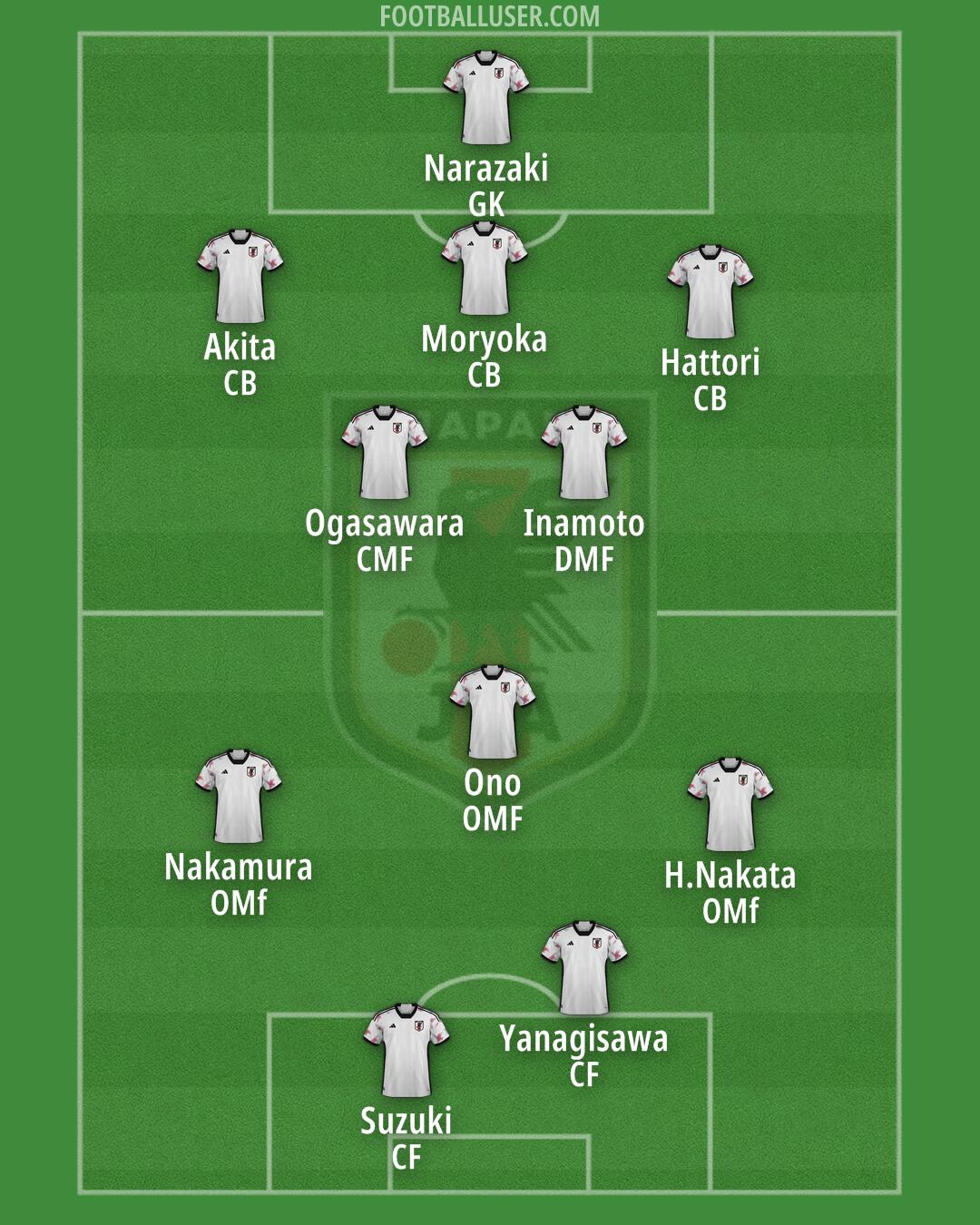

Japan National Football Team Formation
 March 28, 2026


Starting Lineup
Narazaki (GK) · Akita (CB) · Moryoka (CB) · Hattori (CB) · Inamoto (DMF) · Ogasawara (CMF) · Ono (OMF) · H.Nakata (OMf) · Nakamura (OMf) · Yanagisawa (CF) · Suzuki (CF)Japan operates in a 4-5-1 formation. This lineup is built to play a defensively solid style that relies on a compact block and quick transitions. The team aims to stay organized in deep areas and use a single striker to hold up the ball while the five midfielders work to disrupt the opponent in the middle third.
Suzuki acts as the last line of defense in goal. The back four consists of H.Nakata on the right and Nakamura on the left, while Yanagisawa and Ono occupy the central defender roles. H.Nakata and Nakamura are expected to track back and mark wide attackers, while Yanagisawa and Ono focus on aerial strength and covering space behind the midfield. The defensive unit stays close together to prevent passes through the center.
The midfield features five players working in a dense block. Inamoto sits in the right defensive midfield role to shield the defense and intercept passes. Beside him, Ogasawara sits in the left defensive midfield position to help cover the center. Hattori, Akita, and Moryoka operate in the central areas to connect the defense to the attack. These five players work to press the ball and break the line of the opponent with short passes.
Japan uses a lone striker, Narazaki, to lead the front line. Narazaki must hold up the ball and wait for the midfielders to push forward. The attack is built through the wide midfielders who can cut inside or provide crosses into the box. This formation requires Narazaki to press the opposing central defenders to force mistakes and create space for the midfield to run into.
One major advantage of this formation is the ability to create compactness when defending. By packing the middle with Inamoto, Ogasawara, Hattori, Akita, and Moryoka, the team makes it difficult for opponents to find gaps between the lines. Another strength is the speed of transition once the ball is won in the middle third. The team can quickly switch play to the wings to catch the opposition out of position.
This 4-5-1 formation creates a difficult barrier for opponents to break down through the center. It is best suited for games where the team needs to sit deep and defend a lead against a more dominant side.