
Austria National Football Team Formation
 March 29, 2026


Starting Lineup
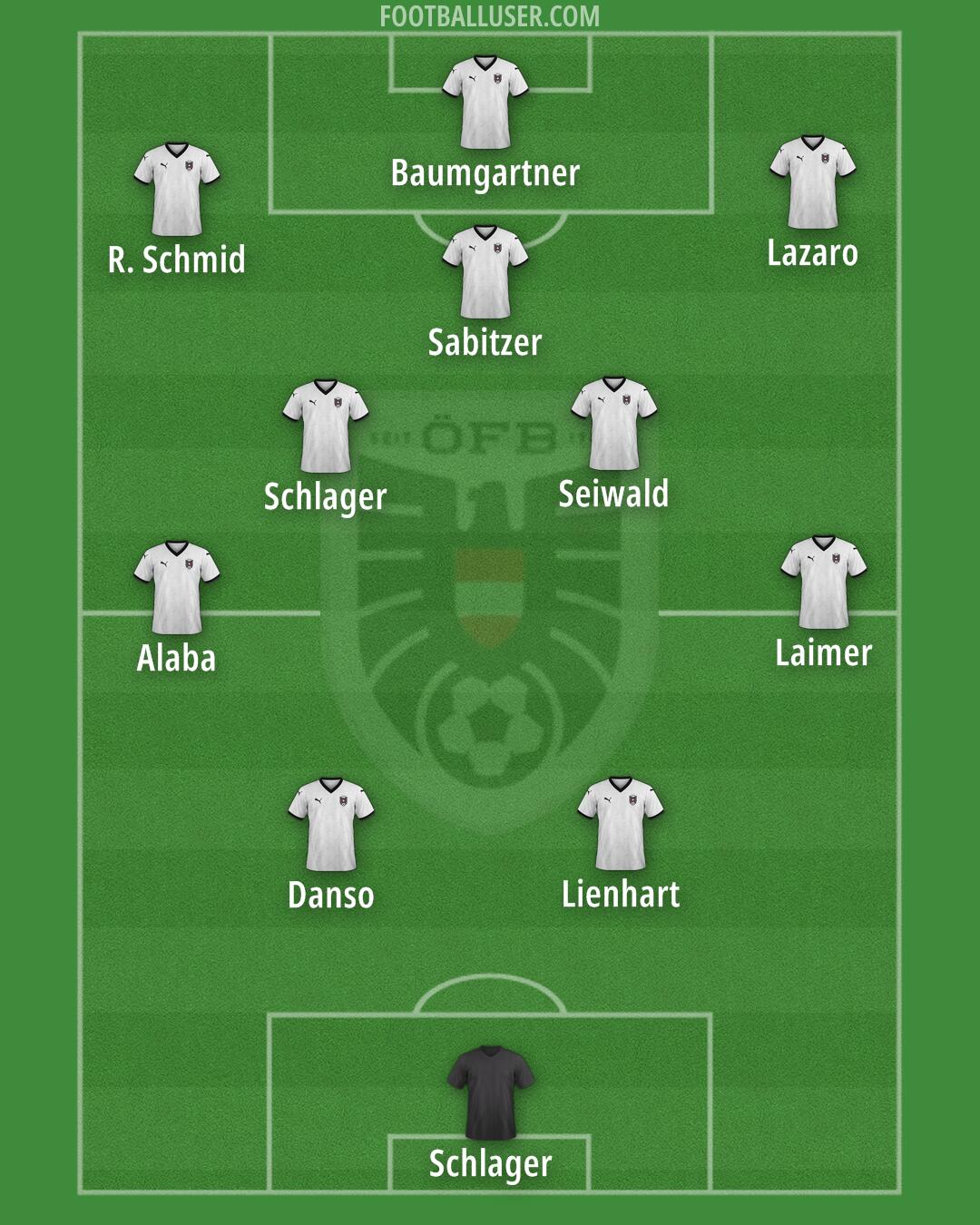
Lienhart · Danso · Alaba · Laimer · Lazaro · Schlager · Seiwald · Baumgartner · R. Schmid · Sabitzer · SchlagerAustria plays with a 5-4-1 formation that relies on a deep defensive block and rapid verticality. This lineup aims to sit deep to deny space between the lines before launching quick attacks. The goal for Austria is to remain compact and hard to break down while looking for moments to exploit transitions.
Baumgartner guards the goal behind a back five. The central trio of Sabitzer, Seiwald, and Schlager provides a wall of strength, with Schlager and Seiwald providing aerial strength and Sabitzer acting as a ball playing defender to start attacks. Lazaro and R. Schmid operate as wing backs, tasked to cover the entire flank and provide width during transitions. These wide players must track back quickly to maintain the defensive line when the team loses possession.
The midfield functions as a flat four to protect the central zone. Alaba sits in a deep role to shield the defense and break the line with his passing range, while Laimer works alongside him to press and intercept passes. Moving higher, Danso and Lienhart occupy the lateral spaces in the midfield to connect the defense to the lone forward. This midfield unit focuses on marking opponents tightly and shifting side to side to prevent central penetrations.
Up front, the team relies on a lone striker, Schlager, to hold up the ball and pressure the opposition defenders. This attacker must work hard to press the back line and create space for the advancing midfield. The attacking width comes from the late runs of Lazaro and R. Schmid, who push up the flanks to deliver crosses into the box. The formation forces the opposition to stretch their defensive lines to account for the wide players.
This 5-4-1 offers significant tactical advantages, particularly in terms of compactness when defending in a low block. By keeping the distances between the five defenders and the four midfielders small, the team makes it difficult for opponents to find gaps. Another strength is the ability to exploit wide areas through the overlapping runs of the wing backs. This creates numerical superiority in the channels once the ball is won back in transition.
This formation creates a defensive wall that is very difficult to penetrate through the middle. It is a setup best suited for facing teams that dominate possession and allow Austria to strike on the break.