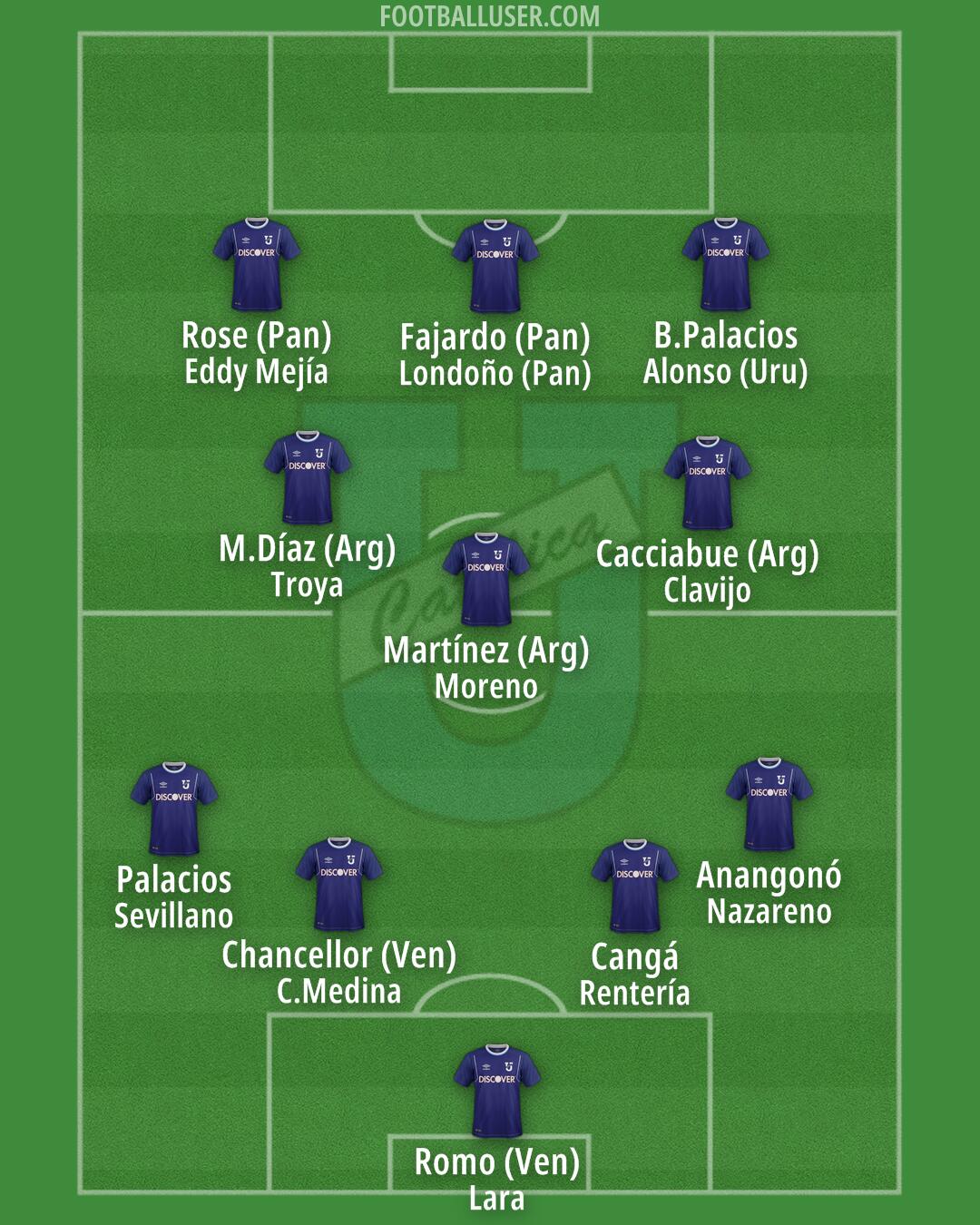

U. Católica (Quito) Football Formation
 March 30, 2026


Starting Lineup
Romo (Ven) (Lara) · Chancellor (Ven) (C.Medina) · Palacios (Sevillano) · Cangá (Rentería) · Anangonó (Nazareno) · Cacciabue (Arg) (Clavijo) · Martínez (Arg) (Moreno) · M.Díaz (Arg) (Troya) · Rose (Pan) (Eddy Mejía) · B.Palacios (Alonso (Uru)) · Fajardo (Pan) (Londoño (Pan))U. Católica (Quito) operates with a 4-3-3 formation. This lineup is built to play a high press and transition quickly into attack. The goal is to use the pitch width to stretch opponents and use vertical passes to move the ball from the back to the front line.
Romo sits between the posts to organize the defense. The back line works as a flat back four, with Cangá and Chancellor acting as the central defenders. Cangá provides aerial strength while Chancellor covers the spaces behind the midfield. Anangonó and Palacios provide width by pushing up the flanks to overlap the attackers. This defensive unit works to stay compact and step up together to keep the team high on the pitch.
The midfield features a single pivot to protect the center. Martínez acts as the holding player to shield the defense and intercept passes. Moving ahead of him, Cacciabue and M.Díaz occupy the central spaces to connect the lines. Cacciabue drives forward into gaps while M.Díaz helps to recycle possession and switch play. This group works to control the tempo and ensure the ball reaches the attacking trio efficiently.
The attack uses three attackers to pressure the opposition. Fajardo plays as a lone striker to hold up the ball and lead the press from the front. On the wings, Rose and B.Palacios act as wide attackers who look to cut inside and create threats. Rose moves into half spaces to find pockets of room, while B.Palacios stays wide to provide crosses. This attacking lineup is designed to create quick combinations in the final third.
One main advantage for U. Católica (Quito) is the ability to press high in coordinated waves. The front three and midfield three can push up together to win the ball back close to the opponent goal. Another strength is the use of wide overloads. When Anangonó and Palacios push high, they create two on one situations against the opposing full backs. This allows the team to bypass a crowded central area.
This 4-3-3 formation relies on high intensity and quick transitions to dominate the ball. It is best suited for games where the team wants to control the tempo and pin the opponent back in their own half.