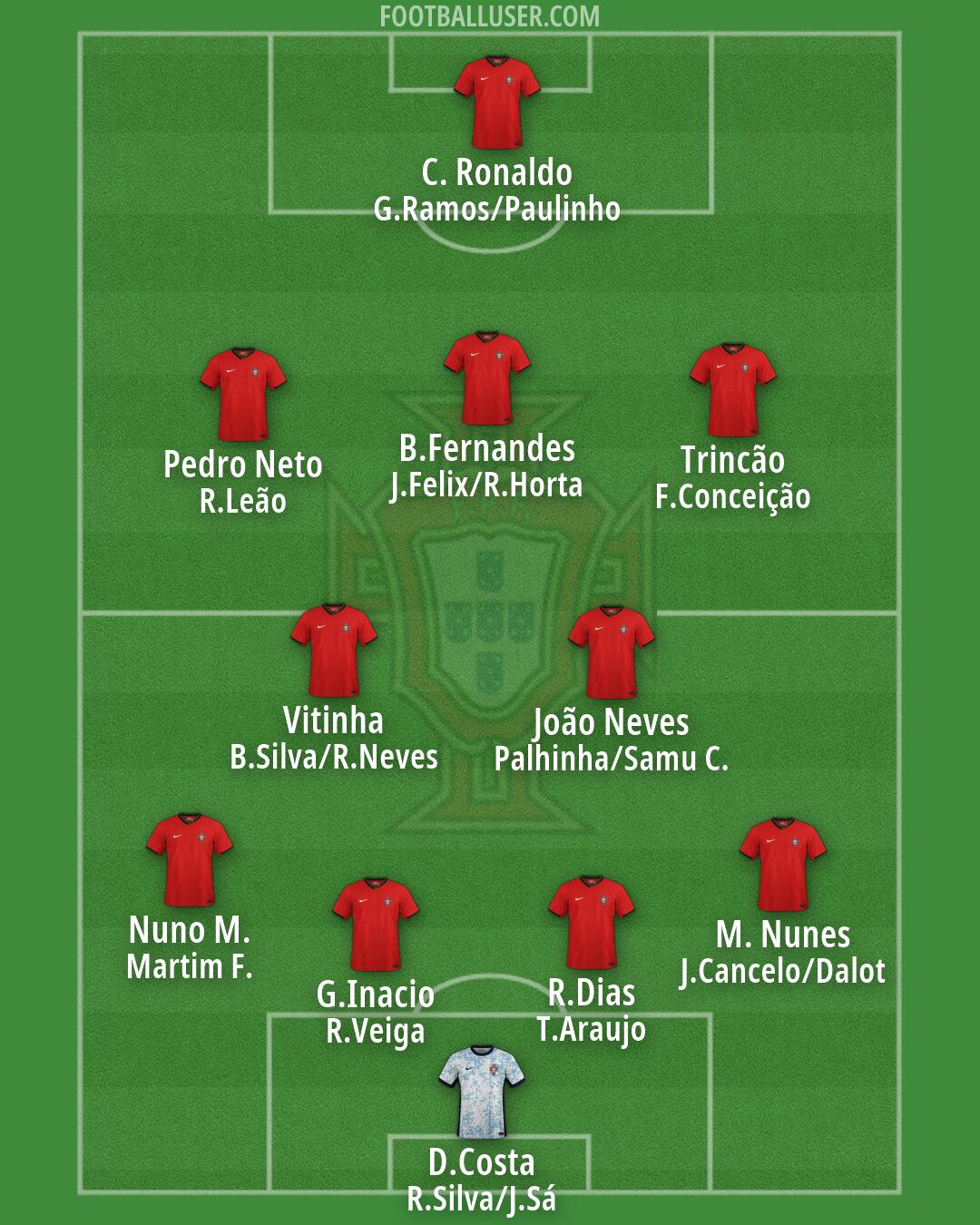

Portugal National Football Team Formation
 April 1, 2026


Starting Lineup
C. Ronaldo (G.Ramos/Paulinho) · Pedro Neto (R.Leão) · B.Fernandes (J.Felix/R.Horta) · Trincão (F.Conceição) · Vitinha (B.Silva/R.Neves) · João Neves (Palhinha/Samu C.) · Nuno M. (Martim F.) · M. Nunes (J.Cancelo/Dalot) · G.Inacio (R.Veiga) · R.Dias (T.Araujo) · D.Costa (R.Silva/J.Sá)Portugal operates with a 4-5-1 formation. This lineup is built to play with a high press and control the middle of the pitch through heavy numbers. The intent is to dominate possession and use a compact unit to suffocate the opponent. This formation is designed to allow for quick transitions from a central defensive block into a rapid attacking move.
D.Costa acts as the last line of defense in goal. The back line consists of a flat four where R.Dias and G.Inacio function as the central defenders. R.Dias provides strength in the air and uses his positioning to intercept play, while G.Inacio covers the space when the team steps up. M. Nunes and Nuno M. play as the full backs. M. Nunes will often overlap to provide width, whereas Nuno M. can tuck in to help the central area. The whole defensive unit works to keep the lines close together.
The midfield utilizes a double pivot of João Neves and Vitinha to protect the back four. João Neves works to tackle and shield the defense, while Vitinha uses his passing range to move the ball forward. In front of the pivot, B.Fernandes (C) acts as the main engine. B.Fernandes (C) uses his passing range to break the line and drive the team forward. Trincão and Pedro Neto play in the spaces ahead of the pivot, providing the link between the midfield and the lone striker.
In the attacking phase, C. Ronaldo operates as a lone striker. He stays central to hold up the ball and uses his movement to find space in the box. The width is provided by the movement of Trincão and Pedro Neto who can push high to support the attack. C. Ronaldo leads the press from the front to force turnovers. This creates a central presence that forces the opposition to sit deep.
The team gains a major advantage through numerical superiority in the midfield. Having five players in the center makes it very hard for opponents to find passing lanes. Another strength is the ability to press high in coordinated waves to win the ball back quickly. Speed of transition also benefits the team when the ball is won in the middle.
This 4-5-1 formation relies on a massive central presence to control the game. It is best suited for matches against opponents who try to build play through the center of the pitch.