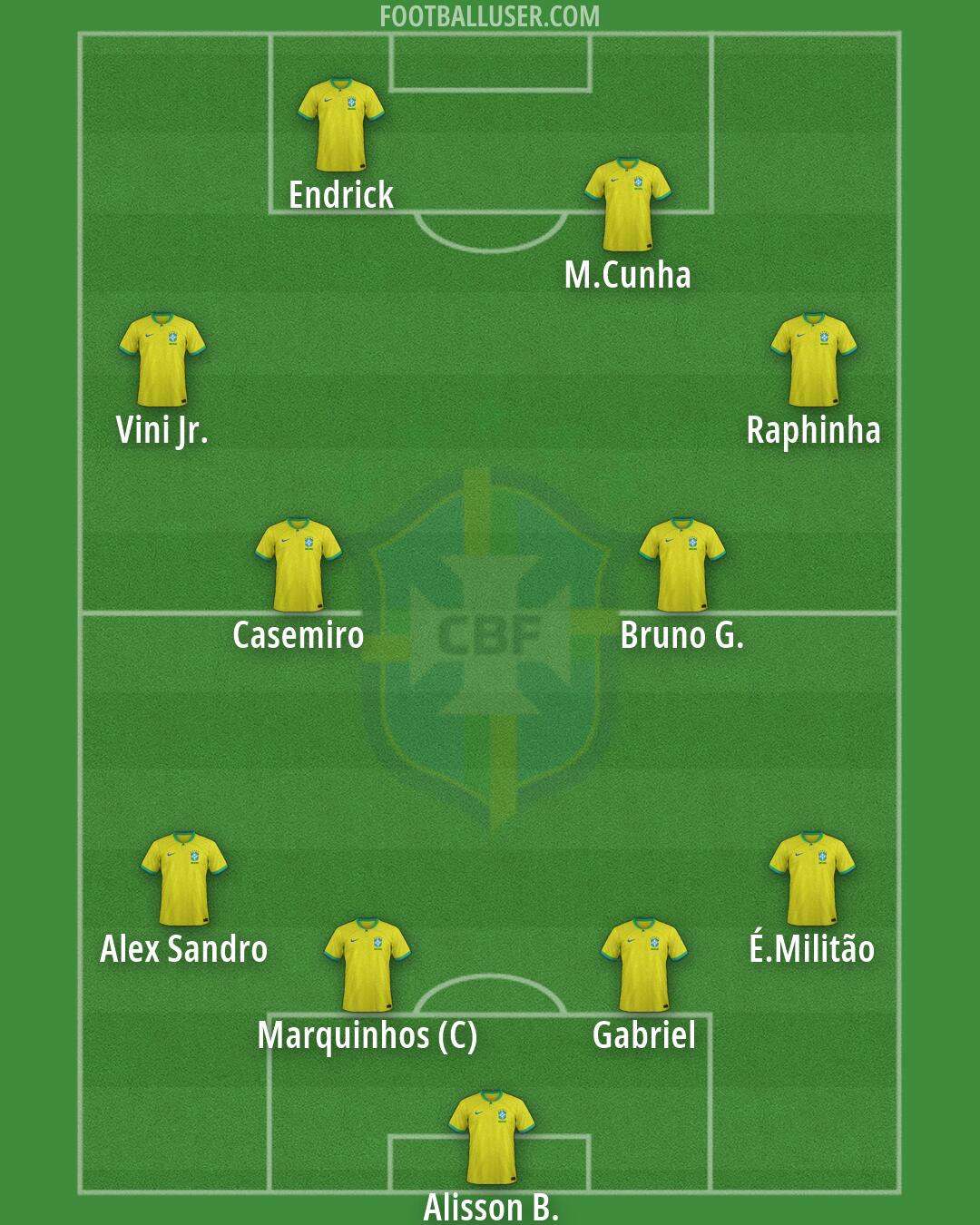

Brazil National Football Team Formation
 April 1, 2026


Starting Lineup
Alisson B. · Marquinhos (C) · Gabriel · Alex Sandro · É.Militão · Casemiro · Bruno G. · Vini Jr. · Raphinha · Endrick · M.CunhaBrazil uses a 4-2-4 formation. This lineup is built to play a very vertical game that relies on overwhelming the opposition with numbers in the final third. The team aims to win the ball quickly and move it forward with speed to exploit gaps in the opponent's defense.
Alisson B. acts as the last line of defense, using his sweeping ability and shot stopping to protect the goal. The back line works as a flat four with Marquinhos (C) acting as the leader. Marquinhos (C) provides great aerial strength and defensive positioning to organize the unit. Gabriel sits beside him to cover space and win physical duels. On the flanks, Alex Sandro pushes up to provide width while É.Militão uses his speed to cover ground and step up when needed.
The midfield consists of a double pivot tasked with controlling the center of the pitch. Casemiro holds the position to shield the defense and intercept passes. He uses his physicality to break up play and disrupt the opponent. Bruno G. works to connect the lines, using his passing range to find the attackers. He must track back to help Casemiro when the team loses possession to prevent being bypassed in the middle.
In front of the midfield, the team plays with four attackers to stretch the defense. Vini Jr. operates as an inverted winger on the left, using his dribbling style to cut inside and run at defenders. Raphinha occupies the right wing to provide crosses and support the attack. The central presence is provided by M.Cunha and Endrick, who act as two forwards. They work to hold up the ball and make runs between the lines to create space for the wide players.
This formation offers significant tactical advantages through wide overloads and high pressing. When Alex Sandro and É.Militão push high, they create extra passing lanes for the wingers. The presence of four attackers allows Brazil to press high in coordinated waves to force turnovers near the opponent's goal. The speed of transition is also a key factor, as the short distance between the double pivot and the front four allows for rapid attacks.
Brazil relies on this high octane lineup to force mistakes from deep defensive blocks. It is a formation best suited for games where the team needs to break down a side that sits deep and lacks speed in central areas.