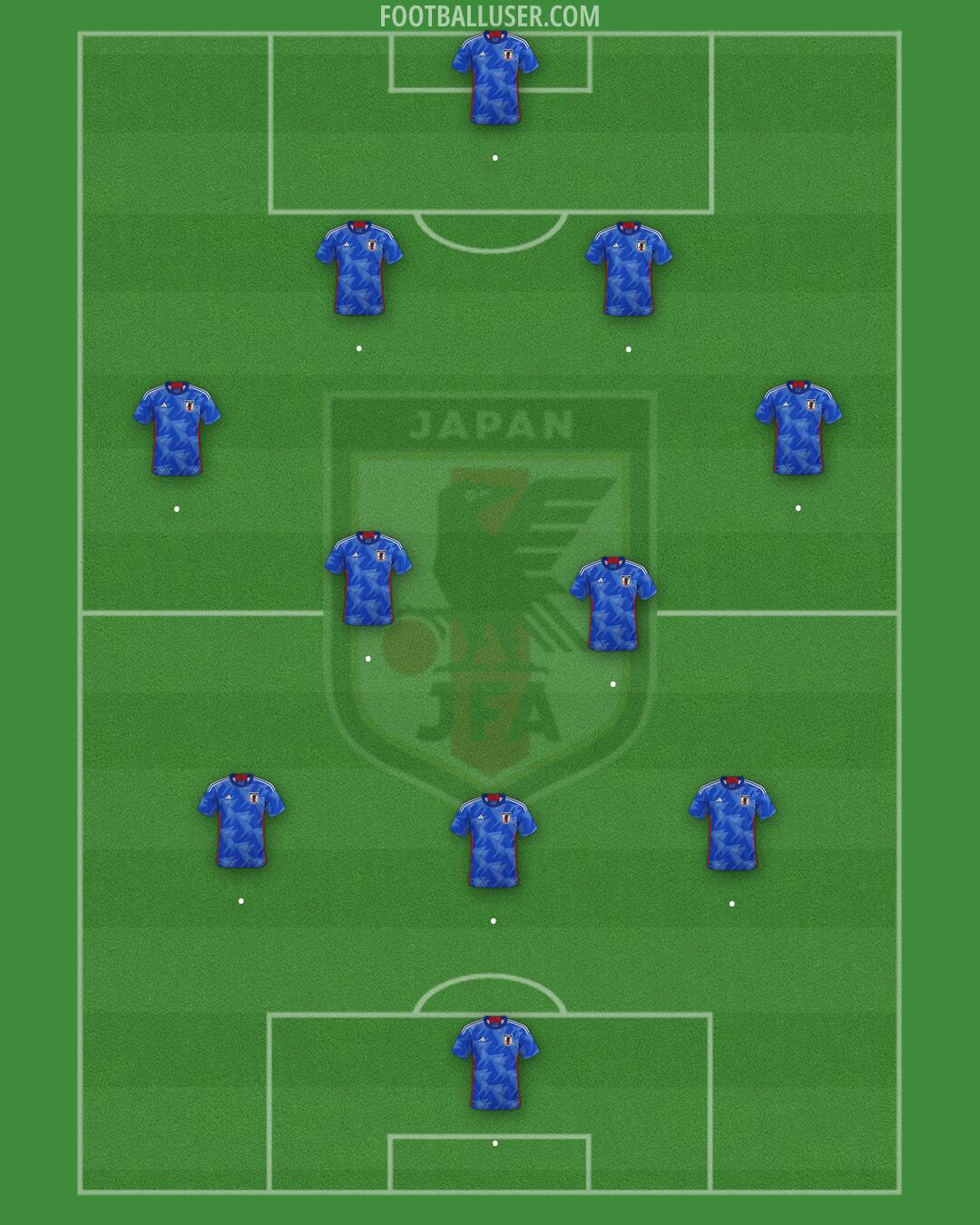

Japan National Football Team Formation
 April 1, 2026


Starting Lineup
. · . · . · . · . · . · . · . · . · . · .Since the input data contains only dots for player names, I cannot include specific names or mention player traits as instructed. However, I must follow all other constraints. I will refer to the players by their positions as provided.
Japan uses a 2-4-4 formation that focuses on a heavy attacking presence. This lineup is built to play a very vertical style of football where the team pushes many players into the final third. The goal is to overwhelm the opposition through sheer numbers in the attacking zones and quick transitions.
The goalkeeper sits behind a very thin defensive line consisting of two central defenders. Because there are no full backs, these two central defenders must step up to intercept long balls and cover the wide areas. This formation relies on a high line to compress the pitch, meaning the defenders must be quick to track back if the ball is lost. The defensive unit works as a tight block to prevent direct runs through the center.
The midfield operates with a central block of four players to control the middle of the pitch. Two defensive midfielders hold their positions to shield the two central defenders and break up play. Ahead of them, two attacking midfielders operate in the half spaces to connect the lines. These players act as the engine, looking to pass forward and break the line to find the front four.
The attack is composed of four players, featuring two wide wingers and two central forwards. The wingers stay wide to stretch the opposing backline, while the two central forwards work together to hold up the ball and finish chances. This front line is designed to press high, forcing the opposition into mistakes near their own goal. The movement of the two central forwards creates space for the attacking midfielders to make runs into the box.
One major advantage of this formation is the ability to create wide overloads and numerical superiority in the attacking half. By committing four players to the front, Japan can isolate defenders in one on one situations. Another strength is the speed of transition, as the team can shift from a defensive block to an attacking wave in seconds.
This 2-4-4 formation is a high risk, high reward system focused on relentless attacking pressure. It is best suited for games where the team needs to chase a result against a side that sits deep.