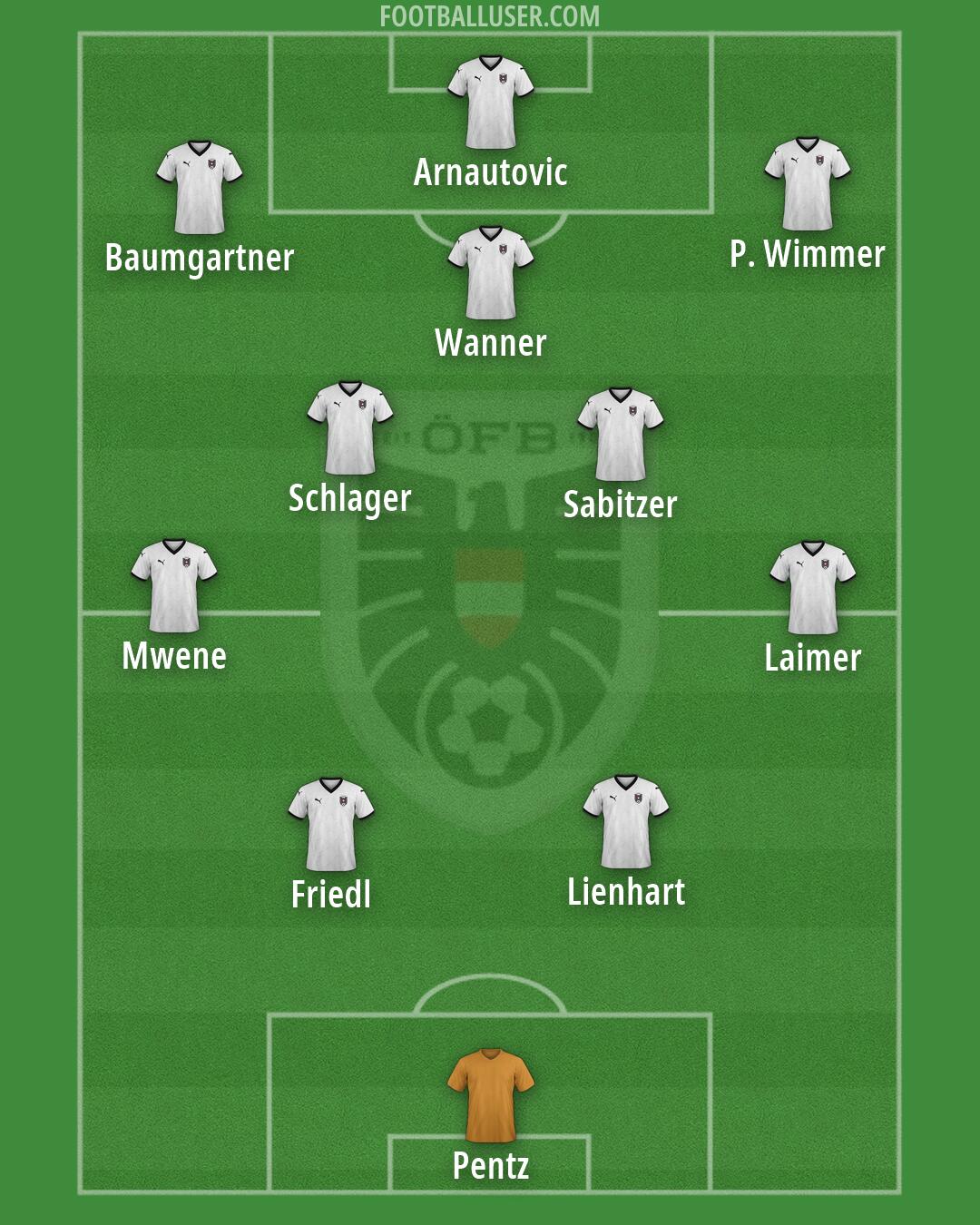

Austria National Football Team Formation
 April 1, 2026


Starting Lineup
Mwene · Laimer · Friedl · Lienhart · Arnautovic · Schlager · Sabitzer · Baumgartner · P. Wimmer · Wanner · PentzAustria relies on a 5-4-1 formation to build a side that is defensively solid and built for quick transitions. The team looks to sit deep when they do not have the ball, waiting to exploit spaces left behind by the opposition. This lineup is designed to absorb pressure and then use vertical passes to catch opponents off guard.
Arnautovic stays between the posts to organize the back line. The defensive unit operates with a back three consisting of Wanner, Schlager, and Sabitzer. Sabitzer and Schlager provide aerial strength and cover the middle, while Wanner acts as a ball playing defender to help move the ball out of the back. On the flanks, Baumgartner and P. Wimmer act as wing backs who must track back to defend deep and then push up to provide width when the team moves forward.
The midfield works in a flat bank of four to maintain compactness. Laimer and Mwene operate as a double pivot to shield the defense and intercept passes in the central zone. Laimer is known for his high pressing intensity and work rate. Further forward, Lienhart and Friedl occupy the wide attacking roles to connect the midfield to the lone striker. They move between the lines to find space and help switch play to the flanks.
Austria uses a lone striker in Pentz to lead the line. Pentz is tasked to hold up the ball and press the opposition central defenders to force mistakes. The width comes from the wing backs rather than the midfielders, which allows Friedl and Lienhart to cut inside and find goal scoring opportunities. The attack relies on quick movements to create gaps in the opponent's defensive block.
One major advantage of this formation is the ability to maintain compactness when defending in a low block. By having five defenders and four midfielders, Austria makes it very difficult for opponents to play through the center. Another strength is the speed of transition when the ball is won. The wing backs can quickly overlap to create numerical superiority on the flanks once the double pivot breaks a line.
This 5-4-1 formation is a resilient lineup built to frustrate dominant teams. It is best suited for matches where Austria needs to defend a lead or play against a side that dominates possession.