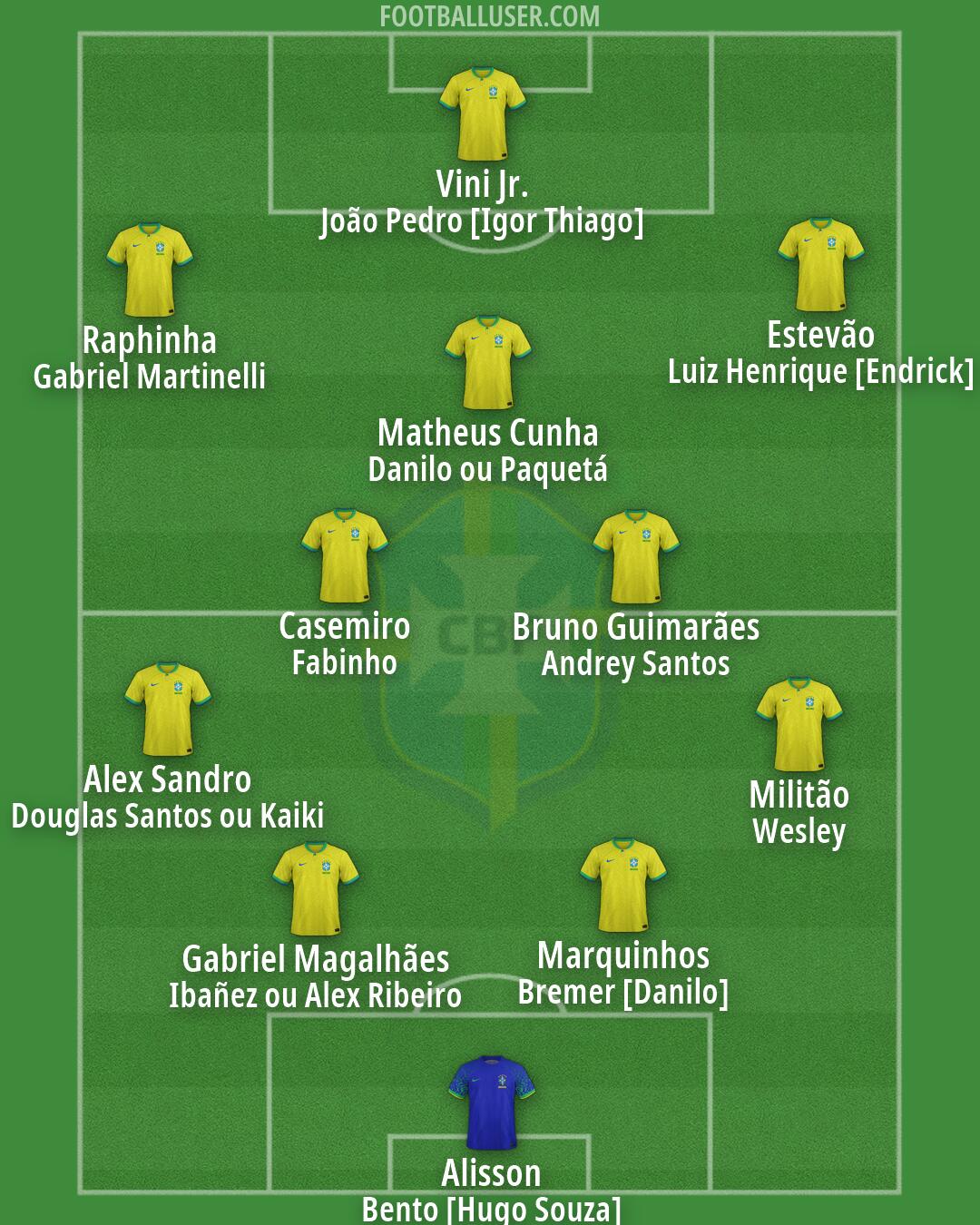

Brazil National Football Team Formation
 April 1, 2026


Starting Lineup
Alisson (Bento [Hugo Souza]) · Gabriel Magalhães (Ibañez ou Alex Ribeiro) · Militão (Wesley) · Casemiro (Fabinho) · Bruno Guimarães (Andrey Santos) · Estevão (Luiz Henrique [Endrick]) · Matheus Cunha (Danilo ou Paquetá) · Raphinha (Gabriel Martinelli) · Alex Sandro (Douglas Santos ou Kaiki) · Marquinhos (Bremer [Danilo]) · Vini Jr. (João Pedro [Igor Thiago])Brazil uses a 2-5-3 formation to drive a vertical and high pressing game. This lineup is built to dominate the central areas and overwhelm the opposition through constant pressure and rapid transitions. The goal is to control the tempo of the match by pushing players forward to squeeze the space in which the opponent can operate.
Alisson acts as the lone man between the posts, playing a vital role in starting attacks with his long passing range. Behind the midfield, Gabriel Magalhães and Marquinhos form a central defensive pair that must hold a high line. These two central defenders act as ball playing defenders who must be ready to step up and intercept passes while covering the space behind them if the press is bypassed. Because there are only two in the back, they must remain compact to prevent being caught out by long balls.
The midfield functions as a massive five man block that connects the defense to the attack. Casemiro sits deep to shield the defense, using his physical presence to intercept plays and win tackles. Beside him, Militão and Alex Sandro provide width and cover in the defensive midfield roles. Bruno Guimarães operates in the central midfield space to drive forward and break the line with his passing. Matheus Cunha plays as the attacking ten, sitting just behind the front three to create chances and link the midfield to the forwards.
The attack relies on three dangerous players working in close proximity. Vini Jr. leads the line as the striker, using his dribbling style and pace to run at defenders and cut inside. On the flanks, Raphinha and Estevão provide width and goal threat as inverted wingers. Raphinha and Estevão will often look to cut inside to occupy the half spaces, creating room for the midfield to push into. These three attackers lead the first line of the press, forcing the opposition into mistakes.
Brazil gains a major advantage through numerical superiority in the middle of the pitch. With five players in the midfield, they can easily outnumber many traditional formations and control the ball. The formation also allows for quick transitions where the ball moves rapidly from the central defenders to the attacking trio. This setup forces the opposition to defend a lot of ground, often leaving them stretched and vulnerable to quick switches of play.
This aggressive 2-5-3 formation creates a heavy presence in the center and attacking third. It is best suited for games where Brazil wants to dominate possession and force the opponent into a deep, defensive block.