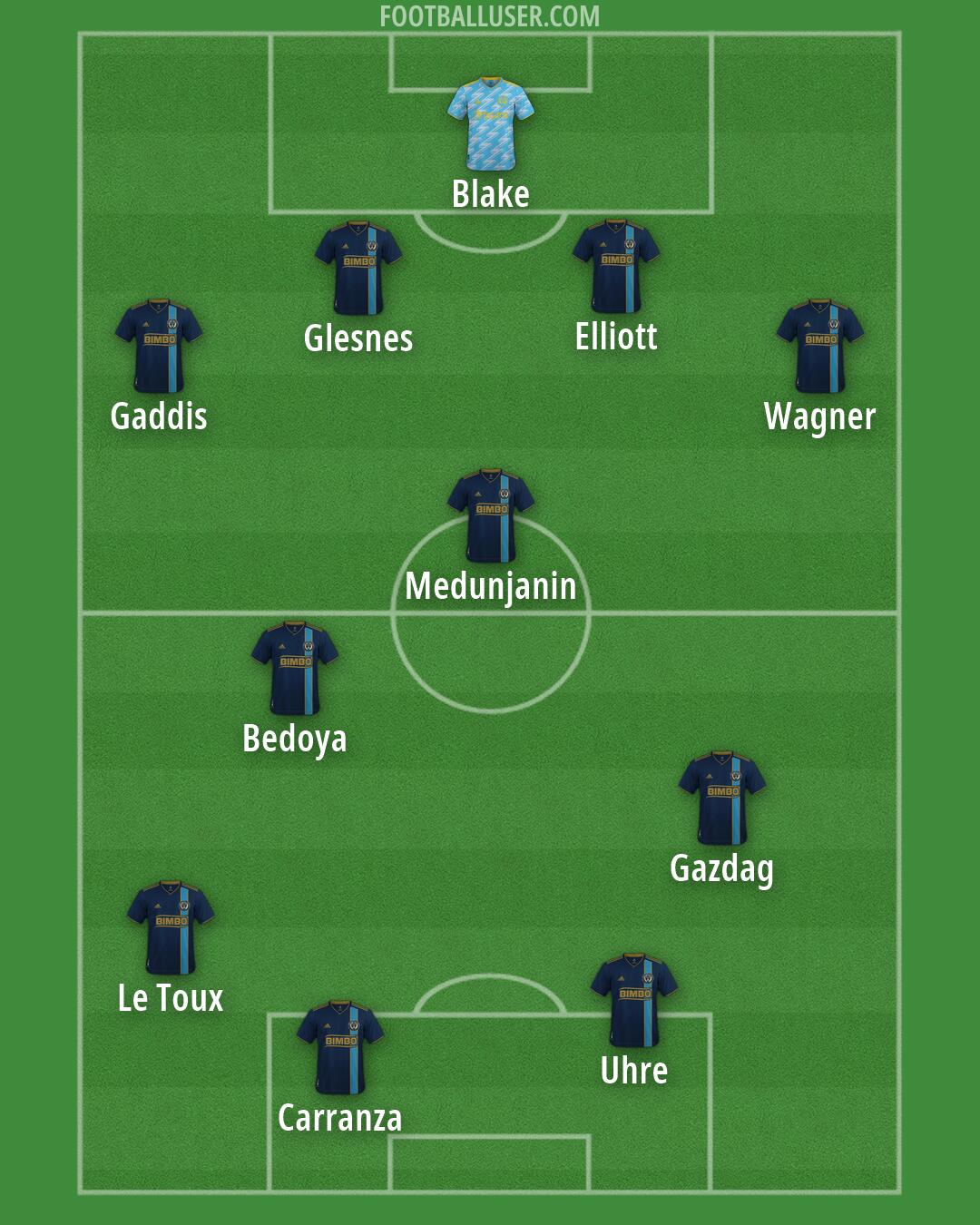
Philadelphia Soccer Formation
 April 4, 2026


Starting Lineup
Blake · Glesnes · Elliott · Gaddis · Wagner · Medunjanin · Le Toux · Carranza · Uhre · Bedoya · GazdagPhiladelphia plays a 4-3-3 formation designed for high pressing and quick transitions. This lineup focuses on winning the ball high up the pitch and moving it forward rapidly to catch the opponent out of position. The team looks to dominate the middle third while maintaining enough verticality to stretch the opposition defense.
Blake stands between the posts to organize the back line. The defense operates with a flat back four where Gaddis acts as a right back to provide width and Wagner handles the left side. In the center, Glesnes and Elliott act as the main pillars, with Glesnes offering aerial strength and Elliott providing cover when the line steps up. This unit works together to maintain a compact block and close down spaces quickly.
The midfield utilizes a single pivot system to control the center of the park. Medunjanin sits in front of the defense to shield the back four and use his passing range to switch play. Bedoya works alongside him to drive forward and break the line, while Gazdag operates in the attacking ten role to connect the midfield to the front three. This trio works to intercept passes and ensure the ball moves smoothly from defense to attack.
Philadelphia uses three attackers to pin back the opposing defenders. Carranza plays as a lone striker to hold up the ball and lead the press from the front. On the flanks, Le Toux and Uhre act as wide wingers who look to cut inside and create chances. Their movements pull the defenders out of position, creating space for Gazdag to run into the box or for the midfielders to push up.
This formation offers a clear advantage through its ability to press high in coordinated waves, making it difficult for opponents to build from the back. The presence of Medunjanin allows for quick ball circulation, which helps in isolating wide players in one on one situations. By using the width provided by the wingers and full backs, the team can create constant overloads in the final third.
The 4-3-3 lineup is built for aggressive, vertical football that relies on quick ball movement. It is best suited for matches against teams that struggle to play under intense pressure or leave large spaces behind their midfield.