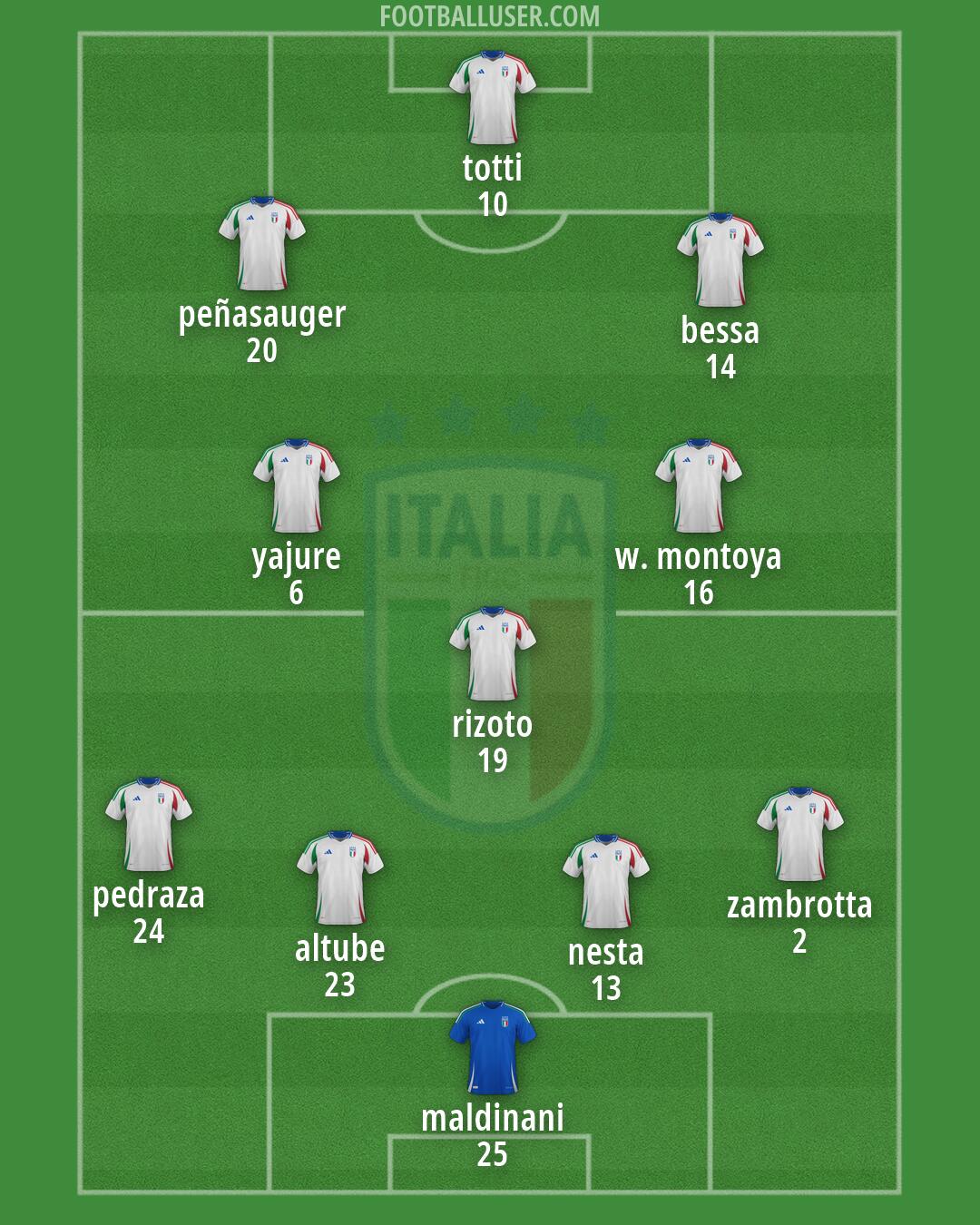

Italy National Football Team Formation
 April 4, 2026
 tass_2


Starting Lineup
maldinani (25) · zambrotta (2) · nesta (13) · altube (23) · pedraza (24) · rizoto (19) · w. montoya (16) · yajure (6) · bessa (14) · peñasauger (20) · totti (10)Italy utilizes a 5-4-1 formation. This lineup is built to play a defensive style that relies on a low block and rapid transitions. The main goal is to sit deep, soak up pressure, and wait for the right moment to break the line.
totti acts as the last line of defense in goal. The back line consists of a central trio with rizoto sitting in the middle to cover the space. yajure and w. montoya act as the wide central defenders to provide protection. On the flanks, peñasauger and bessa operate as wing backs. peñasauger is tasked to overlap and provide width on the right, while bessa must track back to support the defense. The unit functions by staying compact to deny space between the lines.
The midfield works in a flat four to control the central areas. nesta and altube form the central pair, where nesta can drive forward while altube stays to shield the defense. On the edges, zambrotta and pedraza provide the width in the middle third. zambrotta helps to switch play from the right, while pedraza must mark opponents tightly on the left. This midfield group links the defense to the attack by recycling possession and finding the lone striker.
Italy uses a lone striker in maldinani to lead the line. Because there is only one forward, maldinani must hold up the ball to allow the midfielders to push up. The attack is built through long balls or quick passes to the wide players. pedraza and zambrotta can cut inside to create central presence. The forwards press high to force turnovers, though the primary movement relies on maldinani pulling defenders away to create space for late runners.
This formation offers several tactical advantages. The main strength is the compactness when defending, which makes it very hard for opponents to find gaps. By using three central defenders and two holding midfielders, the team can create a numerical superiority in the defensive third. Another advantage is the ability to use peñasauger and bessa to create wide overloads once the team wins the ball back.
The 5-4-1 formation is a defensive powerhouse built for stability. It is best suited for games against superior attacking sides where the goal is to sit deep and strike on the break.