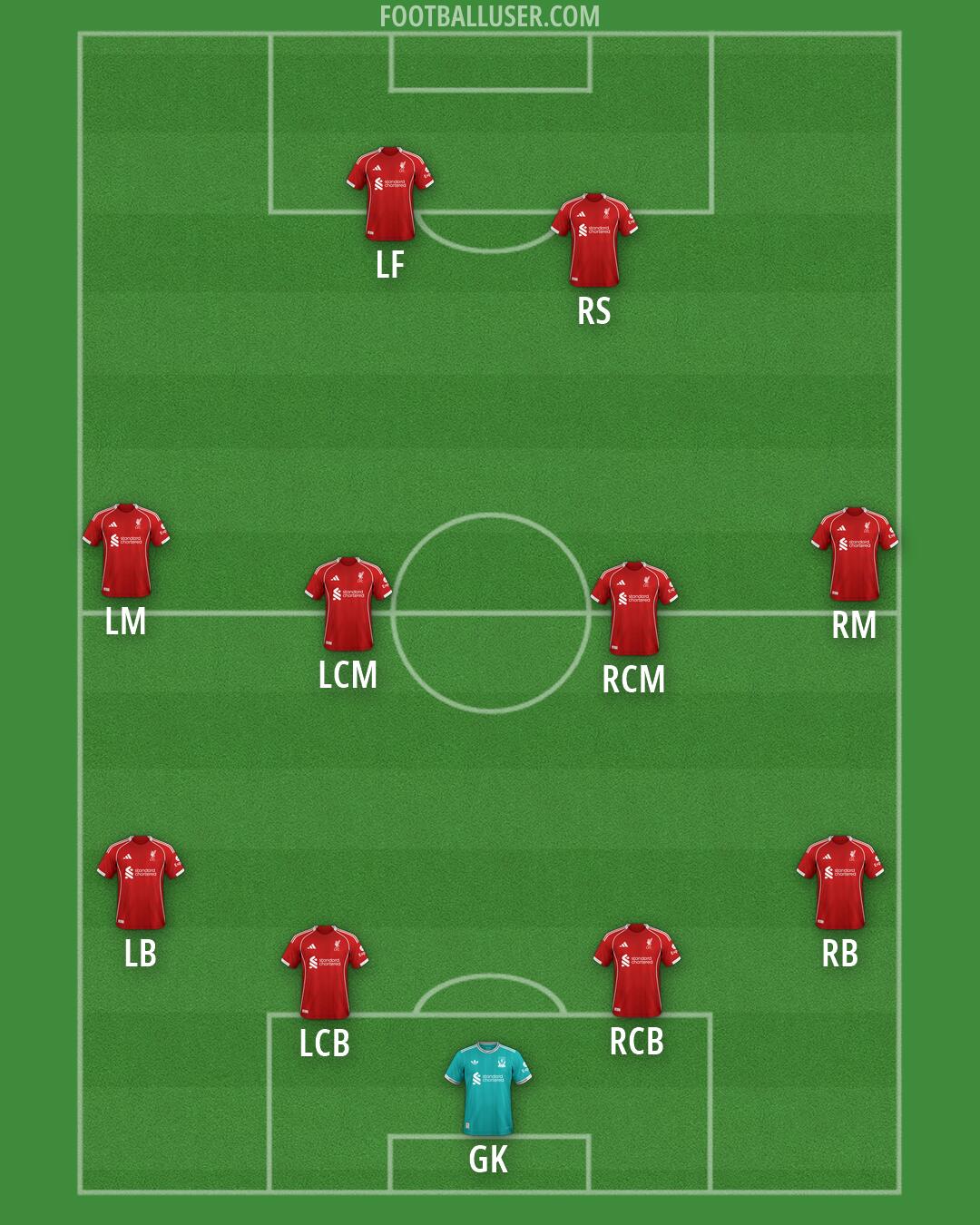
Liverpool Football Formation
 April 4, 2026
 rarustan


Starting Lineup
GK · LB · LCB · RCB · RB · LCM · RCM · LM · RM · LF · RSLiverpool uses a 4-4-2 formation designed to play a high press and quick vertical football. This lineup relies on maintaining compactness to force errors in the opponent half. The club intends to win the ball back as high up the pitch as possible to catch the opposition out of position.
The goalkeeper acts as the first point of distribution. Behind them, the back line operates as a flat back four. The LCB and RCB must step up to squeeze the space while remaining ready to cover runs behind them. On the flanks, the LB and RB push high to provide width, acting as overlapping full backs to support the midfielders. This defensive unit must shift together to block passing lanes and maintain a high line to keep the team compact.
In the center of the pitch, the midfield functions with a central pair of RCM and LCM. These two players must work to shield the defense and intercept passes in the middle third. The RCM and LCM act as the engine, with one often driving forward to break the line while the other holds position. On the sides, the LM and RM provide width and track back to help the full backs. This four man midfield connects the defense to the front line through quick passing and constant movement.
The attacking unit consists of two forwards, the LF and RS. They operate as a pair to pressure the opposition center backs and force long balls. The LF often drifts wide or drops slightly to link play, while the RS stays central to hold up the ball and occupy the defenders. This two man front line creates space for the LM and RM to cut inside or make runs into the box. The goal is to create quick transitions from midfield to the strikers.
This 4-4-2 formation offers several tactical advantages for Liverpool. The team can create wide overloads by using the LM and RM alongside the LB and RB to overwhelm the opposition flanks. Another strength is the ability to press high in coordinated waves, with the LF and RS leading the charge. This high intensity forces the opponent to play under pressure, often leading to turnovers in dangerous areas.
This formation is built for high intensity pressing and rapid vertical transitions. It works best against teams that struggle to play out from the back under heavy pressure.