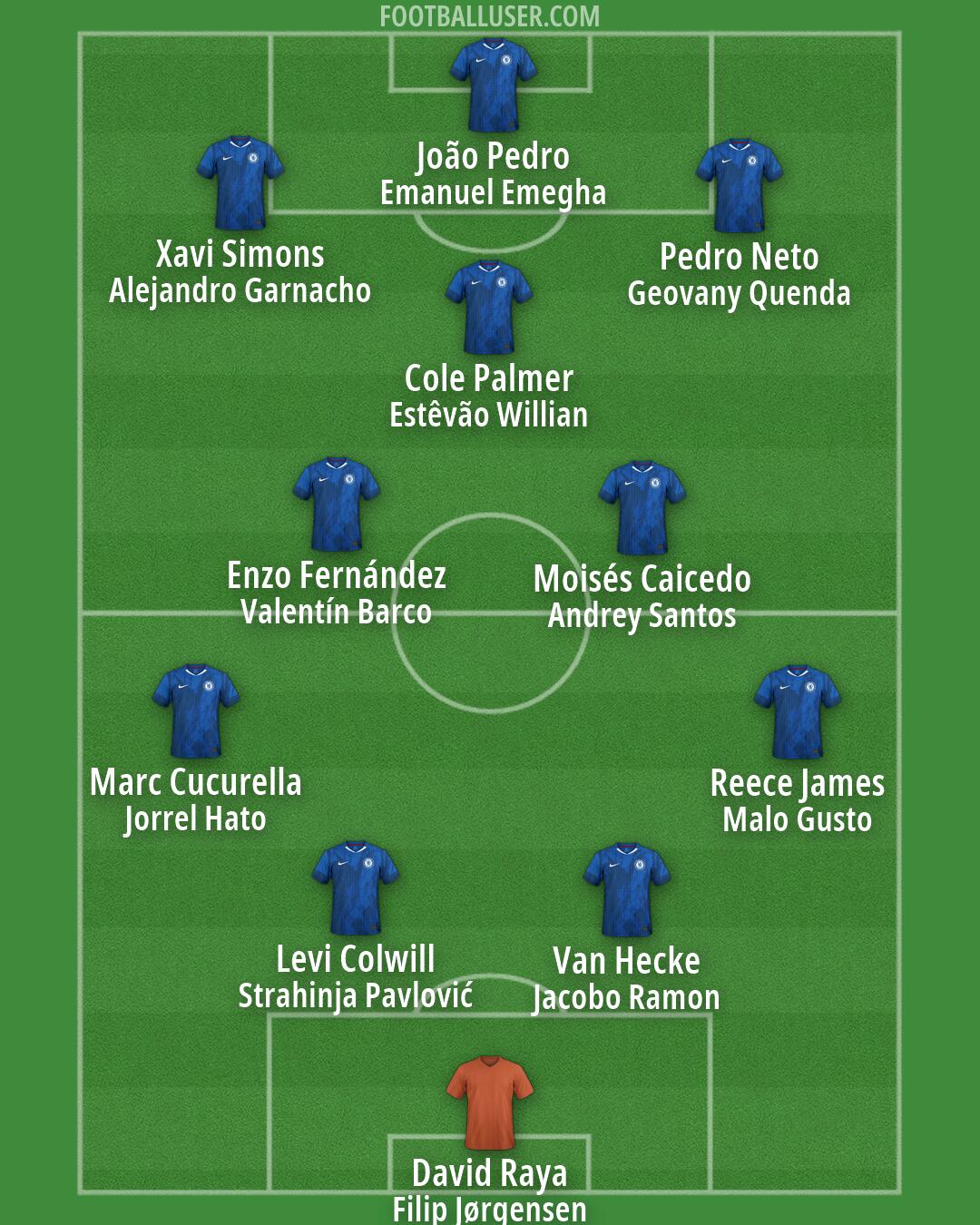
Chelsea Football Formation
 April 5, 2026


Starting Lineup
Van Hecke (Jacobo Ramon) · Levi Colwill (Strahinja Pavlović) · Reece James (Malo Gusto) · Marc Cucurella (Jorrel Hato) · Enzo Fernández (Valentín Barco) · Moisés Caicedo (Andrey Santos) · Cole Palmer (Estêvão Willian) · João Pedro (Emanuel Emegha) · Pedro Neto (Geovany Quenda) · Xavi Simons (Alejandro Garnacho) · David Raya (Filip Jørgensen)Chelsea utilizes a 4-3-3 formation that leans heavily on a high press and quick verticality. This lineup is built to dominate the ball in the middle third and use aggressive movements to force turnovers in the opponent half. The goal is to use high energy to win the ball back early and transition into attack before the opposition can settle into a defensive block.
David Raya starts between the posts to command his area and distribute the ball to start attacks. The back four operates with a high line to squeeze the pitch. Van Hecke and Levi Colwill act as the central pairing, with Colwill using his left foot to play long passes and Van Hecke providing cover. Reece James pushes up the right flank to provide width and crossing ability, while Marc Cucurella tucks inside to help the midfield when the ball is on the opposite side.
The midfield acts as the engine room for Chelsea. Enzo Fernández operates as a deep playmaker, using his passing range to switch play and break lines. Beside him, Moisés Caicedo works to shield the defense by intercepting passes and tracking runners. Cole Palmer plays in the space between the lines as an attacking midfielder, looking to find pockets of space and create chances. This trio links the defensive unit to the front three by maintaining control of the central zones.
In the attacking third, the team uses three attackers to stretch the opposition. Xavi Simons and Pedro Neto occupy the wide areas, with both players looking to cut inside onto their stronger feet to shoot or cross. João Pedro leads the line as a lone striker, tasked to hold up the ball and bring others into play. The front three press in coordinated waves to prevent the opposition from building from the back, creating space for late runs from the midfield.
This formation offers a significant advantage in terms of numerical superiority in the central areas when the full backs move up. The ability to press high in coordinated waves makes it difficult for opponents to play out from their own defense. Additionally, the movement of the wingers allows the team to isolate wide players in one on one situations, creating clear chances in the final third.
Chelsea employs a high intensity 4-3-3 that relies on rapid transitions and pressing. This formation is best suited for games where the team wants to dominate possession and force the opponent into mistakes.