Chelsea Football Formation
 April 5, 2026


Starting Lineup
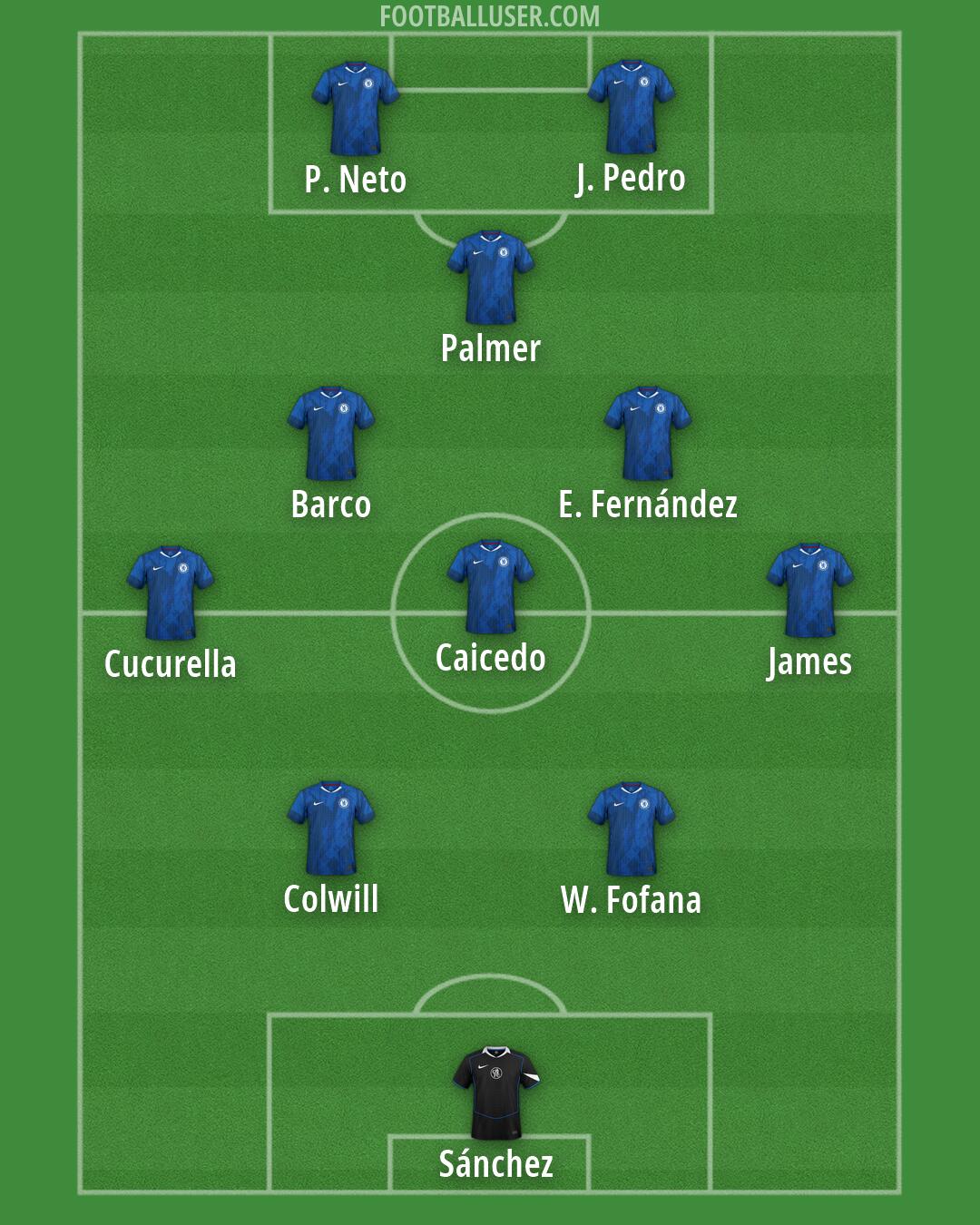
Cucurella · James · Colwill · W. Fofana · J. Pedro · Barco · P. Neto · Palmer · Caicedo · E. Fernández · SánchezChelsea utilizes a 2-6-2 formation that centers on aggressive control of the central areas. This lineup is built to dominate the middle of the park through heavy numbers, focusing on high pressing and immediate ball recovery. The intention is to squeeze the opponent into their own half by saturating the zones where the game is most often contested.
Sánchez operates between the posts to provide the initial point of distribution. In front of him, W. Fofana and Colwill form a narrow pair of central defenders who must maintain a high line to keep the team compact. Because there are no traditional wide defenders in this lineup, these two must be ready to step up and intercept long balls or cover wide channels if the opposition attempts to break the lines. They act as the foundation for the rest of the team to push forward.
The midfield is the engine of this Chelsea formation, using a massive six man block to control every passing lane. Cucurella, James, and Caicedo form a deep trio that shields the back two and recovers possession. They provide the platform for the attacking trio of Barco, E. Fernández, and Palmer to operate in the half spaces. Palmer uses his dribbling style and creative vision to find gaps, while Barco and E. Fernández connect the deep holding players to the front two. This large group makes it very difficult for opponents to find space between the lines.
The attack consists of two forwards, P. Neto and J. Pedro, who play in the channels to stretch the defense. They do not sit deep but instead look to run behind the opposition back line or cut inside to link with the attacking midfielders. By staying high, P. Neto and J. Pedro force the opposing defenders to stay deep, which creates more room for the six midfielders to move the ball. The forwards must press hard to prevent the opposition from building play from the back.
This formation offers a massive numerical superiority in the center of the pitch, making it nearly impossible for a standard midfield to win second balls. The heavy presence of Barco, E. Fernández, and Palmer allows the team to quickly switch play or break the line with vertical passes. Another advantage is the ability to press high in coordinated waves, as the six midfielders can surround any player on the ball instantly.
This 2-6-2 formation is a high risk, high reward system designed to suffocate the opposition in their own half. It is best suited for games where the team needs to dominate possession against a side that lacks the passing range to bypass a crowded midfield.