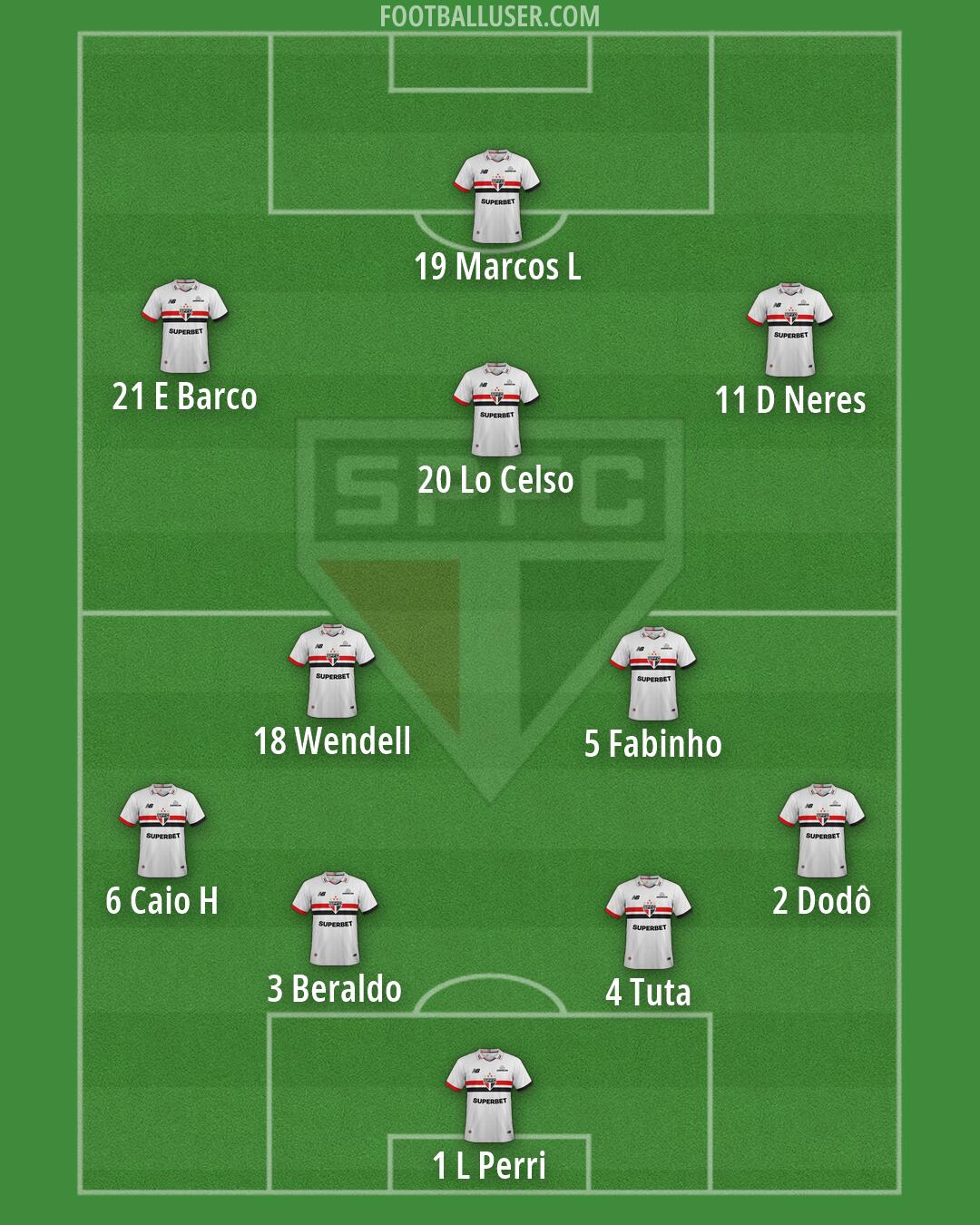

São Paulo Football Formation
 April 8, 2026
 RPLemos


Starting Lineup
1 L Perri2 Dodô
11 D Neres
4 Tuta
6 Caio H
5 Fabinho
3 Beraldo
20 Lo Celso
18 Wendell
19 Marcos L
21 E Barco
São Paulo operates with a 4-3-3 formation that focuses on a high press and quick verticality. This lineup is built to dominate the pitch by forcing turnovers in the attacking third. The team looks to win the ball back immediately to catch the opposition out of position and move the ball forward with speed.
L Perri stays in goal to command the area. The defensive unit operates with a high line to keep the team compact and reduce the space for the opponent to play. Tuta and Beraldo act as ball playing central defenders who can step up to intercept passes. Dodô pushes forward to overlap on the right side to create extra numbers, while Caio H provides cover on the left. The defenders work to stay close together to prevent through balls.
In the center, the team uses a single attacking ten and two central players. Lo Celso operates in the hole to connect the lines, using his passing range to break defensive blocks and find the attackers. Fabinho sits in front of the defense to shield the back four and intercept plays. Wendell provides the energy in the middle, driving forward to support the attack and helping to transition the ball from defense to the front three.
Up front, the team utilizes three attackers working in tandem. Marcos L acts as a lone striker who must hold up the ball to allow the midfield to push up. D Neres plays as an inverted winger on the right, looking to cut inside and find shooting lanes. E Barco stays wide on the left to stretch the opposition and provide a way to switch play. These attackers press high to prevent the opponent from building from the back.
A key strength of this São Paulo lineup is the ability to press high in coordinated waves. The movement of the forwards and midfield makes it difficult for opponents to find a way out. The team also creates wide overloads when Dodô joins the attack, which helps to isolate D Neres in one on one situations. This allows the team to maintain constant pressure in the final third.
This 4-3-3 formation is designed for teams that want to play with high intensity and aggressive pressing. It is best suited for game situations where the opponent struggles to play under pressure or leaves space behind their midfield.