
SK Rapid Football Formation
 April 8, 2026


Starting Lineup
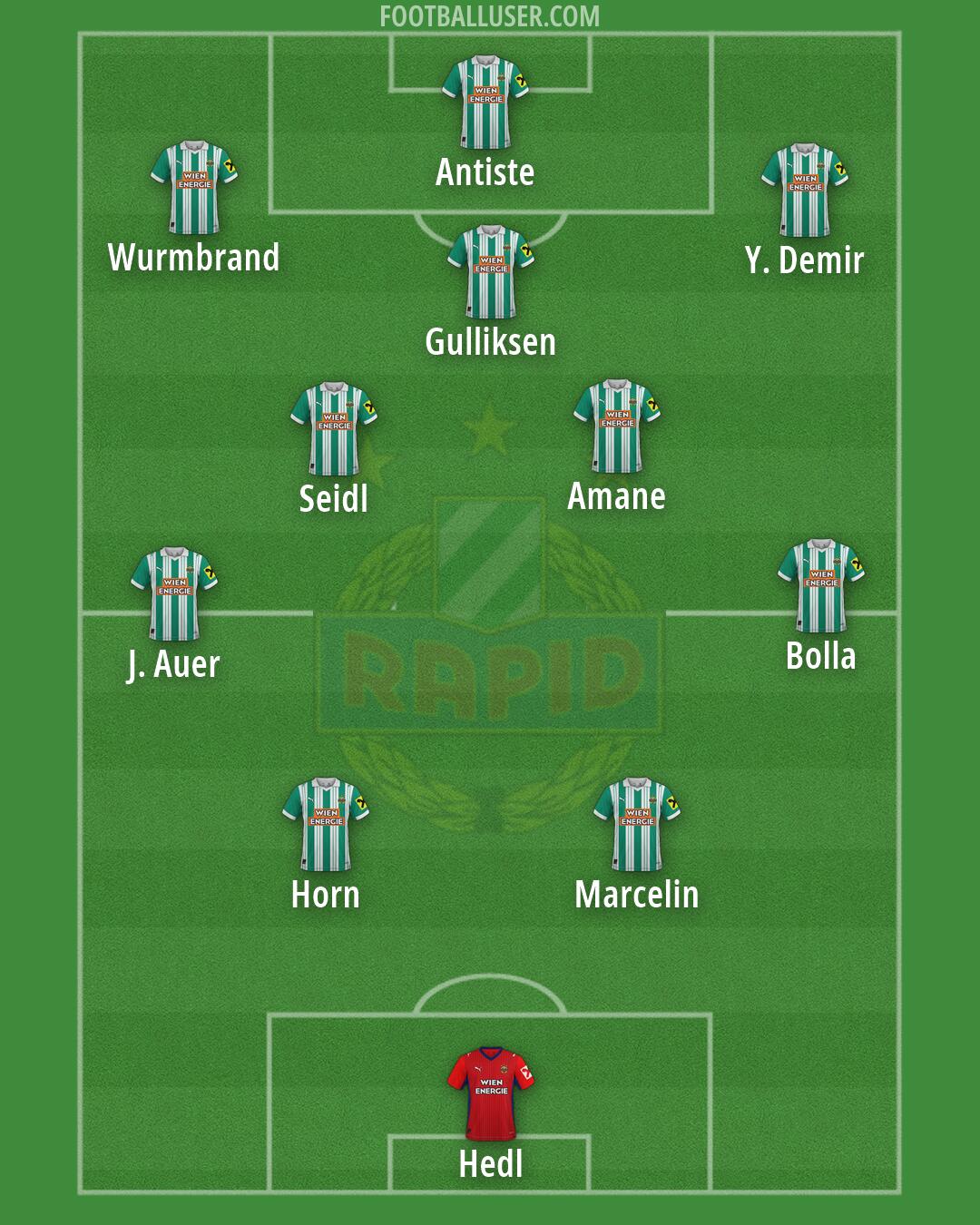
J. Auer · Horn · Marcelin · Bolla · Antiste · Wurmbrand · Y. Demir · Gulliksen · Seidl · Amane · HedlSK Rapid (Austria) utilizes a 5-4-1 formation designed for a defensive and counter attacking identity. This lineup focuses on maintaining a compact block to deny space between the lines. The goal is to sit deep, absorb pressure, and use quick vertical passes to catch the opposition when they push too high.
Antiste stays on his line to provide the first layer of protection. Ahead of him, the defense operates as a back five with Gulliksen, Amane, and Seidl forming the central core. These three center backs must stay close together to block passing lanes and win aerial duels. On the flanks, Wurmbrand acts as a right wing back to provide width, while Y. Demir works as the left wing back to cover the wide areas. The unit shifts together to maintain a narrow defensive block, forcing opponents out wide.
The midfield sits in a flat bank of four to protect the central zone. Bolla and J. Auer operate as a double pivot to shield the back line and intercept passes. They hold their positions to prevent the opposition from breaking the lines. Further up, Horn and Marcelin occupy the wide attacking midfield roles. They link the defense to the attack by tracking back when lost the ball and looking to switch play quickly once possession is regained.
SK Rapid (Austria) uses a lone striker in Hedl to lead the line. This attacker must hold up the ball to allow the midfield to push forward. The width comes from the wing backs, Wurmbrand and Y. Demir, who push up to support the attack. Horn and Marcelin look to cut inside to create central overloads. The forwards press in a coordinated way to trigger transitions when the ball is played into the wide zones.
One strength of this formation is the compactness when defending in a low block. By having five defenders and four midfielders, the team makes it very difficult for opponents to find gaps in the middle. Another advantage is the ability to create wide overloads when the wing backs overlap. This setup allows the team to defend many players in the box while still having the legs to break away on the counter.
This formation provides a very solid base for teams that want to play without the ball. It is best suited for matches against dominant teams that rely heavily on central attacking play.