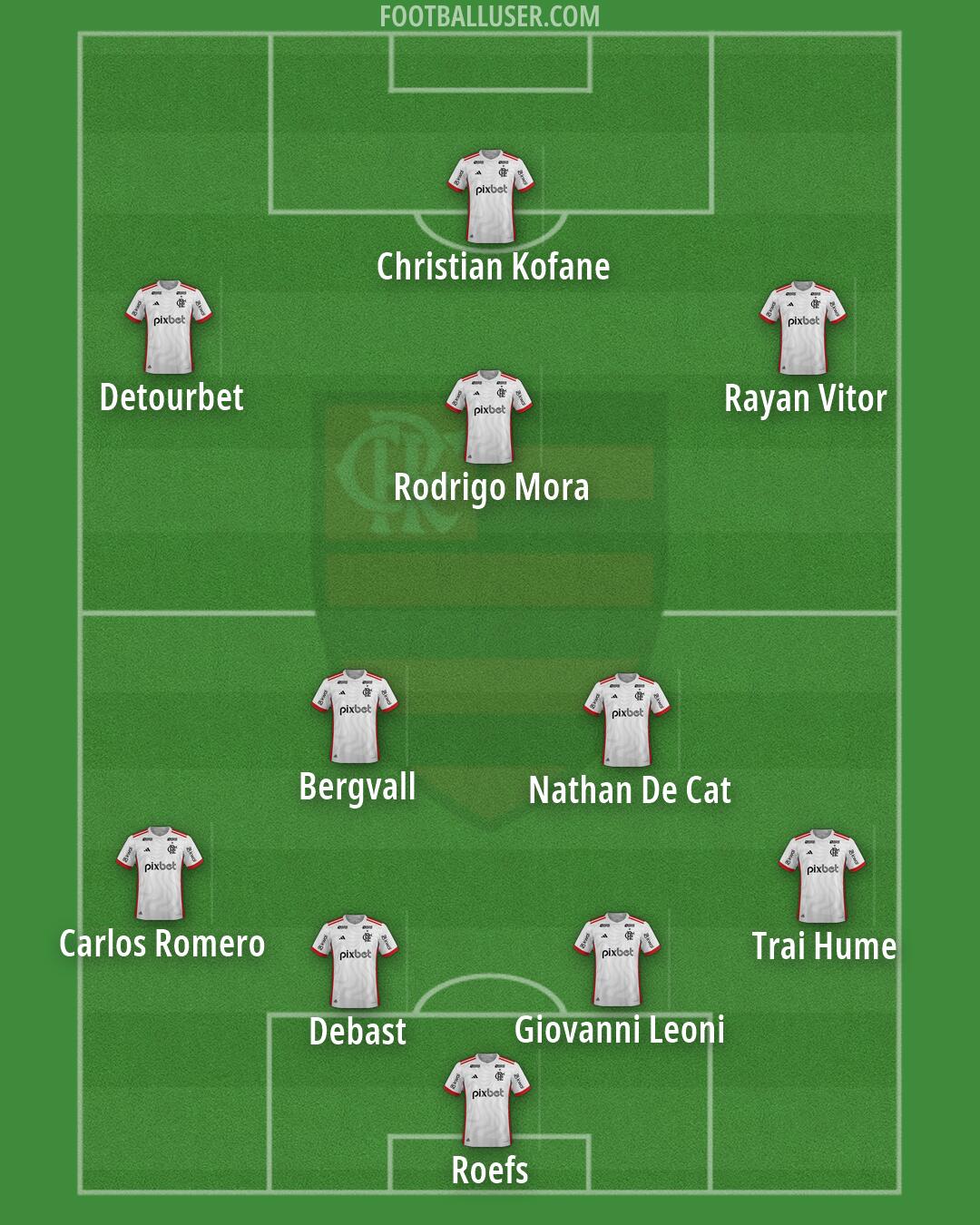

Flamengo Football Formation
 April 11, 2026
 Jorge90


Starting Lineup
Christian Kofane · Detourbet · Rayan Vitor · Rodrigo Mora · Bergvall · Nathan De Cat · Carlos Romero · Trai Hume · Giovanni Leoni · Debast · RoefsFlamengo relies on a 4-3-3 formation that focuses on a high press and quick vertical transitions. This lineup is built to play an aggressive style of football, looking to win the ball high up the pitch and immediately attack the space behind the opposition defense. The goal is to use the width of the pitch to stretch opponents while maintaining a heavy presence in the central areas.
Roefs acts as the last line of defense in goal, commanding the area during crosses. The defensive unit works in a flat back four, where Trai Hume and Carlos Romero act as wide defenders. Trai Hume looks to overlap to provide width on the right, while Carlos Romero pushes forward to support the attack. In the center, Debast and Giovanni Leoni form the defensive pairing, with Debast acting as a ball playing defender to start attacks from the back while Giovanni Leoni focuses on covering space and winning aerial duels.
The midfield functions with a central trio that connects the defense to the forward line. Rodrigo Mora plays in the attacking ten role to create chances and find pockets of space between the lines. Bergvall and Nathan De Cat work to control the tempo, with Bergvall driving forward into advanced positions to support the press. These players must track back quickly to protect the back four when possession is lost, ensuring the midfield remains compact to prevent central breakthroughs.
Flamengo utilizes three attackers to maintain constant pressure on the opposing back line. Detourbet and Rayan Vitor operate as wide wingers, with Rayan Vitor looking to cut inside to create goal scoring opportunities. Christian Kofane plays as the lone striker, tasked to hold up the ball and make runs into the channels to pull defenders out of position. This front line is designed to press in coordinated waves, forcing errors from the opposition in their own half.
One major tactical advantage of this formation is the ability to create wide overloads by using the full backs to support the wingers. Another strength lies in the speed of transition, where the midfield can quickly move the ball to the attackers as soon as they intercept a pass. This lineup also offers the ability to press high in a coordinated manner, making it very difficult for opponents to build play from their own goalkeeper.
This 4-3-3 formation is a high intensity system built for teams that want to dominate through pressure and rapid attacking movements. It is best suited for matches against opponents that struggle to play out from the back under duress.