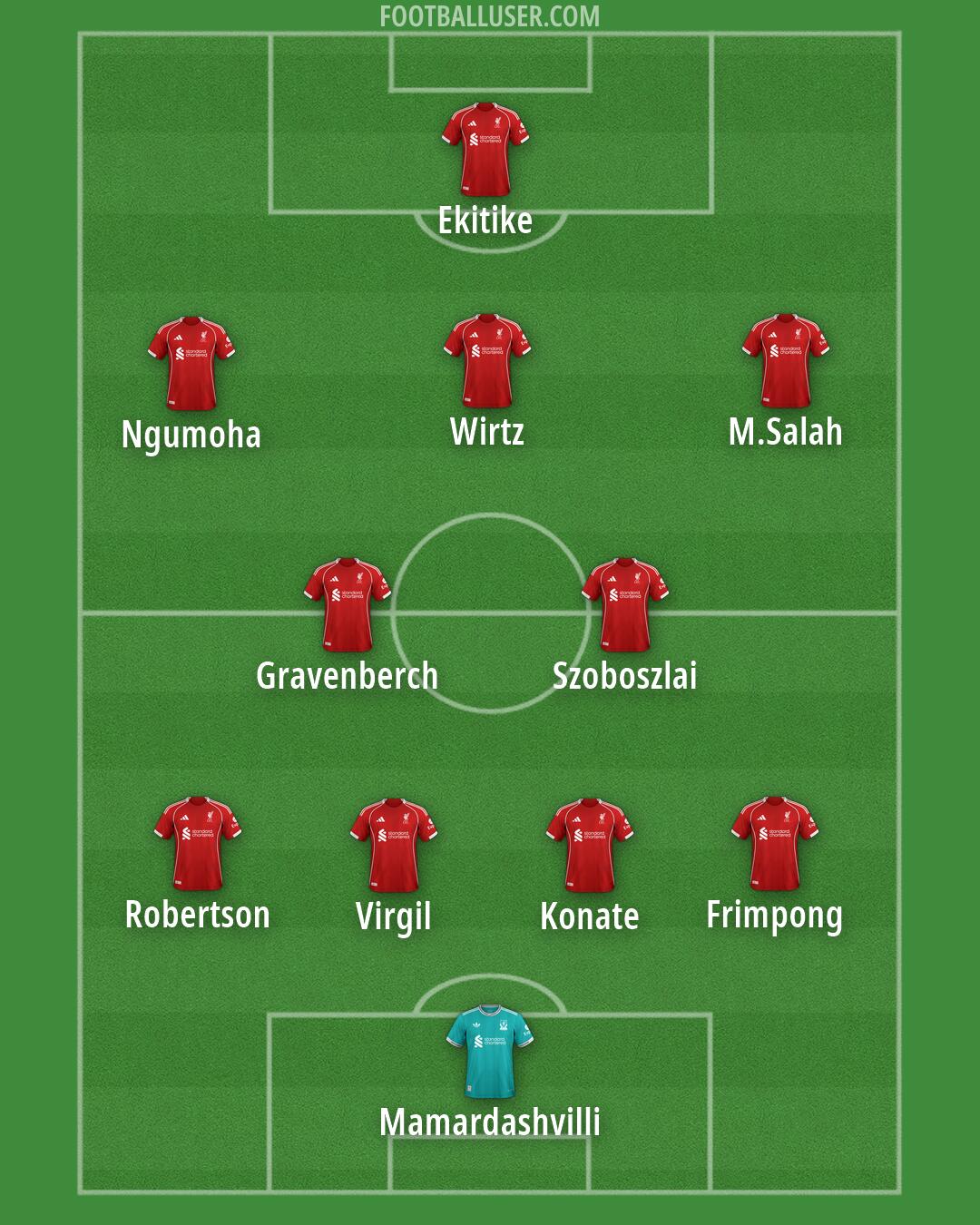
Liverpool Football Formation
 April 13, 2026


Starting Lineup
Frimpong · Konate · Virgil · Robertson · Gravenberch · Szoboszlai · Wirtz · Ngumoha · M.Salah · Ekitike · MamardashvilliLiverpool uses a 5-4-1 formation. This lineup focuses on a defensive block that looks to sit deep and wait for opportunities to break on the counter. The team aims to remain compact and hard to beat while using the wide areas to stretch the opposition once they win the ball back.
Ekitike stays between the posts to command the area. The defensive unit works with a back three of Wirtz, Gravenberch, and Szoboszlai who must remain disciplined to hold the line. In front of them, M.Salah and Ngumoha act as wing backs, pushing high to provide width or dropping back to help the defenders. Wirtz and Szoboszlai need to be dominant in the air and quick to intercept passes, while Gravenberch covers the space behind the wing backs.
The midfield is a flat four that occupies the central lanes. Virgil and Konate act as the central engine, where Virgil uses his passing range and positioning to connect the defense to the rest of the team. Konate provides the physical presence to tackle and shield the back three. On the flanks, Robertson and Frimpong occupy the wide roles to drive forward and cross the ball. This midfield unit must shift together to block passing lanes and track back when the team loses possession.
Liverpool plays with a lone striker in Mamardashvilli who must hold up the ball to allow the midfielders to join the attack. The attack relies on the wing backs, M.Salah and Ngumoha, to cut inside or deliver crosses into the box. The wide midfielders, Robertson and Frimpong, also push up to create numerical superiority in the final third. Mamardashvilli is tasked to press the opposing defenders and make runs into the channels to stretch the opponent.
One major advantage is the ability to create wide overloads through the movement of the wing backs and wide midfielders. This formation also offers great compactness when defending, making it difficult for opponents to find space between the lines. When the ball is won, the team can use the speed of transition to catch the opposition out of position.
This 5-4-1 formation is built to be a defensive wall that relies on quick transitions. It is best suited for games against teams that dominate possession where Liverpool can sit deep and strike on the break.