
Djurgårdens IF Football Formation
 April 16, 2026


Starting Lineup
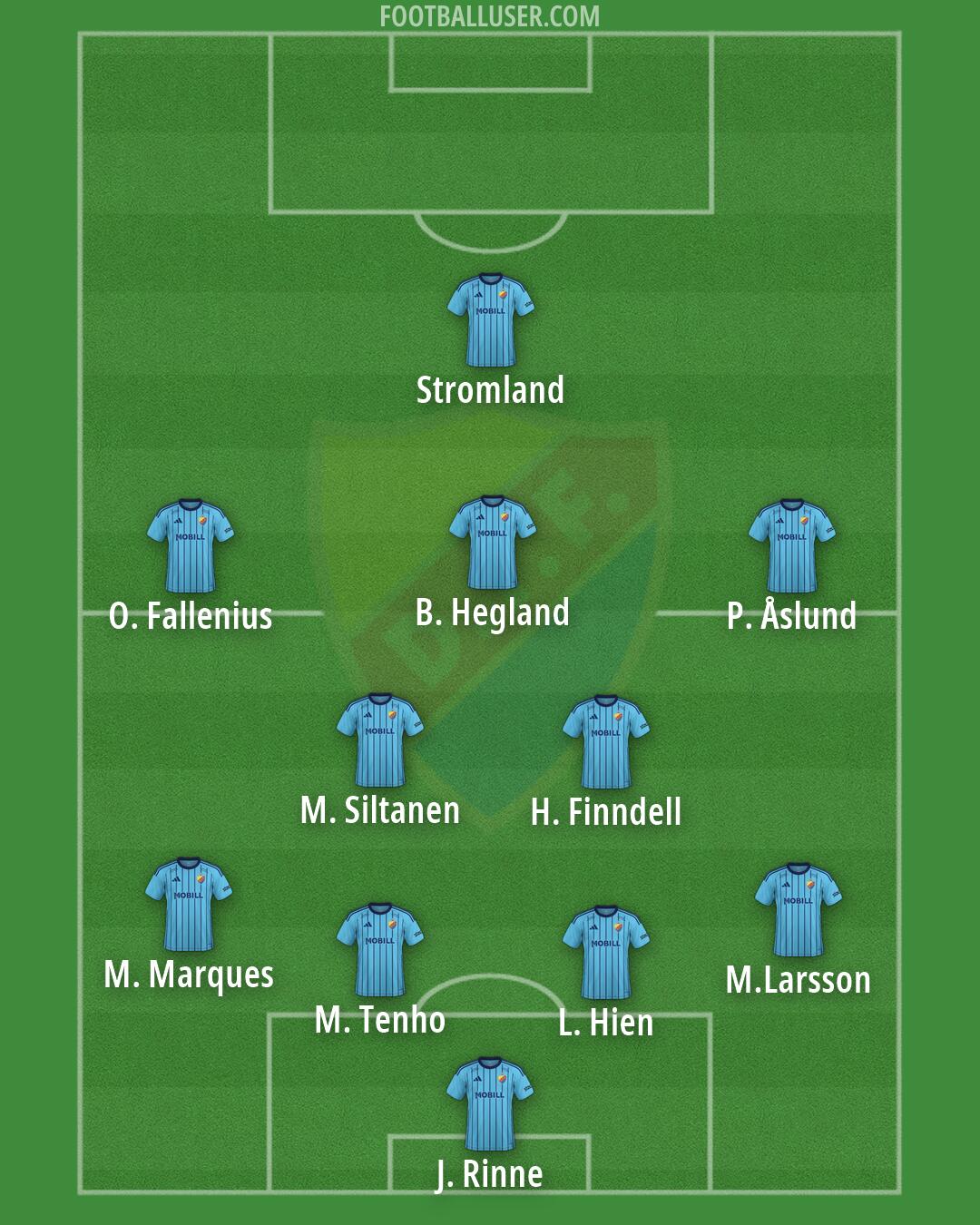
J. Rinne · M. Marques · M.Larsson · M. Tenho · L. Hien · M. Siltanen · H. Finndell · B. Hegland · O. Fallenius · P. Åslund · StromlandDjurgårdens IF uses a 4-5-1 formation to build a game based on defensive solidity and quick transitions. This lineup is designed to stay compact in the middle and strike quickly when the ball is won. The team focuses on controlling space between the lines while remaining prepared to push forward in direct bursts.
J. Rinne starts between the posts to organize the back line. A flat back four consists of M.Larsson on the right and M. Marques on the left. In the center, L. Hien and M. Tenho act as the primary defenders. M.Larsson and M. Marques are tasked to overlap and provide width, while L. Hien and M. Tenho work to block crosses and win aerial duels. This unit functions by shifting together to maintain a tight defensive block.
The midfield operates with a heavy central presence to control the middle of the pitch. H. Finndell and M. Siltanen form a double pivot to shield the defense and intercept passes. Ahead of them, O. Fallenius, P. Åslund, and B. Hegland occupy the central spaces to connect the defense to the attack. These players work to break the line with vertical passes and press opponents to prevent them from turning.
In the attacking phase, Stromland acts as a lone striker to lead the line. The team builds the attack through the wide areas or by playing through the dense midfield group. Stromland must hold up the ball to allow the midfielders to push forward into advanced positions. The five midfielders provide support, often making runs from deep to create numerical advantages in the final third.
This formation offers several tactical advantages for Djurgårdens IF. The presence of five players in the middle creates a strong block that makes it hard for opponents to pass through the center. The double pivot of H. Finndell and M. Siltanen allows the team to transition rapidly from a defensive stance to an attacking one. Additionally, the setup allows the team to press in waves when they lose possession in the opponent half.
The 4-5-1 formation is built for teams that want to remain hard to beat while exploiting gaps on the break. It is a reliable choice when facing opponents that dominate possession and require a compact block to disrupt their rhythm.