
Italy National Football Team Formation
 April 17, 2026


Starting Lineup
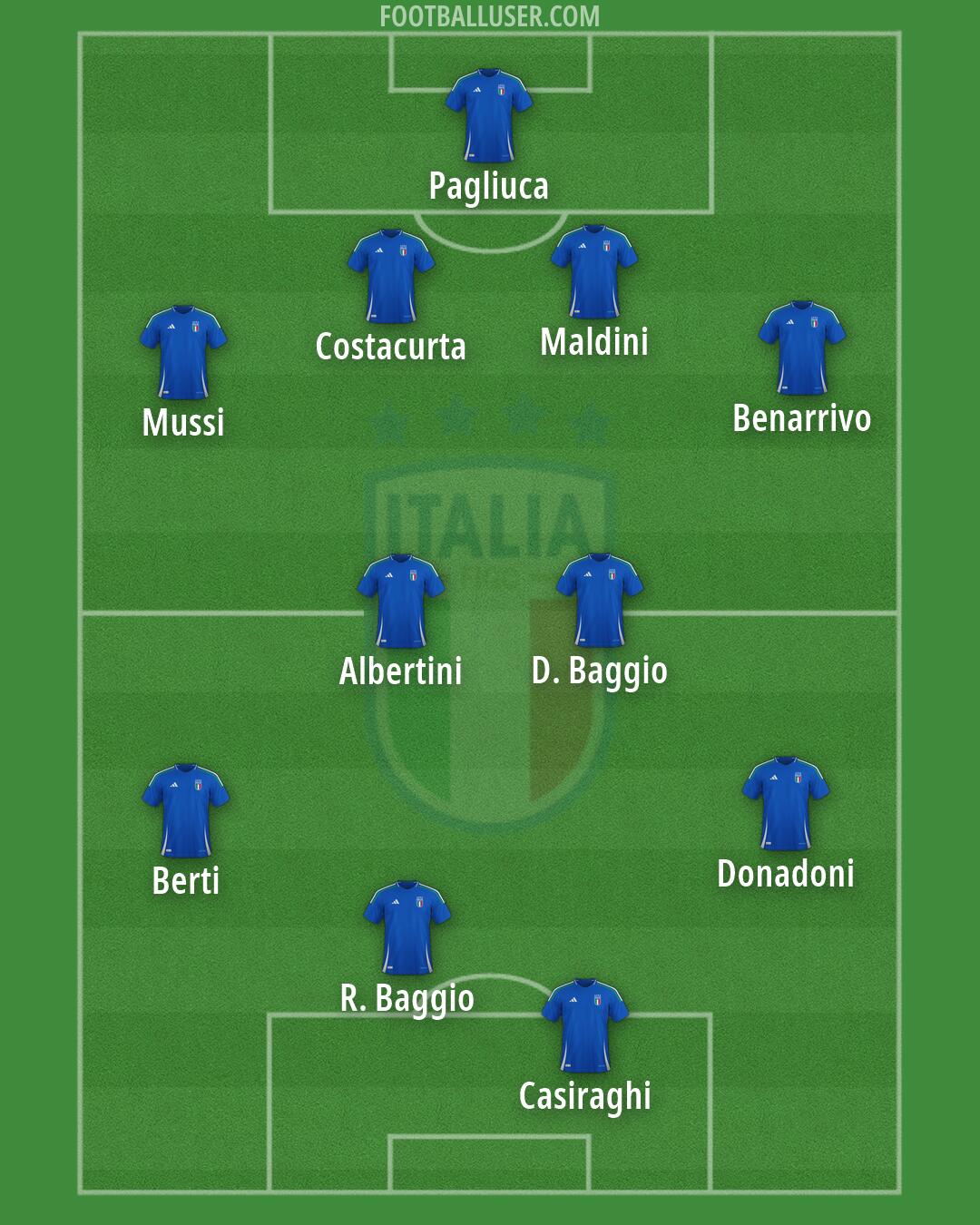
Pagliuca · Costacurta · Maldini · Benarrivo · Mussi · D. Baggio · Albertini · Casiraghi · R. Baggio · Donadoni · BertiItaly employs a 4-2-4 formation that prioritizes heavy attacking presence. This lineup is built to play a direct and vertical brand of football, aiming to overwhelm the opposition in the final third. The intention is to use high numbers upfront to force errors and create immediate scoring chances.
Pagliuca sits between the posts to command the area and organize the back four. A flat back four consists of Mussi at right back and Benarrivo at left back, who provide width and track back when needed. In the center, Maldini and Costacurta form the defensive pairing, with Maldini known for his exceptional positioning and tackling, while Costacurta provides cover and aerial strength. This defensive unit works to stay compact to prevent central penetration.
The midfield operates as a double pivot to provide a platform for the attackers. Albertini acts as the anchor, using his wide passing range to switch play and control the tempo. Beside him, D. Baggio works to drive forward and connect the defense to the front line by breaking the line with progressive passes. This pair must work hard to intercept play and cover the space left behind by the advancing wide players.
Up front, the team utilizes two central forwards supported by two wide attackers. R. Baggio and Casiraghi act as the primary goal threats, with R. Baggio known for his dribbling and ability to operate in tight spaces. Donadoni and Berti stay wide to stretch the opposition defense, with Donadoni capable of cutting inside to create more central presence. The forwards are expected to press high to force the opponent into long balls.
One major advantage of this formation is the ability to create numerical superiority in the attacking third, making it difficult for a back four to mark everyone. Italy can also isolate wide players in one on one situations when the wingers receive the ball with space. The setup allows for quick transitions, moving the ball from the double pivot to the four attackers in very few passes.
This 4-2-4 formation is a bold attacking lineup that relies on individual quality in the final third. It is best suited for games where the team needs to chase a result against a side that sits deep.