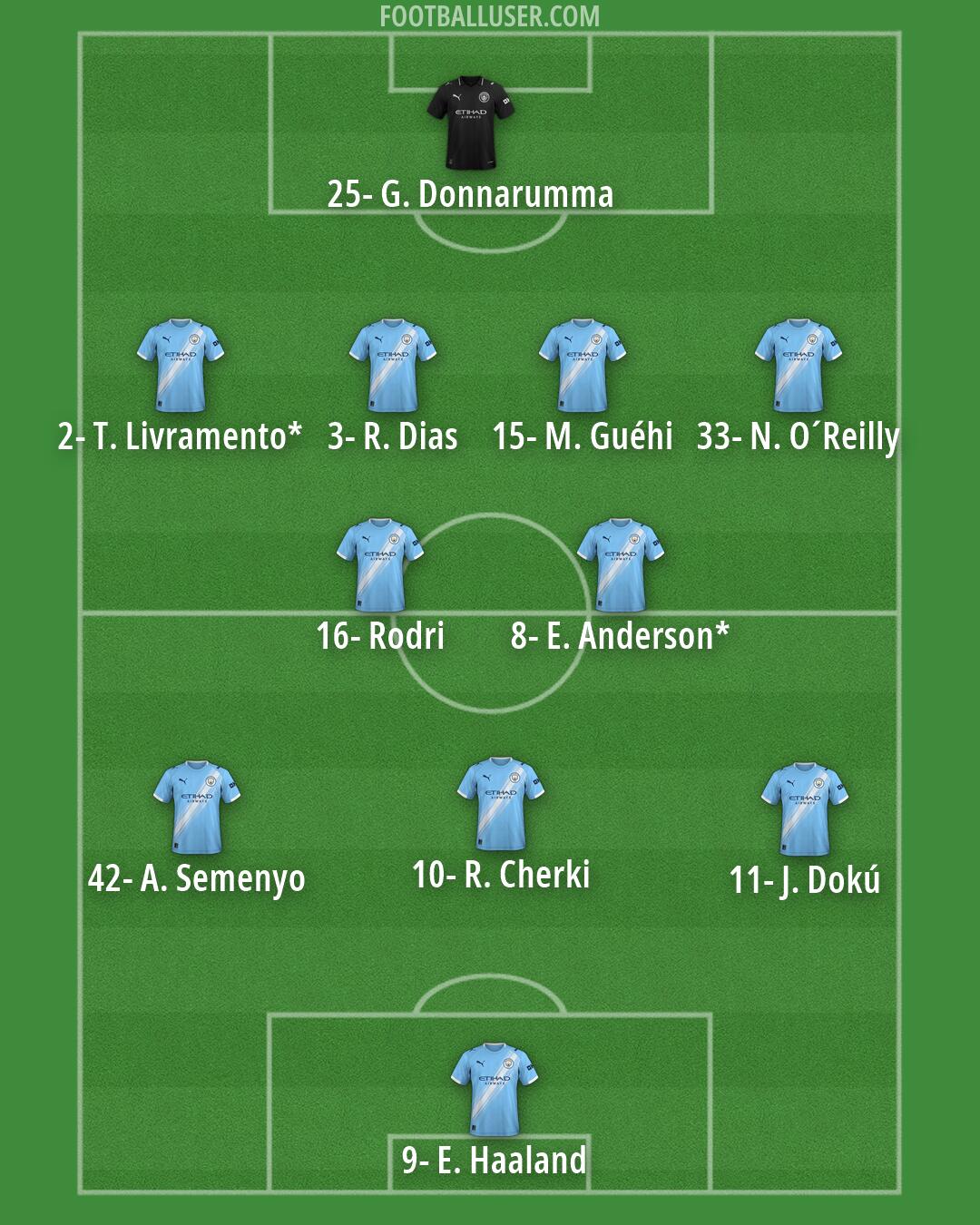
Man City Football Formation
 April 20, 2026


Starting Lineup
25- G. Donnarumma2- T. Livramento*
3- R. Dias
15- M. Guéhi
33- N. O´Reilly
16- Rodri
8- E. Anderson*
10- R. Cherki
42- A. Semenyo
11- J. Dokú
9- E. Haaland
Man City utilizes a 4-5-1 formation designed for heavy possession and controlling the tempo of the game. This lineup focuses on dominating the central areas to maintain control while keeping a clear pathway for vertical attacks. The team looks to use their numbers in the middle of the park to squeeze opponents and force errors through constant passing and movement.
G. Donnarumma stays between the posts to command the area and launch long passes to start transitions. A back four provides a solid foundation with R. Dias acting as a ball playing defender to break lines with his distribution. Beside him, M. Guéhi provides aerial strength and cover to manage the defensive line. T. Livramento pushes forward to provide width on the right, while N. O´Reilly tracks back to cover the left flank when the team loses possession.
The midfield works in a heavy block to control the center of the pitch. Rodri sits in front of the defense as a single pivot to shield the back line and recycle possession. E. Anderson works alongside him to help maintain the central density. Moving higher, R. Cherki and A. Semenyo connect the midfield to the attack by finding pockets of space between the lines. J. Dokú operates in a central midfield role but has the dribbling style to push the ball into the final third.
In the attacking phase, E. Haaland acts as a lone striker to lead the line. He is tasked to hold up the ball and pin the opposing center backs to create space for the midfielders to run into. The five midfielders support him by making late runs into the box or drifting wide to pull defenders out of position. This setup relies on the front line to press high and force the opposition to play long balls.
One major advantage for Man City is the numerical superiority they create in the middle of the field. By packing the central zones with players like Rodri and E. Anderson, they can intercept passes and quickly switch play to the wings. The formation also allows for wide overloads when T. Livramento overlaps to support the advanced midfielders. This creates isolated one on one situations for the attackers in the final third.
This 4-5-1 formation prioritizes ball retention and control through a crowded central midfield. It is best suited for matches where the team needs to dominate possession against a side that sits deep in a low block.