
São Paulo Football Formation
 April 20, 2026
 RPLemos


Starting Lineup
1 Éderson2 Dodô
11 D Neres
4 Tuta
6 Caio H
5 Fabinho
3 Morato
20 Lo Celso
18 Wendell
19 Marcos L
21 E Barco
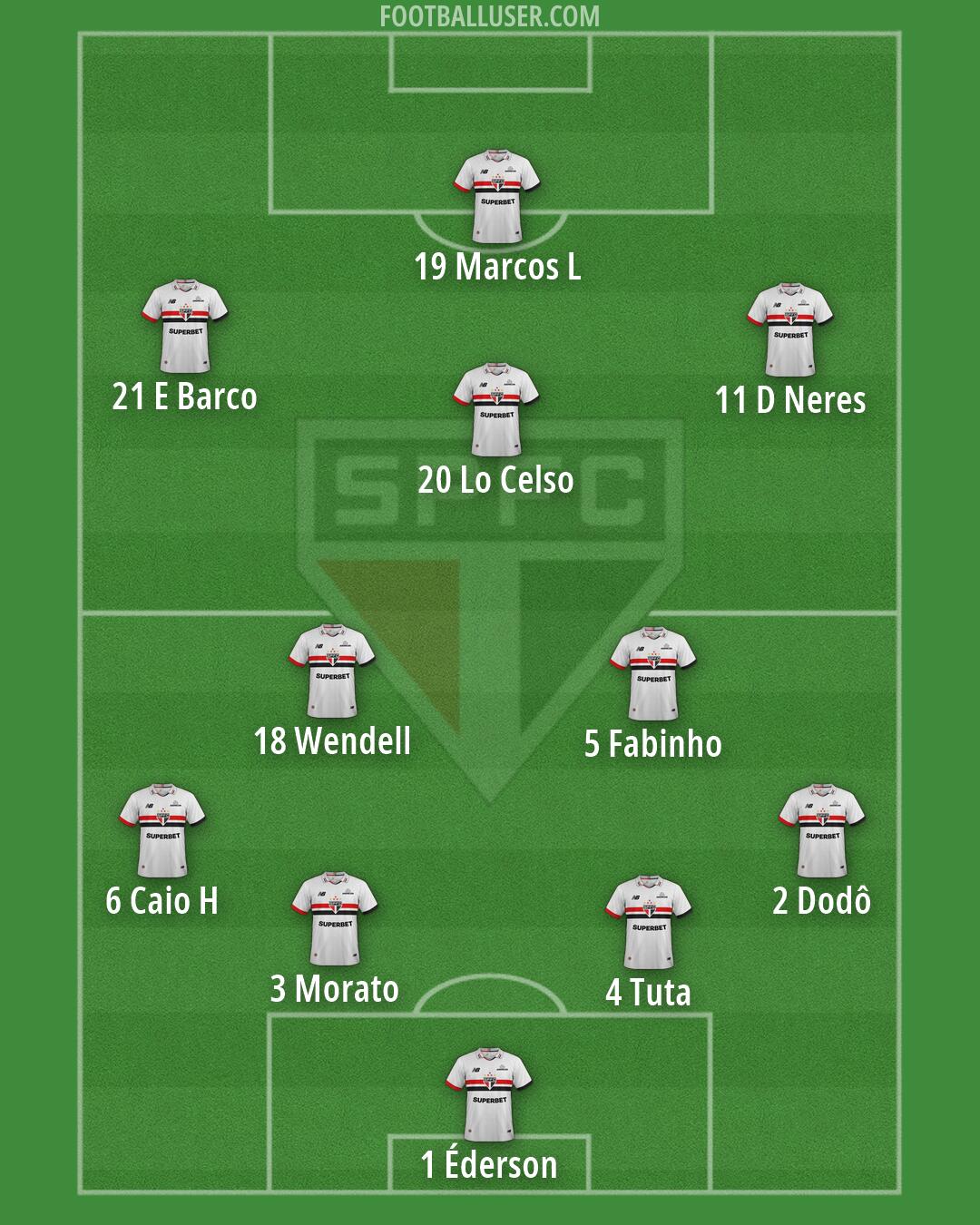
São Paulo operates with a 4-3-3 formation designed for high pressing and quick verticality. This lineup aims to win the ball high up the pitch and transition rapidly toward the goal. The tactical identity relies on aggressive movement to unsettle the opposition and dominate through high intensity in the final third.
Éderson acts as the last line of defense, providing stability from the goal. The back line features Tuta and Morato as the two central defenders, where Tuta uses his aerial strength and Morato provides cover. Dodô operates as an overlapping full back on the right to provide width, while Caio H covers the left flank. The defensive unit maintains a high line to keep the team compact and press the opponent effectively.
The midfield functions as a central trio that controls the tempo and links the lines. Fabinho plays as a single pivot to shield the defense and break the lines with his passing range. Wendell works alongside him to drive forward and disrupt play through his pressing intensity. Lo Celso operates in the space ahead as an attacking ten, looking to create chances and connect the midfield to the front three.
São Paulo utilizes three attackers to stretch the opposition defense. Marcos L acts as the lone striker to hold up the ball and pin the central defenders. On the wings, D Neres and E Barco act as inverted wingers who cut inside to threaten the goal. This movement creates space for the full backs to overlap and provides various ways to break the line through the middle or out wide.
This formation offers several tactical advantages for the squad. The positioning of Lo Celso allows for numerical superiority in the half spaces, making it hard for opponents to mark him. Using inverted wingers like D Neres and E Barco allows the team to isolate wide players in one on one situations when the full backs push high. The pressing waves from the front three and midfield ensure the opponent struggles to build from the back.
The 4-3-3 formation creates a highly aggressive and direct threat in the attacking phase. It is best suited for games where the team needs to dominate possession and apply heavy pressure on an opponent that struggles to play out from a low block.