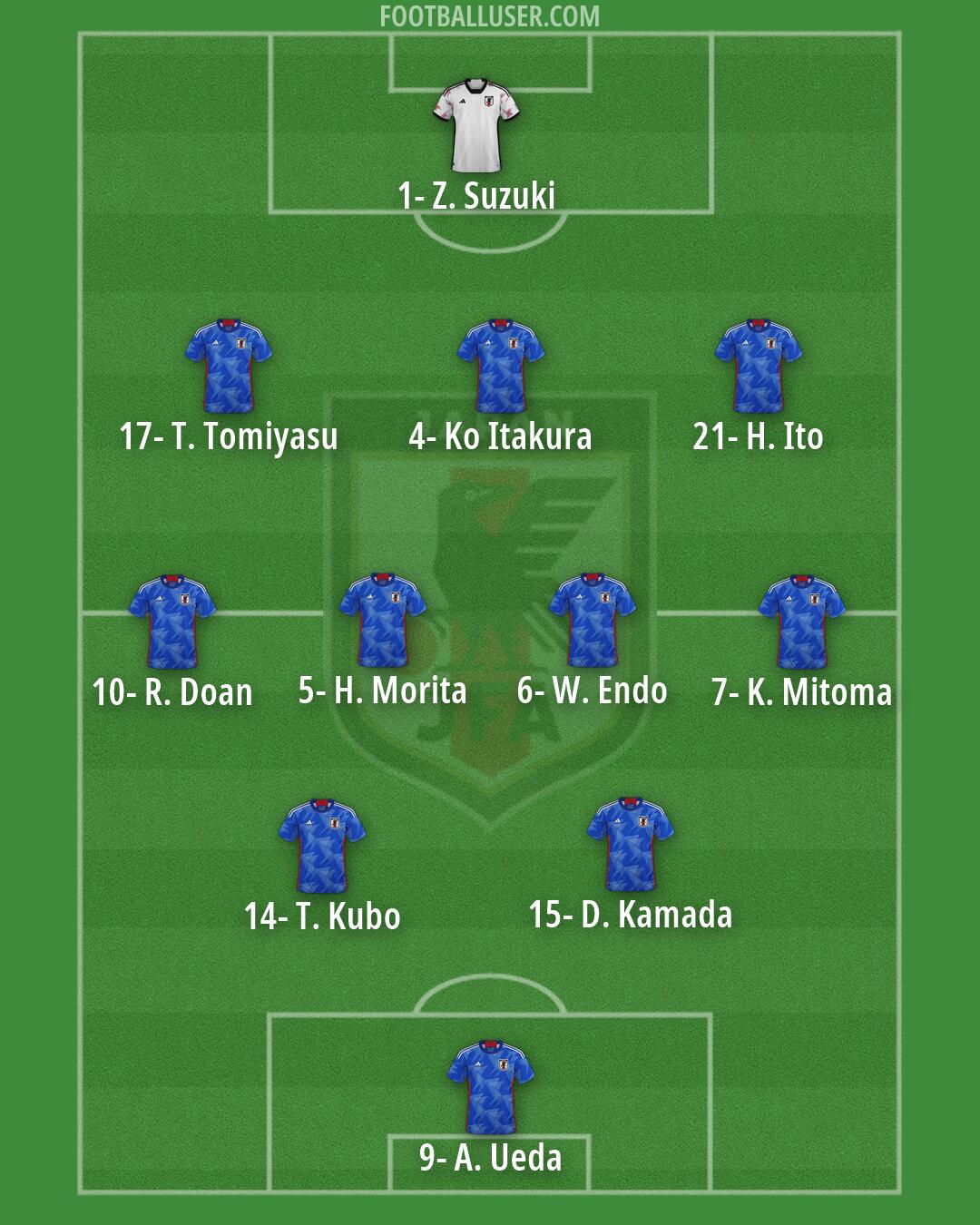

Japan National Football Team Formation
 April 21, 2026


Starting Lineup
1- Z. Suzuki4- Ko Itakura
17- T. Tomiyasu
21- H. Ito
7- K. Mitoma
10- R. Doan
5- H. Morita
6- W. Endo
14- T. Kubo
15- D. Kamada
9- A. Ueda
Japan plays a 3-4-3 formation that focuses on high pressing and quick transitions. This lineup is built to control the middle of the park and use wide areas to stretch the opposition. The team seeks to win the ball high up the pitch and move it forward rapidly to catch defenses before they can settle.
Z. Suzuki stays between the posts to organize the defense from the back. The back line consists of a three man unit with Ko Itakura, T. Tomiyasu, and H. Ito. T. Tomiyasu provides strength and versatility while covering the right side of the central trio. Ko Itakura and H. Ito work together to intercept passes and win aerial duels. This unit can step up to compress the space between the defense and midfield when the team pushes high.
The midfield operates with a central duo consisting of H. Morita and W. Endo. W. Endo acts as the primary shield for the defense, using his high pressing intensity and work rate to break up play. H. Morita helps to connect the lines by recycling possession and driving forward into space. On the flanks, K. Mitoma and R. Doan act as wide midfielders who provide both width and extra cover for the defenders.
The attacking unit features three players positioned to exploit spaces between the lines. A. Ueda plays as the lone striker to hold up the ball and act as a focal point for the attack. D. Kamada and T. Kubo operate in the wide channels, often cutting inside to create goal scoring chances. K. Mitoma and R. Doan help build the width, while T. Kubo uses his dribbling style to beat defenders one on one.
This formation offers a significant advantage through its ability to press high in coordinated waves. By using the front three and the wide midfielders, Japan can squeeze the opponent in their own half. The wide overloads created by K. Mitoma and R. Doan force the opposing full backs to make difficult decisions. This setup also allows for quick transitions when the ball is won in the middle third.
Japan relies on a high energy system that uses wide players to create constant pressure. This formation is best suited for games against teams that struggle to play out from the back under intense pressure.