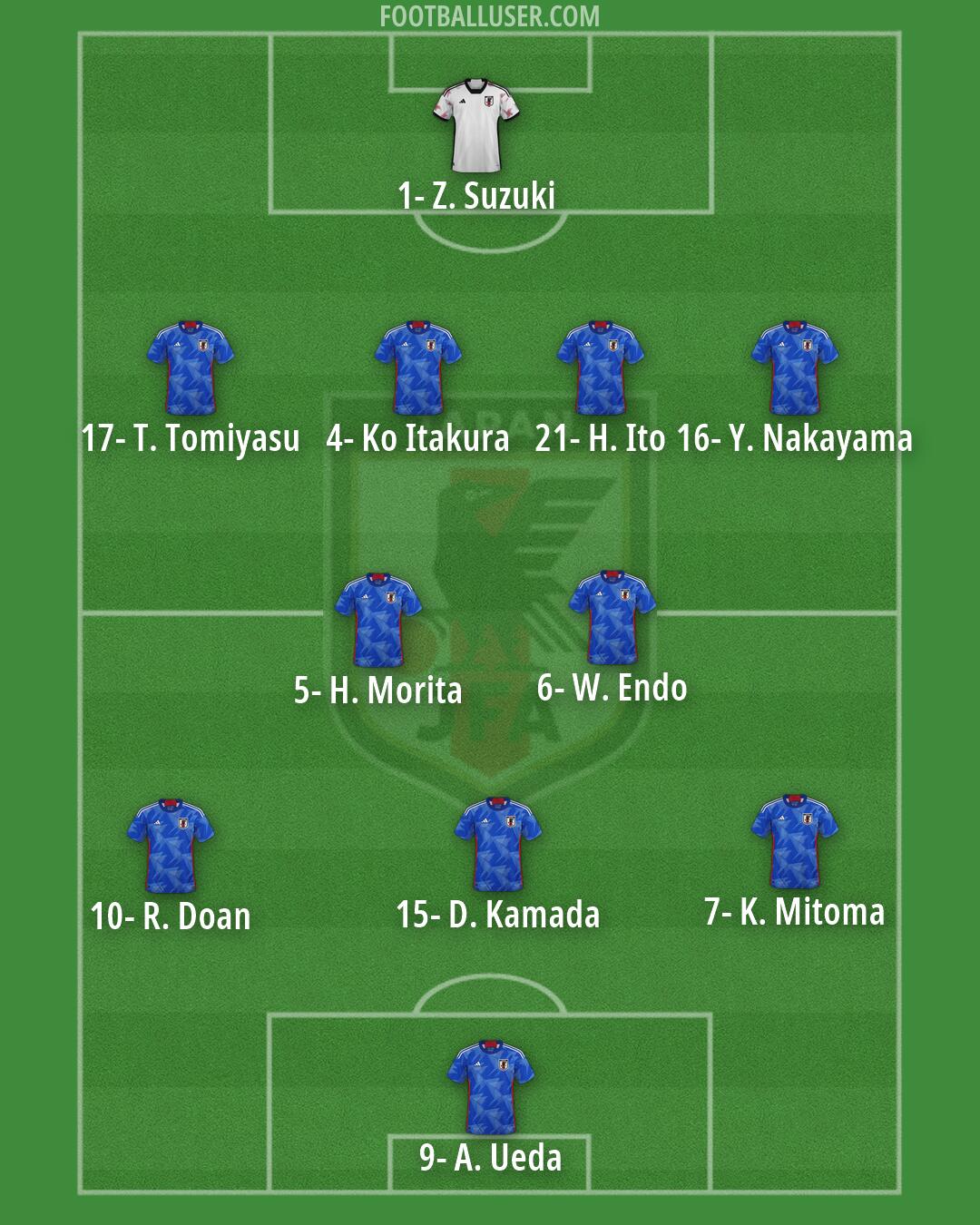

Japan National Football Team Formation
 April 21, 2026


Starting Lineup
1- Z. Suzuki4- Ko Itakura
17- T. Tomiyasu
21- H. Ito
7- K. Mitoma
10- R. Doan
5- H. Morita
6- W. Endo
16- Y. Nakayama
15- D. Kamada
9- A. Ueda
Japan employs a 4-5-1 formation that focuses on a high press and quick transitions. The lineup is built to press opponents in their own half and use compact lines to force turnovers. This setup allows Japan to control the tempo when they have the ball while remaining ready to hit opponents on the break.
Z. Suzuki guards the goal as the last line of defense. The back four operates with a high line to compress the space in the middle of the pitch. T. Tomiyasu plays as an overlapping full back on the right, while Y. Nakayama provides width on the left. In the center, Ko Itakura acts as a ball playing defender to start attacks, while H. Ito provides cover and aerial strength to handle direct balls.
The midfield utilizes a double pivot to maintain control. W. Endo acts as the primary shield for the defense, using his pressing intensity to disrupt play. H. Morita works alongside him to help break the lines with his passing range. Ahead of them, K. Mitoma, D. Kamada, and R. Doan occupy the central spaces. K. Mitoma is known for his dribbling style, often cutting inside to find space, while D. Kamada and R. Doan connect the midfield to the lone attacker.
A lone striker, A. Ueda, leads the front line. He works to hold up the ball and allow the midfielders to push forward. Because there is only one striker, the attacking movements rely on the three central midfielders to make late runs into the box. The wide presence comes from the midfielders shifting to create overloads, while A. Ueda presses the opposition defenders to prevent them from playing out from the back.
This formation offers great compactness when defending in a mid block. By having five players in the central midfield, Japan can create numerical superiority against teams playing a three man midfield. Another advantage is the speed of transition, as the team can quickly switch play from a turnover to the wide areas or the attacking trio.
Japan relies on a cohesive pressing unit and quick ball movement to unsettle opponents. This formation is best suited for matches against technically gifted sides where controlling the central zones is vital.