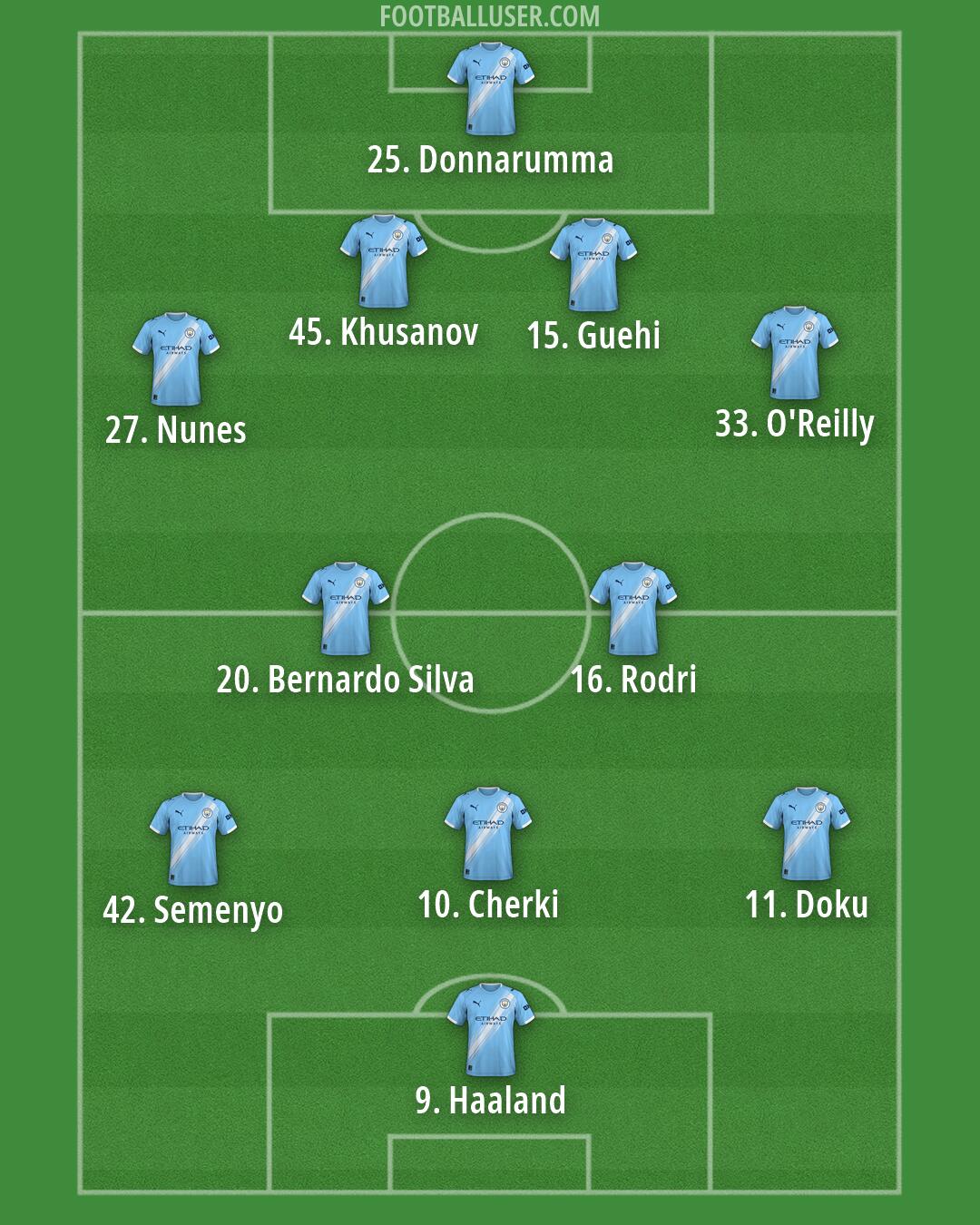
Man City Football Formation
 April 22, 2026


Starting Lineup
25. Donnarumma27. Nunes
45. Khusanov
15. Guehi
33. O'Reilly
20. Bernardo Silva
16. Rodri
42. Semenyo
10. Cherki
11. Doku
9. Haaland
Man City utilizes a 4-2-4 formation to play an aggressive, vertical game. This lineup focuses on putting immense pressure on the opponent in their own half. The goal is to win the ball back quickly and strike fast through a heavy front line. This type of football is built to dominate possession and keep the opponent pinned deep in their own territory.
Donnarumma stays between the posts to command the area. Khusanov and Guehi form the central pair, needing to be quick to cover the space behind the high line. O'Reilly and Nunes act as wide defenders who push up to overlap, providing much needed width during transitions. They must also track back with pace to ensure the defensive unit stays compact when the opponent manages to switch play.
The midfield works through a double pivot of Bernardo Silva and Rodri. Rodri protects the back line and uses his passing range to break the line and find the attackers. Bernardo Silva connects the defense to the attack, using his dribbling and pressing intensity to move the ball into dangerous areas. This pair must work hard to intercept passes and prevent the opponent from playing through the middle of the pitch.
The attacking unit features four players positioned high up the pitch. Doku and Semenyo occupy the wide positions, with Doku looking to cut inside and use his dribbling to beat his man. Haaland and Cherki operate centrally to create a constant threat. By using his strength and movement, Haaland can hold up the ball and finish, while the whole front four press high in waves to force mistakes.
This formation offers clear tactical advantages for Man City. The most notable is the ability to press high in coordinated waves, using the four forwards to crowd the opposition and win the ball back near the goal. There is also a high capacity for isolating wide players in one on one situations when Doku or Semenyo receive the ball. The speed of transition allows the team to move from a winning the ball state to a scoring chance in seconds, using the directness of the front four to catch the opponent out of position.
This formation is built for heavy attacking and high intensity pressing. It is best suited for matches where the team needs to break down a compact opponent through sheer numbers in the final third.