Aston Villa Football Formation
 April 22, 2026


Starting Lineup
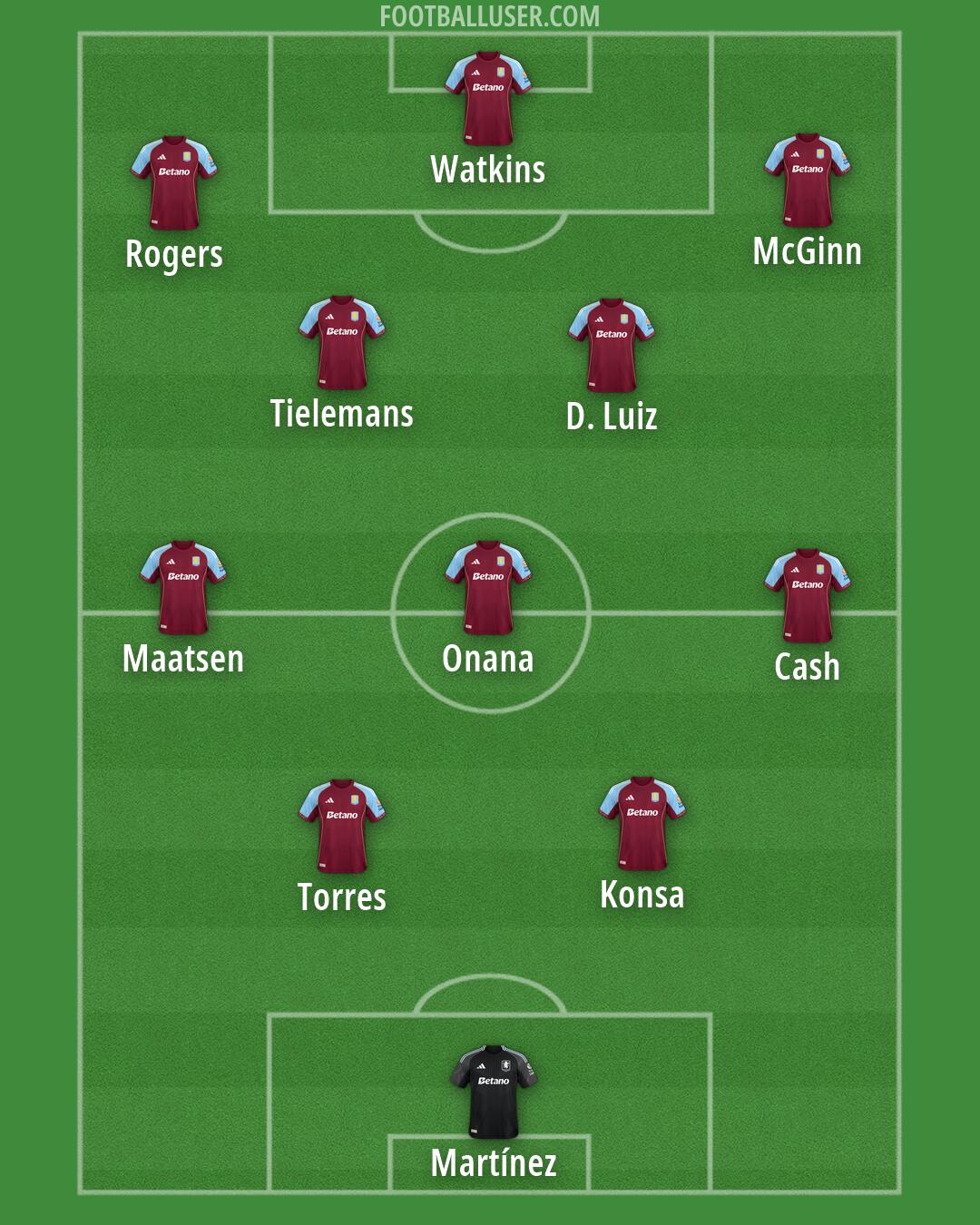
Maatsen · Torres · Konsa · Cash · Watkins · McGinn · Rogers · Onana · Tielemans · D. Luiz · MartínezAston Villa operates with a 4-5-1 formation that prioritizes a high press and quick verticality. This lineup is built to congest the central areas and force the opposition into wide areas where they are less dangerous. The team seeks to win the ball in high areas and use the central strength to move the ball quickly toward the goal in transition.
Watkins plays as the goalkeeper to anchor the defensive unit. The back four functions as a single block, with McGinn at left back and Rogers at right back providing width and tracking back when needed. Tielemans and D. Luiz act as the central defenders, with Tielemans using his passing range to start attacks from the back and D. Luiz utilizing his aerial strength to defend crosses. The defensive unit must stay disciplined to maintain a high line and prevent long balls.
The midfield consists of five players who provide a wall in front of the defense. Onana sits in the central pivot role to shield the back four and intercept passes with his physical presence. Maatsen and Cash work as the central midfielders who connect the lines, with Cash often looking to drive forward into space. Torres and Konsa operate in the advanced midfield roles, acting as the link between the central pivot and the lone striker. Maintaining this midfield control is key for Aston Villa.
In the attacking phase, Martínez acts as the lone striker. He must hold up the ball to bring the rest of the team into the game. The attack is built by moving the ball through the wide midfielders, Torres and Konsa, who look to cut inside or find pockets of space. Such movement forces the opposition defense to shift constantly and creates gaps for Martínez to exploit.
One major tactical advantage of this formation is the ability to create numerical superiority in the middle of the pitch. With five midfielders, the team can overwhelm opponents who try to play through the center. Additionally, the team can press high in coordinated waves, using the proximity of the five midfielders to the striker to trap the opposition. Quick turnovers in dangerous positions result from this pressure.
This 4-5-1 formation provides a compact and pressing identity that is hard to break down. It is best suited for games against ball-dominant teams that require constant pressure to disrupt their rhythm.