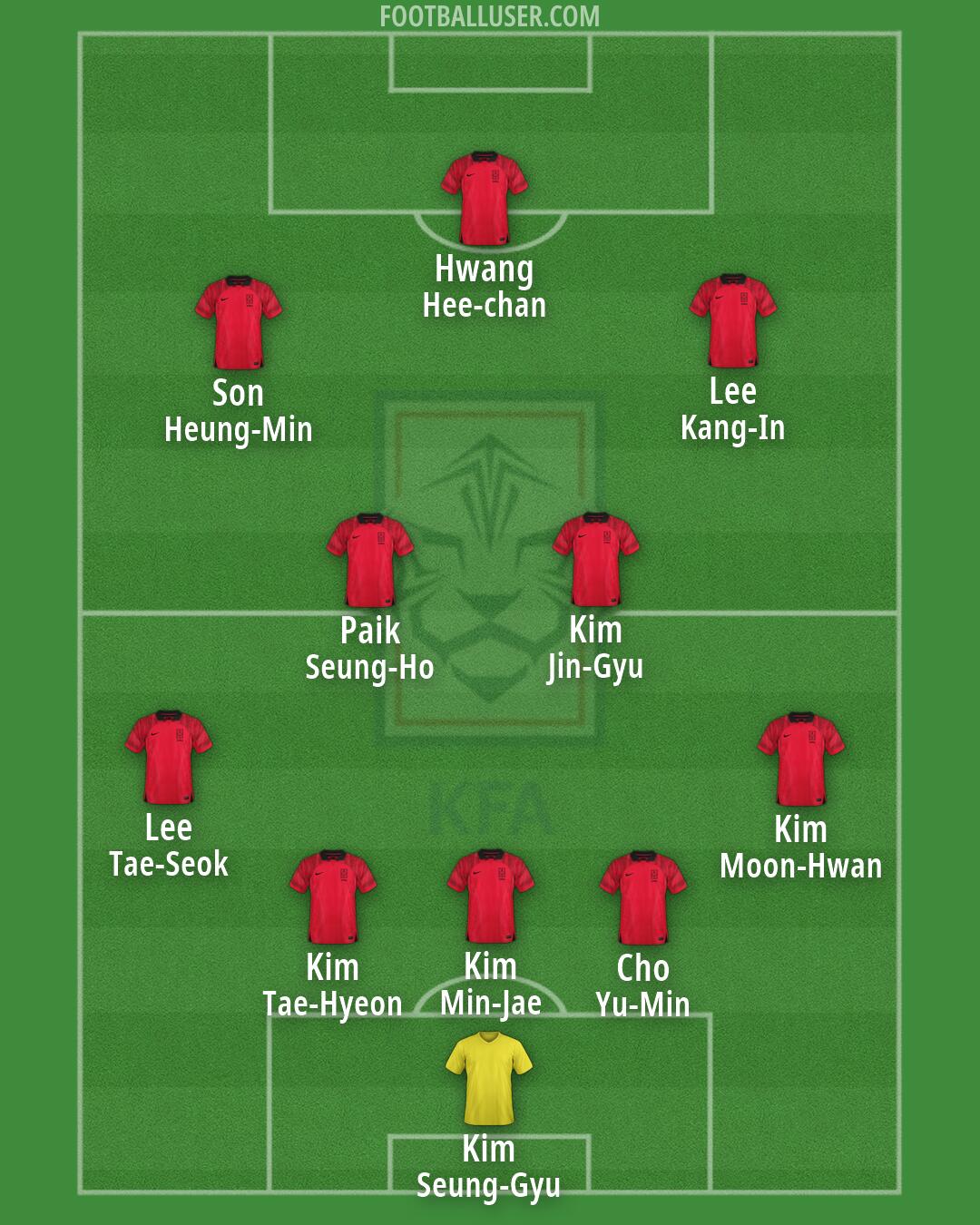

South Korea National Football Team Formation
 April 23, 2026


Starting Lineup
Kim (Seung-Gyu) · Cho (Yu-Min) · Kim (Min-Jae) · Kim (Tae-Hyeon) · Kim (Moon-Hwan) · Lee (Tae-Seok) · Kim (Jin-Gyu) · Paik (Seung-Ho) · Son (Heung-Min) · Hwang (Hee-chan) · Lee (Kang-In)South Korea utilizes a 5-2-3 formation. This lineup focuses on a strong defensive foundation while looking to strike quickly through vertical transitions. The team aims to stay compact when they do not have the ball and use the pace of their front three to punish opponents in open space.
Kim operates between the posts to organize the back line. The defense relies on a back three composed of Kim, Kim, and Cho to protect the central area. These central defenders must hold their position and dominate in the air to stop crosses. Lee and Kim act as wing backs, tasked to push up the pitch to provide width and track back when the team loses possession. This defensive unit stays tight to prevent gaps between the lines.
The midfield consists of a pair of central players, Paik and Kim, operating in a double pivot. These two must work hard to shield the back three and intercept passes before they reach the final third. Paik and Kim need to connect the defense to the attack by making quick passes and covering large areas of the pitch. They are responsible for breaking the line with their distribution and ensuring the team does not get overrun in the middle.
In the attacking phase, the team uses three forwards with Hwang leading as a lone striker. Son operates on the left as an inverted winger, using his ability to cut inside and his finishing to threaten the goal. Lee plays on the right to provide width and stretch the opposition defense. These attackers must press high to force mistakes and make runs behind the defense to support Hwang when he holds up the ball.
One major advantage for South Korea is the ability to create wide overloads when the wing backs, Lee and Kim, overlap the front three. This creates many options for crosses into the box. The formation also allows for great compactness when defending, making it hard for opponents to play through the middle. Another strength is the speed of transition, allowing the team to move from a deep block to a heavy attack in seconds.
This formation is built for defensive solidity and rapid counter attacking. It is best suited for games against teams that control possession and leave space behind their defensive line.