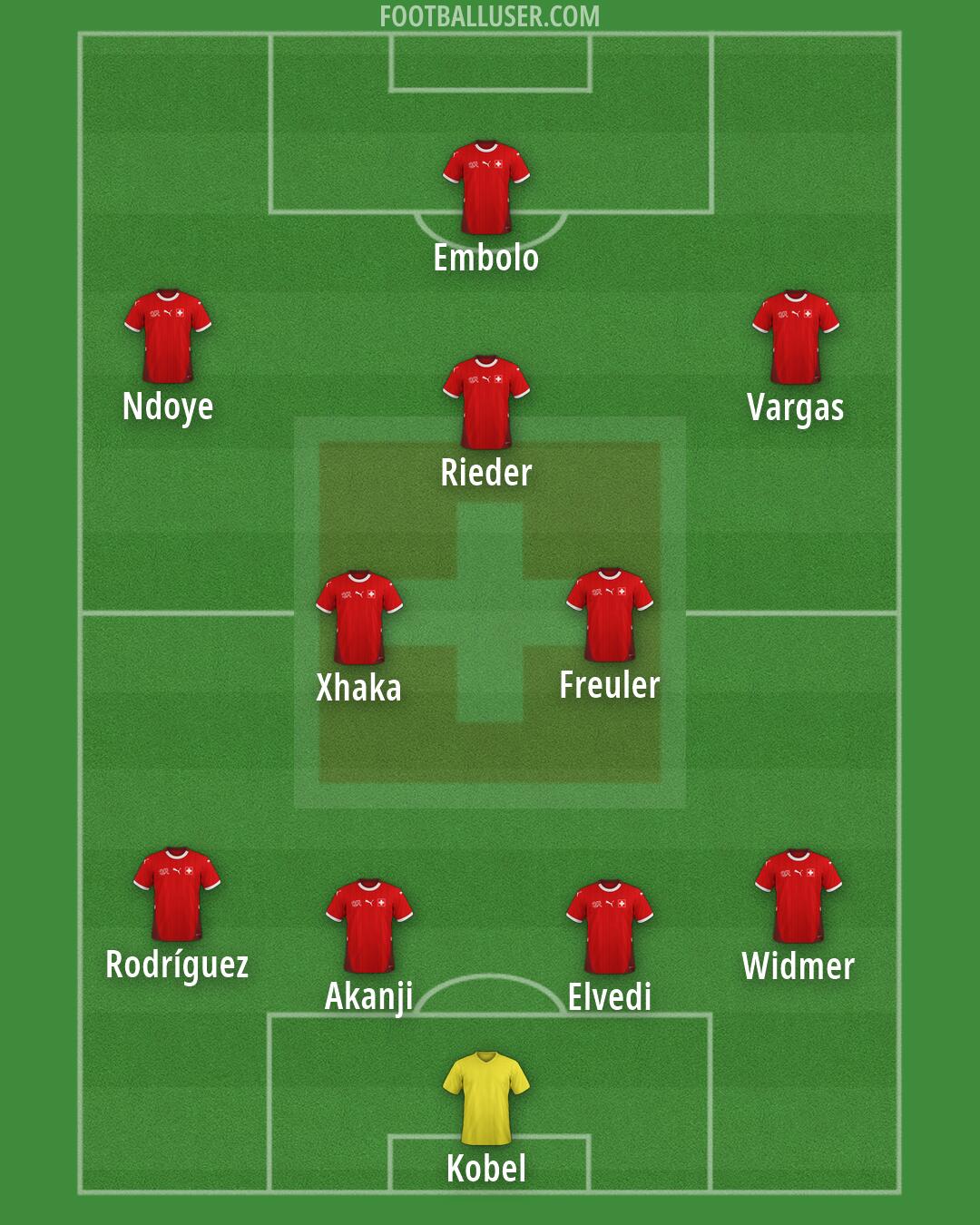

Switzerland National Football Team Formation
 April 28, 2026
 tjc****@btinternet.com


Starting Lineup
Kobel · Akanji · Elvedi · Widmer · Freuler · Rodríguez · Rieder · Xhaka · Vargas · Ndoye · EmboloSwitzerland employs a 4-2-4 formation that prioritizes a high press and verticality. This lineup is built to overwhelm the opposition in the final third and win the ball back quickly after losing possession. By pushing many players forward, Switzerland aims to force turnovers in the attacking half and create immediate goal-scoring chances through direct play.
Kobel acts as the last line of defense, providing stability from the goal. The back line operates with a high line to compress the pitch, featuring Elvedi and Akanji as the central pair. Akanji uses his aerial strength and ability to cover large spaces to manage the defensive line, while Elvedi focuses on marking and intercepting passes. Widmer plays as an attacking full back to provide width on the right, whereas Rodríguez provides balance on the left, often cutting inside to help the midfield. The defensive unit must stay compact to prevent being caught by long balls behind them.
The midfield functions as a double pivot to provide a bridge between the defense and the attack. Xhaka, who is the captain, uses his passing range and ability to control the tempo to dictate play from a deep position. He is joined by Freuler, who works to drive forward and connect the lines through intense running. This duo must hold their positions to shield the defense while ensuring they do not get bypassed when the team commits many players forward.
In the attacking third, the formation uses four players to stretch the opposition. Embolo and Rieder act as two central forwards, with Embolo able to hold up the ball and create space for his partner. Vargas operates as an inverted winger on the right to cut inside and shoot, while Ndoye provides pace and width on the left flank. These attackers press in coordinated waves to prevent the opponent from building play out from the back.
One major tactical strength of this formation is the ability to create wide overloads and isolations for the wingers. By pushing the two central midfielders high, the team can overwhelm the opposition midfield and force them into deep blocks. Another advantage is the speed of transition, where the team can move from a defensive stance to a heavy attack in a matter of seconds. This lineup also allows for high pressing intensity across the entire front line.
This 4-2-4 formation creates a heavy offensive presence designed to dominate the final third. It is best suited for matches where the team needs to break down a low block or face an opponent that struggles with high intensity pressing.