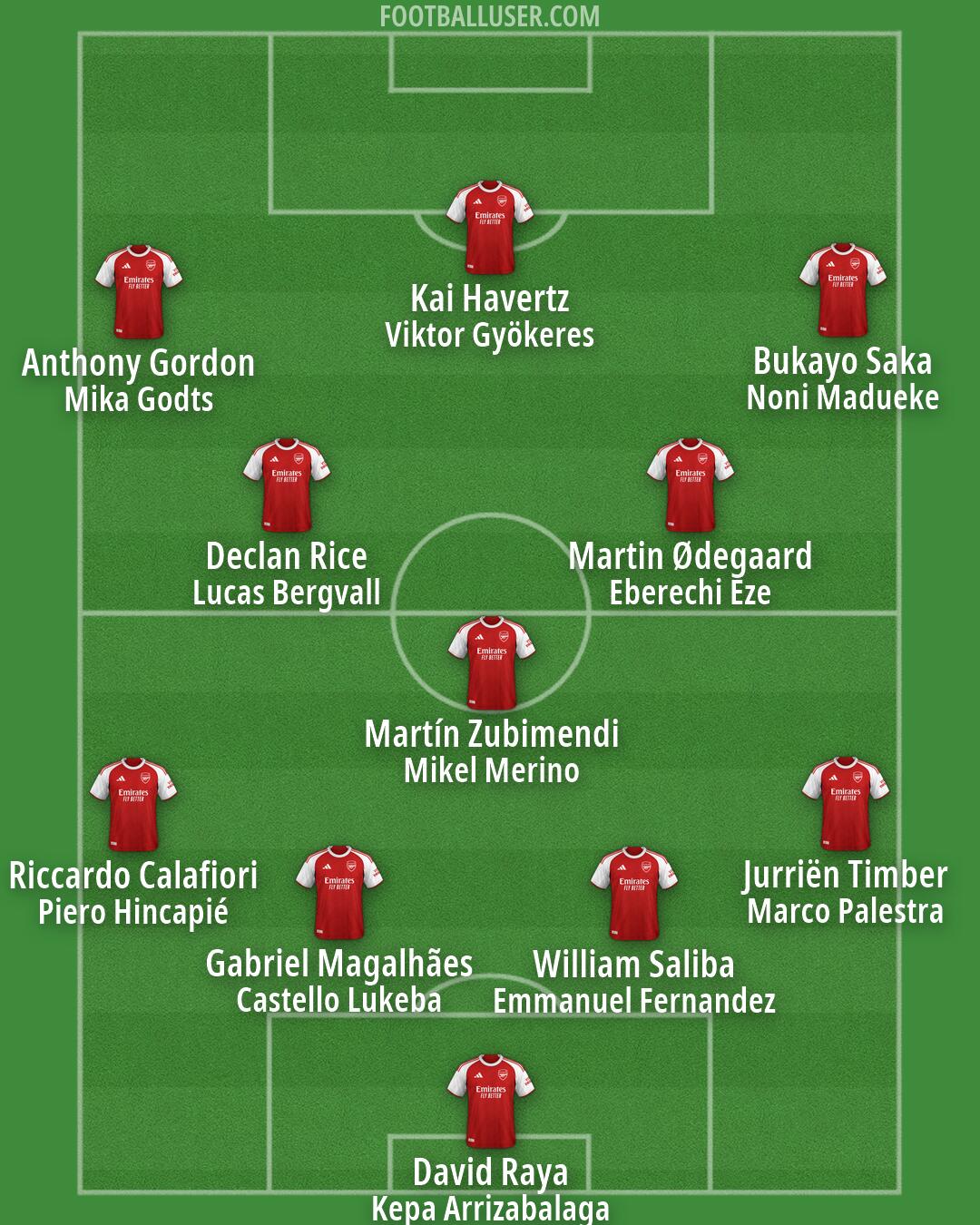
Arsenal Football Formation
 April 29, 2026


Starting Lineup
David Raya (Kepa Arrizabalaga) · Gabriel Magalhães (Castello Lukeba) · William Saliba (Emmanuel Fernandez) · Riccardo Calafiori (Piero Hincapié) · Jurriën Timber (Marco Palestra) · Declan Rice (Lucas Bergvall) · Martín Zubimendi (Mikel Merino) · Martin Ødegaard (Eberechi Eze) · Anthony Gordon (Mika Godts) · Bukayo Saka (Noni Madueke) · Kai Havertz (Viktor Gyökeres)Arsenal operates with a 5-2-3 formation that focuses on a high press and controlled possession. This lineup is built to dominate the ball and win it back quickly in the opponent half. The team wants to control the tempo by using short passes to move the opponent around.
David Raya sits behind a back five to command the area. The central defense features William Saliba, Gabriel Magalhães, and Martín Zubimendi. Saliba provides coverage with his speed while Gabriel Magalhães uses his aerial strength to win headers. Jurriën Timber acts as the right wing back to push forward and provide width. Riccardo Calafiori plays as the left wing back, capable of making runs to support the attack. The whole unit can shift together to block passing lanes or sit deep to protect the middle.
The midfield is a double pivot that connects the defense to the attack. Declan Rice holds his position to shield the center and intercept passes. He can also drive forward to break the line. Martin Ødegaard plays in the right central channel to create chances and find teammates with his passing range. This pair must stay compact to prevent the opposition from playing between the lines.
In the final third, the team uses three attackers to stretch the opposition. Kai Havertz works as a lone striker who can hold up the ball and drift into pockets of space. Anthony Gordon stays wide on the left and looks to cut inside to threaten the goal. Bukayo Saka occupies the right flank, using his dribbling to beat defenders. These movements allow the wing backs to overlap and deliver crosses into the box.
One main strength of this Arsenal lineup is the ability to press high in coordinated waves. The team also creates wide overloads when the wing backs join the attackers. This formation provides numerical superiority in the wide areas and allows for quick transitions. The presence of three central defenders ensures the team remains compact when the opposition has the ball.
This 5-2-3 formation is a powerful tool for teams looking to dictate play through aggression and ball retention. It is best suited for matches against opponents that struggle to play out from the back under intense pressure.