Arsenal Football Formation
 April 29, 2026


Starting Lineup
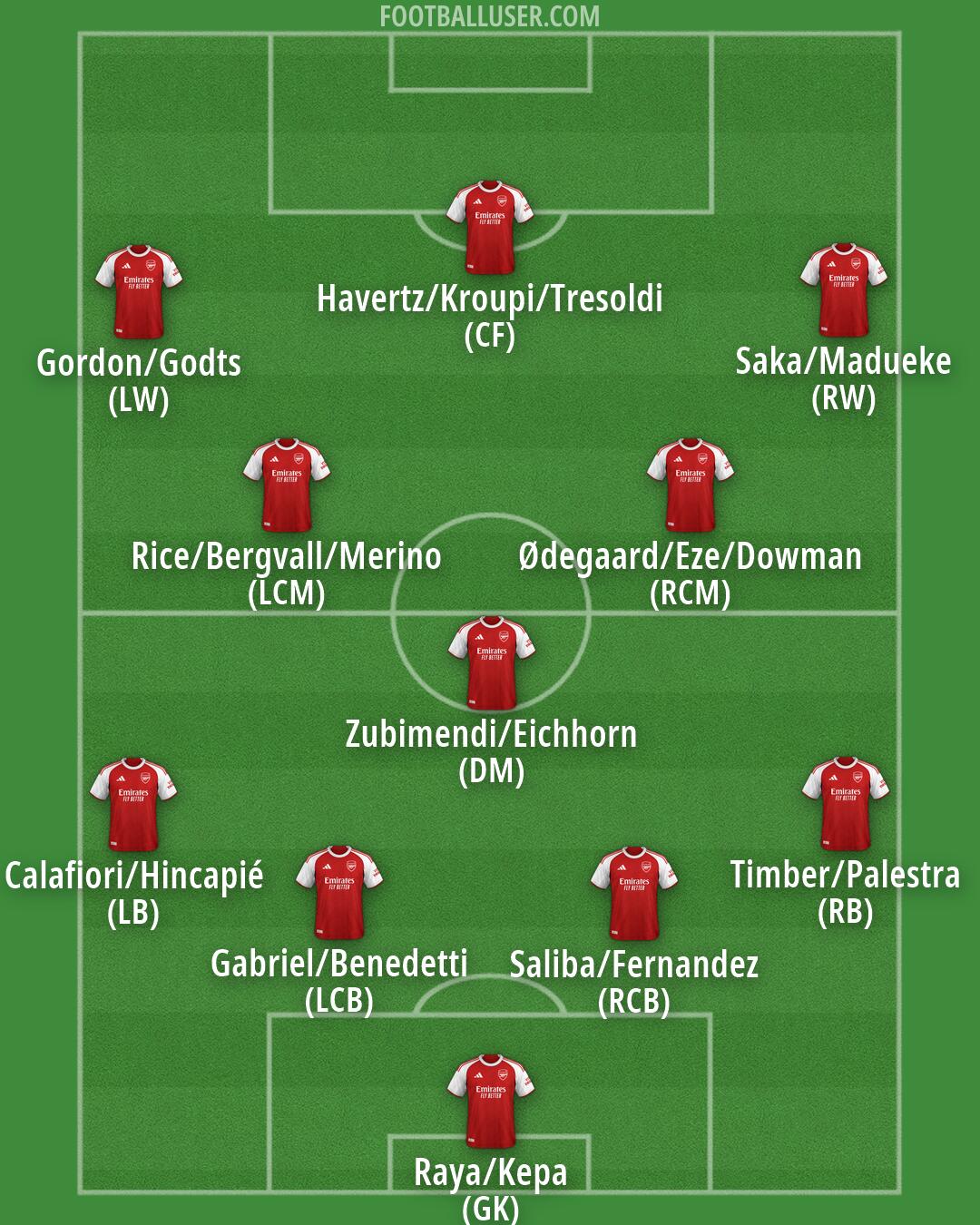
Raya/Kepa (GK) · Gabriel/Benedetti (LCB) · Saliba/Fernandez (RCB) · Calafiori/Hincapié (LB) · Timber/Palestra (RB) · Rice/Bergvall/Merino (LCM) · Zubimendi/Eichhorn (DM) · Ødegaard/Eze/Dowman (RCM) · Gordon/Godts (LW) · Saka/Madueke (RW) · Havertz/Kroupi/Tresoldi (CF)Arsenal plays a 5-2-3 formation that focuses on a high press and rapid verticality. This lineup is built to dominate territory and win the ball back in the attacking third through aggressive positioning. The team looks to use the width of the pitch to stretch opponents before playing quick passes to break the line.
Raya operates as the goalkeeper to start the build up. The defensive unit functions as a back five with Zubimendi acting as the central defender to anchor the back line. Saliba plays as the right central defender where his recovery pace allows the unit to step up. Gabriel holds the left central defender position and uses his aerial strength to win headers. Timber works as the right wing back to push up and overlap, while Calafiori covers the left wing back role to provide width.
The midfield relies on a double pivot to manage the center of the pitch. Rice plays as the left central midfielder to shield the defense and intercept plays with his work rate. Ødegaard acts as the right central midfielder to connect the lines and create chances with his passing range. These two players must cover the spaces left by the wing backs to ensure the team remains compact when they lose possession.
The attack is driven by three players in a front three. Havertz leads the line as a lone striker to hold up the ball and bring others into play. Saka stays on the right wing and likes to cut inside to attack the box, while Gordon operates on the left wing to provide width. This front line presses high to force mistakes and creates space for the midfielders to run into the final third.
A key advantage for Arsenal is the ability to create wide overloads through the overlap of Timber and Saka. The formation also allows the team to press high in coordinated waves, making it difficult for the opponent to play out from the back. This allows for a quick transition from a defensive block to a dangerous attacking move.
This 5-2-3 formation provides a heavy presence in both the defensive and attacking zones. It is best suited for matches against teams that play a back four and can be overwhelmed by wide pressure and high pressing intensity.