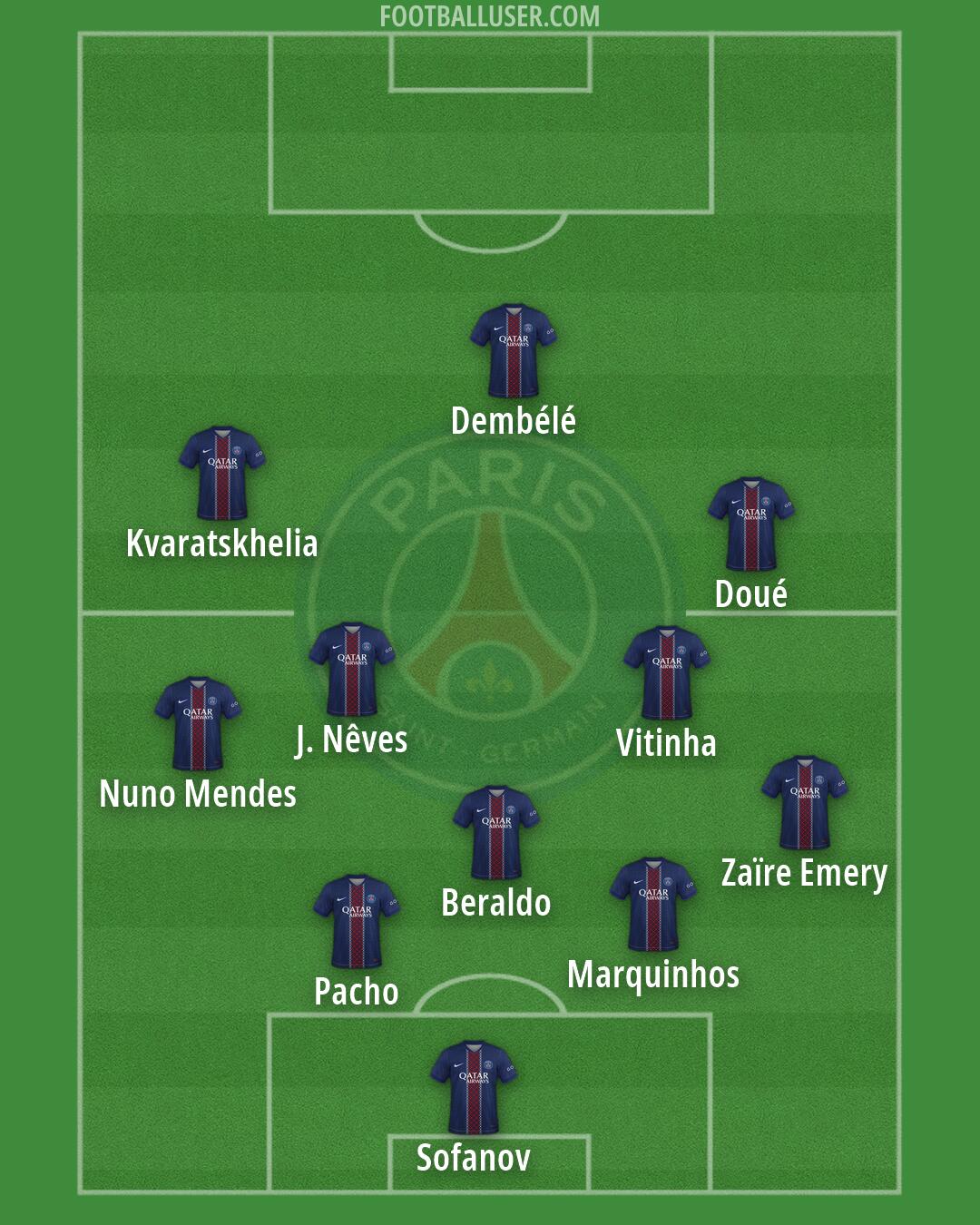

PSG Football Formation
 April 30, 2026


Starting Lineup
Sofanov · Nuno Mendes · Pacho · Marquinhos · Zaïre Emery · Beraldo · J. Nêves · Vitinha · Doué · Kvaratskhelia · DembéléPSG uses a 4-3-3 formation that relies on a high press and quick transitions. This lineup is built to dominate territory through aggressive positioning and rapid ball movement. The intention is to win the ball high up the pitch and force the opposition into mistakes through constant pressure.
Sofanov stays between the posts to manage the back line. The defense operates with a high line to compress the space in front of them. Marquinhos acts as the central anchor, using his aerial strength and reading of the game to cover large areas. Beside him, Beraldo plays as a ball playing defender to start attacks from the back. Zaïre Emery plays as a right back who can push forward, while Pacho covers the left side to provide defensive stability. The unit works together to step up and intercept passes before the opponent can build play.
The midfield uses a trio to control the center of the pitch. J. Nêves holds the position to shield the defense and break up play. Vitinha operates in the middle to connect the lines, using his passing range to move the ball quickly. Nuno Mendes plays in the left central midfield role to drive forward and add numbers to the attack. This midfield group works to press in waves and ensure the team keeps control of the ball during buildup.
PSG attacks with three players positioned high up the pitch. Dembélé plays as a lone striker who can hold up the ball and create space for others. On the flanks, Kvaratskhelia and Doué act as wide attackers. Kvaratskhelia often cuts inside to threaten the goal, while Doué uses his movement to find gaps in the defense. The forwards press intensely to prevent the opposition from playing out from the back.
This formation provides several tactical advantages. The team can create wide overloads when the full backs push high to support the wingers. There is also an ability to press high in coordinated waves to trap the opponent in their own half. When the ball is turned over, the team uses its speed of transition to catch the defense out of position.
The 4-3-3 provides a balanced way for PSG to control games through pressing and ball retention. This formation is best suited for matches against teams that try to build play from the back.