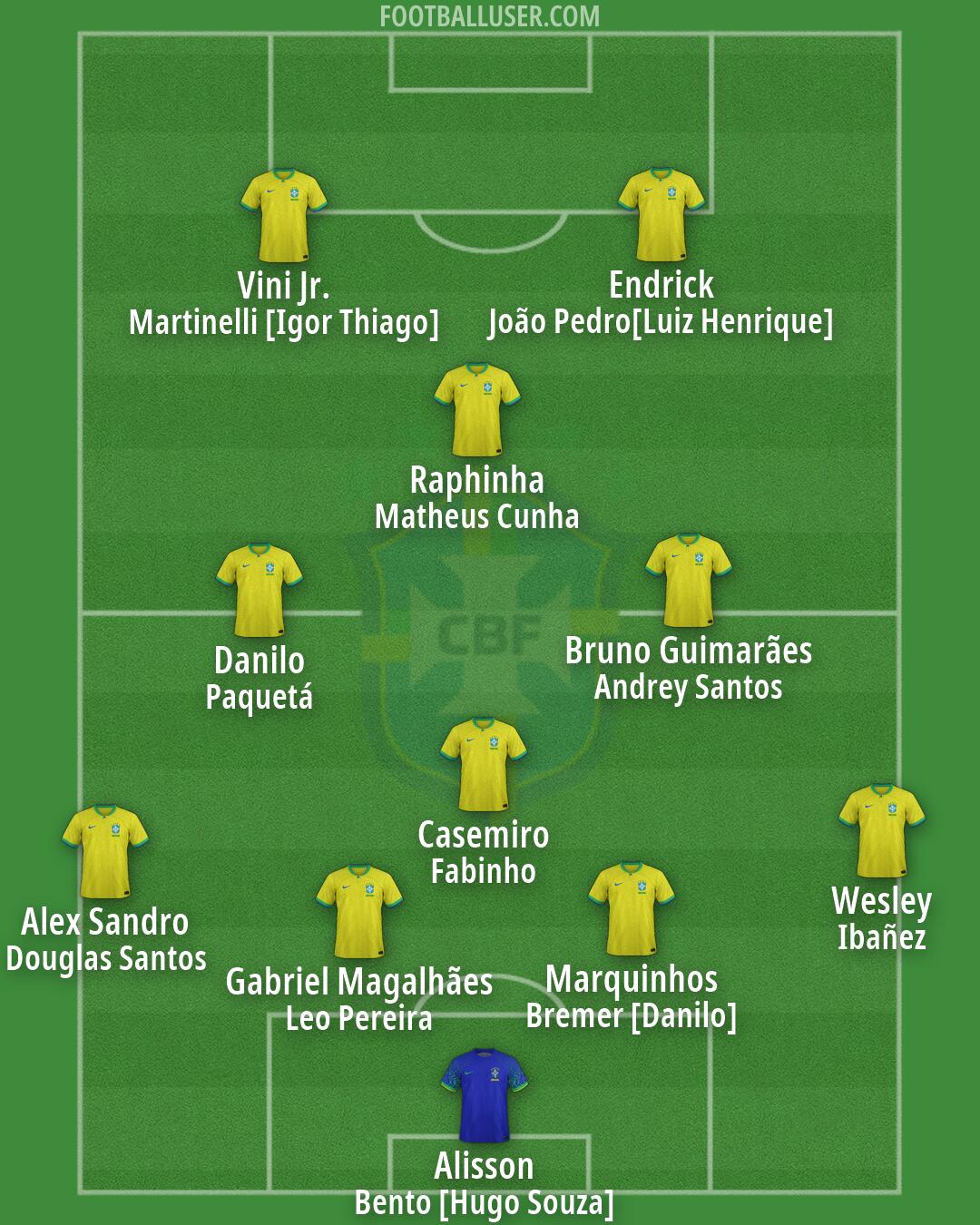

Brazil National Football Team Formation
 April 30, 2026


Starting Lineup
Alisson (Bento [Hugo Souza]) · Casemiro (Fabinho) · Bruno Guimarães (Andrey Santos) · Alex Sandro (Douglas Santos) · Vini Jr. (Martinelli [Igor Thiago]) · Raphinha (Matheus Cunha) · Danilo (Paquetá) · Endrick (João Pedro[Luiz Henrique]) · Marquinhos (Bremer [Danilo]) · Gabriel Magalhães (Leo Pereira) · Wesley (Ibañez)Brazil plays with a 5-3-2 formation that focuses on a strong central core and rapid transitions. This lineup is built to play a direct style of football, using defensive stability to launch quick attacks. The team relies on a heavy central presence to control the middle of the pitch and disrupt the opponent.
Alisson guards the goal and acts as a key player for the backline with his sweeping ability and long distribution. The defense uses a back five that includes Casemiro playing as a central defender alongside Gabriel Magalhães and Marquinhos. Marquinhos provides aerial strength and composure while Gabriel Magalhães focuses on winning physical duels. Alex Sandro acts as the left wing back to provide width, while Wesley operates on the right side to push up the flank. This defensive unit can sit deep to block passing lanes or step up to compress the space.
The midfield operates with a three man central block to link the defense to the attack. Bruno Guimarães controls the tempo with his passing range and ability to break the line, while Danilo provides grit and covers ground to track back. Raphinha plays in the attacking midfield role to connect the middle third to the forwards. This trio works to intercept play and quickly switch play to the wide areas when the ball is won.
Brazil uses two forwards to lead the line, consisting of Vini Jr. and Endrick. Vini Jr. uses his dribbling style and pace to cut inside from the left, creating space for Alex Sandro to overlap. Endrick works to hold up the ball and push the opposition defenders back. The two attackers press high to force mistakes, while the width comes from the wing backs pushing into the final third to cross the ball.
This formation offers several tactical advantages, particularly the ability to create numerical superiority in the central areas. The presence of three central midfielders alongside three central defenders makes the team very compact when defending in a low block. Additionally, the team can use the speed of transition to isolate wide players in one on one situations once they break through the middle.
The 5-3-2 formation provides a solid base for a team that wants to strike quickly on the break. It is best suited for matches against opponents that dominate possession and leave space behind their defensive line.