
Austria National Football Team Formation
 May 1, 2026


Starting Lineup
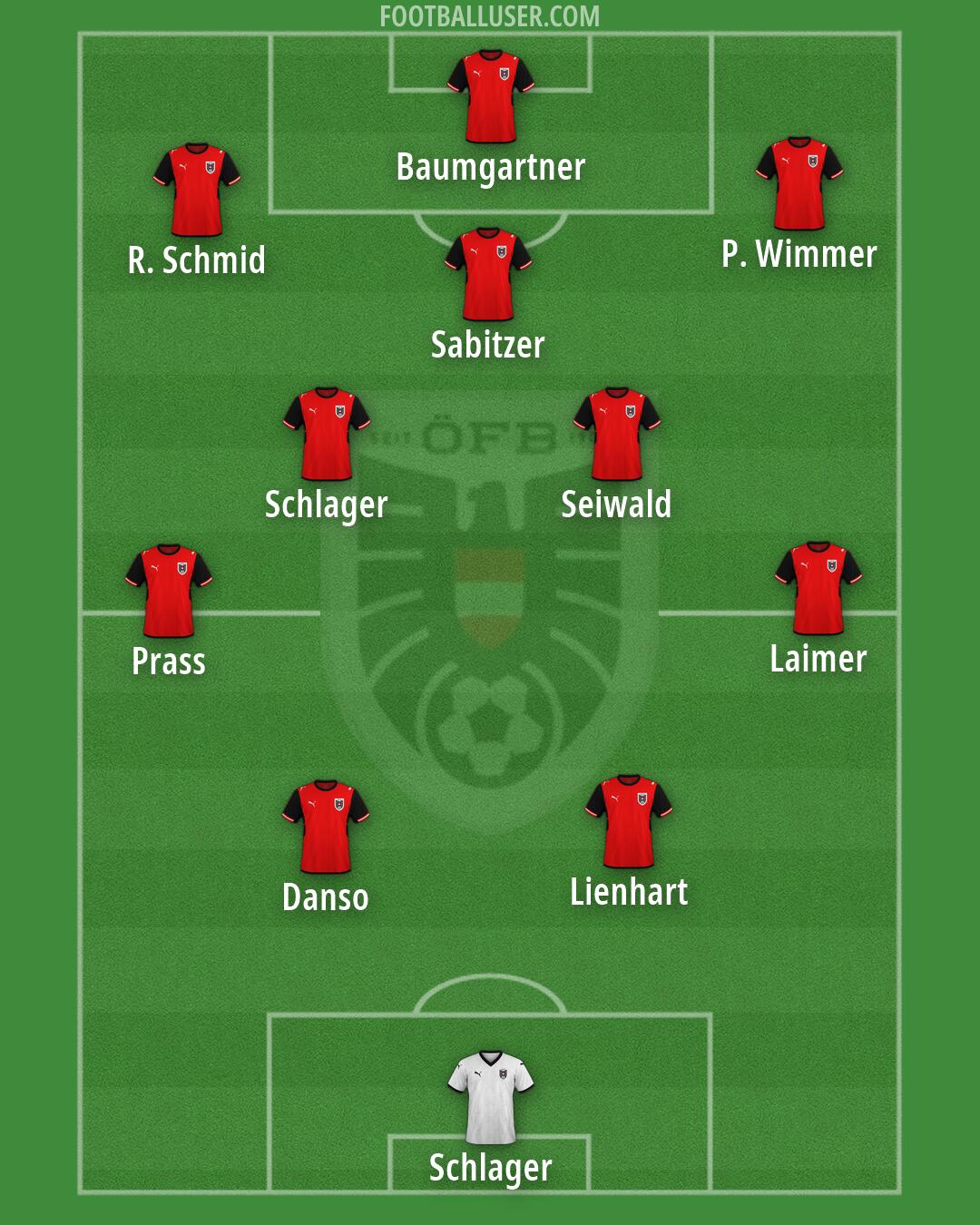
Schlager · Seiwald · Baumgartner · Sabitzer · R. Schmid · P. Wimmer · Prass · Danso · Lienhart · Laimer · SchlagerAustria employs a 5-4-1 formation that relies on a heavy defensive block and quick transitions. This lineup is built to sit deep and soak up pressure, looking to catch opponents on the break. The main idea is to keep the team compact, making it difficult for the opposition to find space between the lines, and then use the width provided by the wing backs to move the ball forward quickly once possession is won.
Baumgartner guards the goal and coordinates the back line from deep. The defensive unit consists of three central defenders in Seiwald, Schlager, and Sabitzer. Seiwald and Schlager provide physical presence to defend crosses and handle aerial duels, while Sabitzer acts as the ball playing defender to start attacks. On the flanks, P. Wimmer and R. Schmid act as wing backs, tasked with tracking back to form a back five when defending but pushing up to provide width during transitions.
The midfield operates in a flat four, focused on covering ground and closing passing lanes. Laimer and Prass form a double pivot to shield the defense, with Laimer using his high pressing intensity to disrupt play in the middle. Lienhart and Danso sit ahead of them, acting as the link between the defensive block and the lone striker. These two must work hard to track back and help the wing backs when the team is under pressure, ensuring the midfield remains compact.
In the attacking phase, Schlager acts as the lone striker, tasked to hold up the ball and wait for support. The attack relies on the movement of Lienhart and Danso to break the lines, while P. Wimmer and R. Schmid provide the width by making runs down the flanks. When the team wins the ball, the goal is to quickly switch play to the wing backs or hit direct passes to Schlager to create immediate pressure on the opponent's back line.
One major advantage for Austria is the compactness they offer when defending in a low block. By keeping the lines close together, they force opponents to play around the perimeter rather than through the center. Another strength is the ability to use the wing backs to create wide overloads, which can catch a high defensive line off guard. The double pivot of Laimer and Prass also provides a solid screen that makes it hard for teams to penetrate the central area.
This 5-4-1 formation is designed to be defensively solid and difficult to break down. It is best suited for matches against teams that dominate possession, allowing the side to defend deep and strike on the counter.