Custom Team Football Formation
 May 4, 2026


Starting Lineup
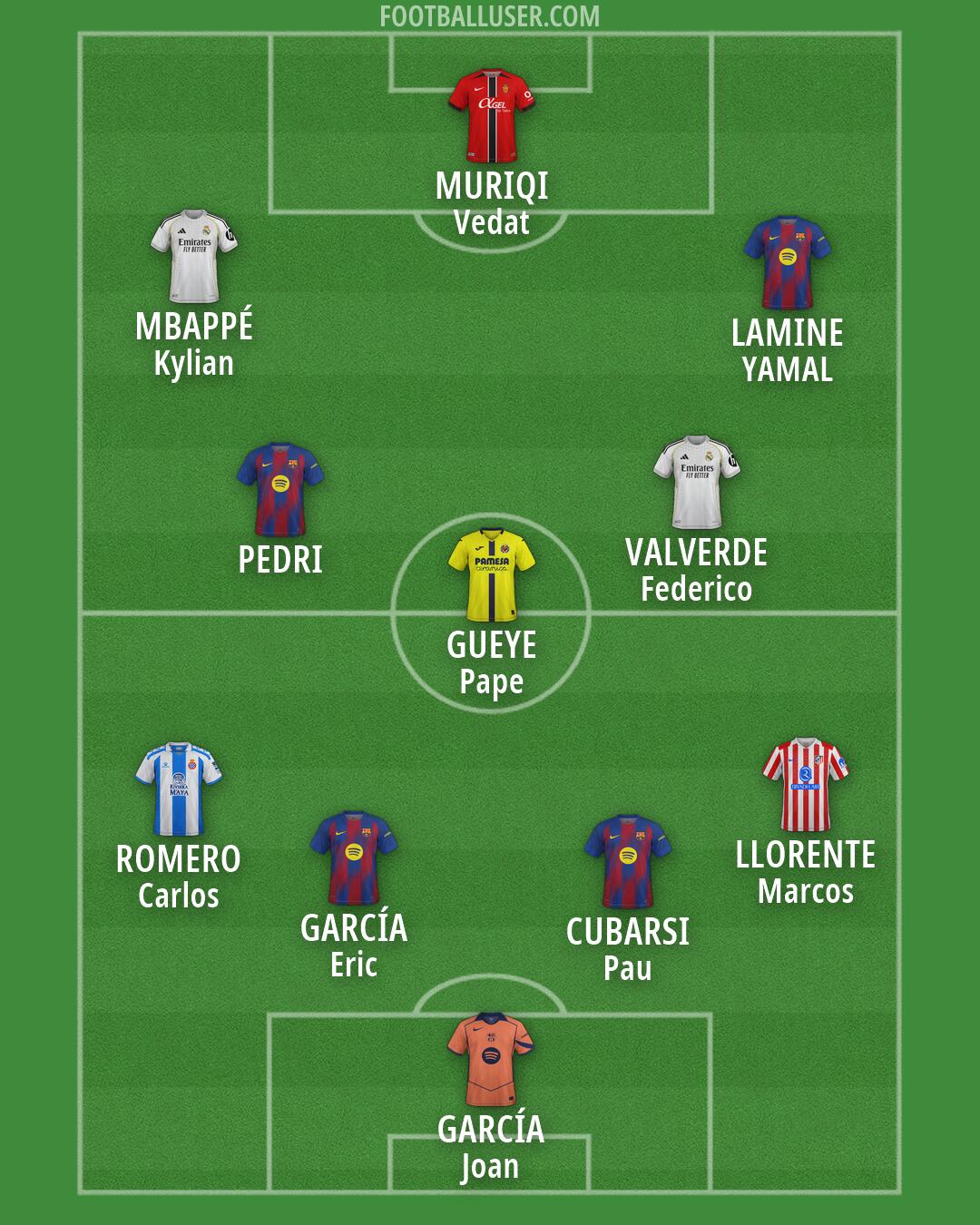
GARCÍA (Joan) (Barcelona) · GARCÍA (Eric) (Barcelona) · LLORENTE (Marcos) (Atlético) · PEDRI (Barcelona) · GUEYE (Pape) (Villarreal) · VALVERDE (Federico) (Real Madrid) · MBAPPÉ (Kylian) (Real Madrid) · MURIQI (Vedat) (Mallorca) · LAMINE (YAMAL) (Barcelona) · CUBARSI (Pau) (Barcelona) · ROMERO (Carlos) (Espanyol)A heavy focus on defensive solidity and quick transitions defines this lineup using a 5-4-1. The team aims to sit deep and wait for the opposition to commit numbers forward before hitting them on the break. This formation is built to play a reactive style of football where the main goal is to deny space between the lines and force long balls.
MURIQI guards the goal while the back five maintains a narrow defensive block. GUEYE acts as the central anchor to protect the area, while VALVERDE and PEDRI operate as wide centre-backs to cover the channels. MBAPPÉ and LAMINE occupy the wing back roles, ready to push up the flanks to provide width when the team wins the ball. The unit works to hold a compact shape, ensuring the defenders stay close together to minimize gaps.
The midfield operates as a flat four to congest the central zones. GARCÍA and CUBARSI form a central pairing to shield the defence and recycle possession when playing out from the back. LLORENTE and ROMERO stay wide to track back and support the wing backs, while also looking to carry the ball forward during transitions. This four-man line helps to compress the midfield and deny the turn of any attacking players attempting to play through the centre.
In the final third, the team relies on a lone striker, GARCÍA, to lead the line. This forward is tasked to hold up the ball and wait for support from the advancing midfielders. When the team attacks, MBAPPÉ and LAMINE push high to provide the necessary width, often looking to deliver crosses into the box. The forwards press from the front to force a long ball, allowing the defensive unit to win the second ball and start a new attack.
One major advantage of this formation is the ability to maintain compactness when defending, making it very difficult for opponents to find gaps in the middle. The team also benefits from the speed of transition, as the wing backs and midfielders can quickly spread wide to exploit spaces left behind by an advancing opposition. This creates a setup that is very hard to break down in a low block.
This 5-4-1 formation is built for teams that want to absorb pressure and strike with pace. It is best suited for matches against dominant opponents where sitting deep and defending zonally is the priority.