
Ivory Coast National Football Team Formation
 May 6, 2026


Starting Lineup
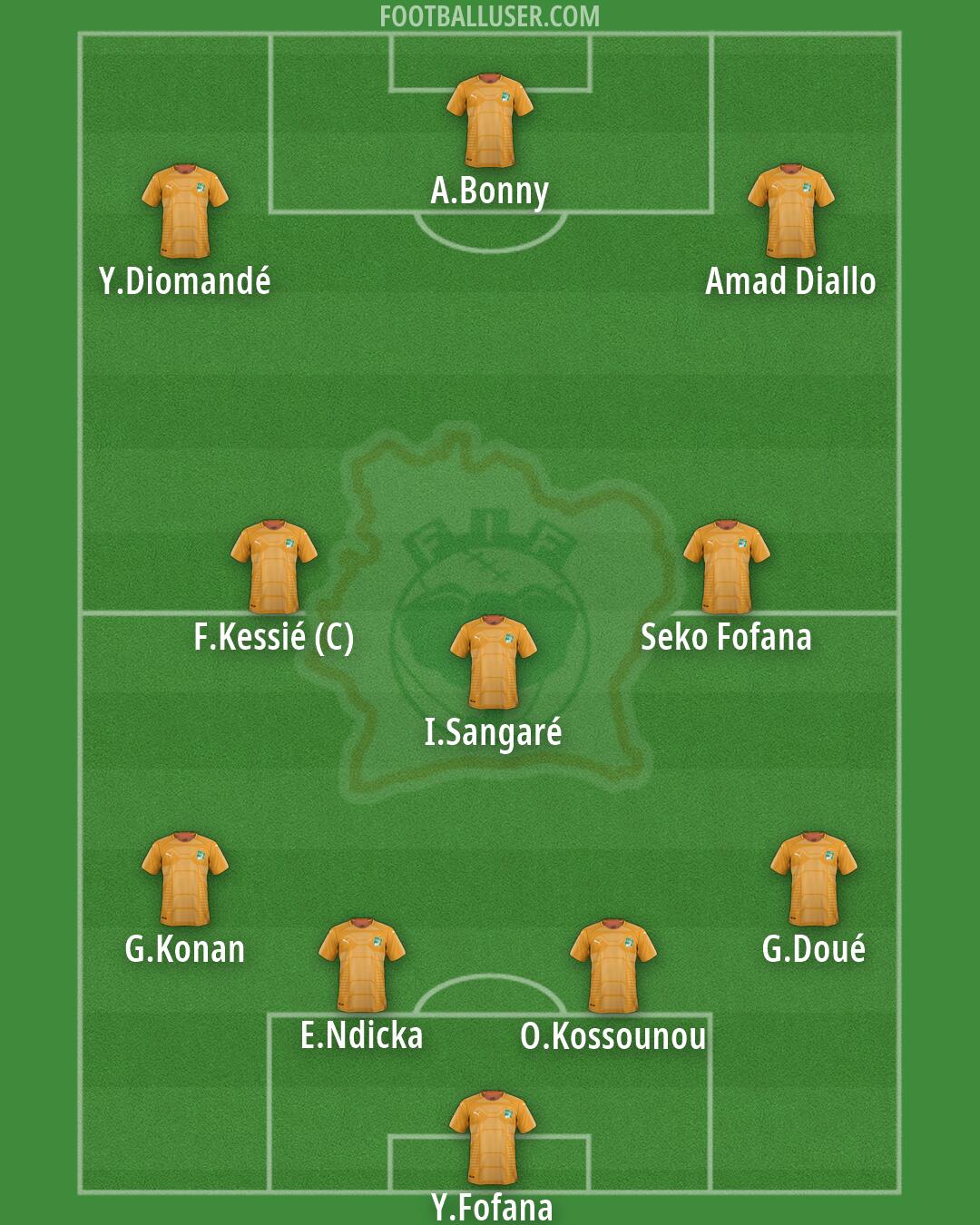
Y.Fofana · E.Ndicka · O.Kossounou · G.Konan · G.Doué · I.Sangaré · F.Kessié (C) · Seko Fofana · Amad Diallo · Y.Diomandé · A.BonnyIvory Coast operates in a 4-3-3 formation. This lineup focuses on a high press and quick vertical transitions to exploit spaces. The team seeks to win the ball high up the pitch and drive directly toward the goal. It is built to play a direct game that uses speed and power to unsettle opponents and prevent them from settling into a rhythm.
Y.Fofana guards the goal as the last line of defense. The back four consists of G.Doué at right back and G.Konan at left back. These wide defenders are expected to push up and overlap to provide width in the final third. O.Kossounou and E.Ndicka form the central pair. O.Kossounou acts as a ball playing defender to start attacks, while E.Ndicka provides cover and relies on his presence to stop crosses. The defensive unit works to stay compact and step up together to catch attackers offside.
In the middle of the pitch, I.Sangaré acts as a single pivot to shield the back four. He stays deep to intercept passes and break the lines with simple distribution. The midfield is completed by F.Kessié (C), who uses his physicality and box to box energy to drive the team forward, and Seko Fofana, who uses his ball carrying and passing range to connect the defense to the attack. This group helps the team transition quickly from a defensive block to an attacking position.
The attacking lineup uses a lone striker in A.Bonny to hold up the ball and pin the opposition defenders. On the flanks, Amad Diallo and Y.Diomandé act as wide wingers. Amad Diallo uses his dribbling to cut inside and create chances in the half spaces, while Y.Diomandé pushes the play wide to stretch the defense. The forwards are tasked to press high, forcing turnovers near the opponent's box to create quick scoring opportunities through rapid movement.
This formation offers clear tactical advantages. The presence of F.Kessié (C) and Seko Fofana allows for numerical superiority in the middle of the park during transitions. The team can also create wide overloads when G.Doué and G.Konan join the attack to support the wingers. Furthermore, the ability to press high in coordinated waves makes it hard for opponents to build play from the back, and the speed of transition allows the team to catch opponents while they are out of position.
Ivory Coast relies on a high intensity attacking identity. This 4-3-3 formation is best suited for matches against teams that play a high line and leave space behind their defenders.