
Argentina National Football Team Formation
 May 7, 2026


Starting Lineup
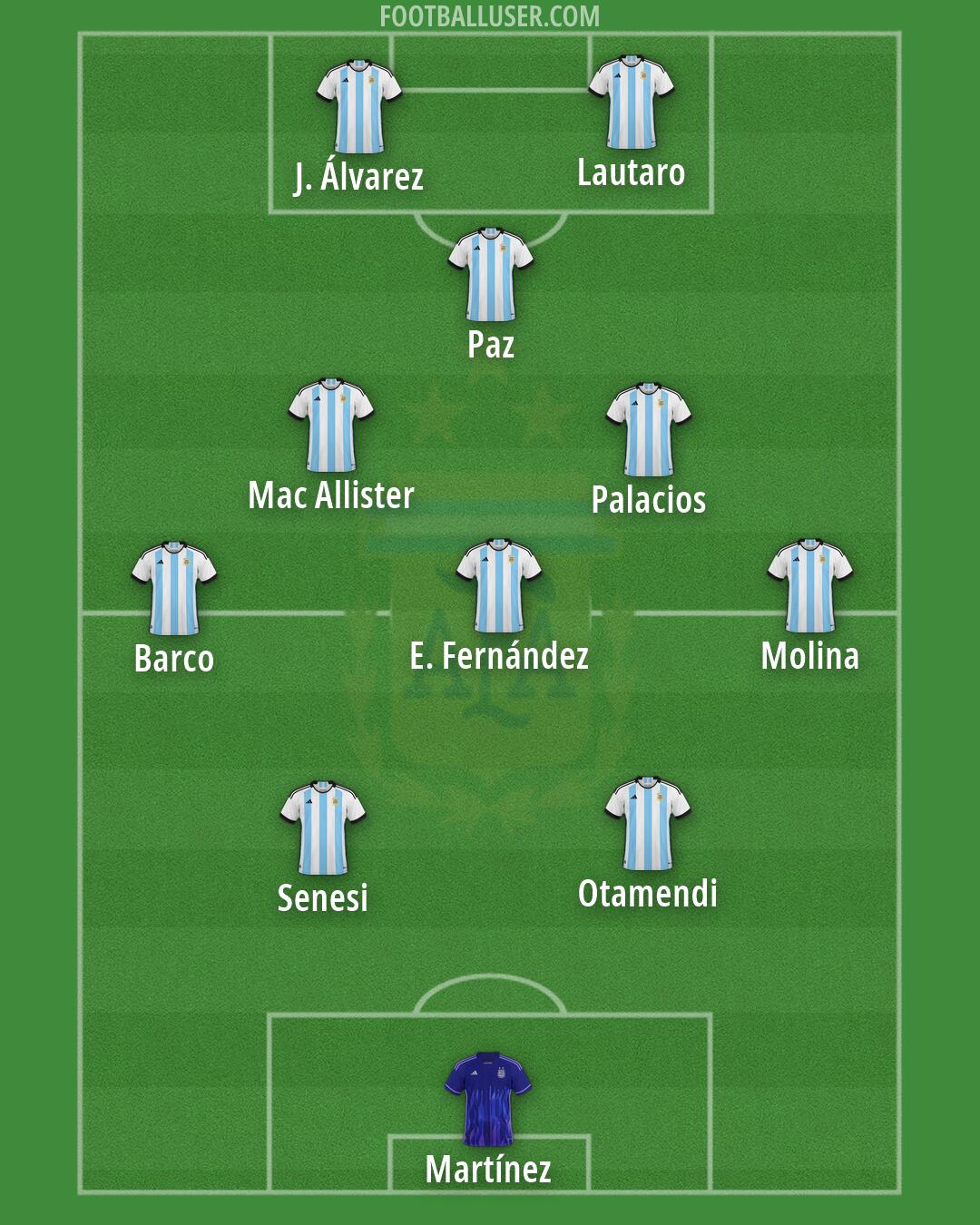
Palacios · Lautaro · J. Álvarez · Paz · Mac Allister · E. Fernández · Molina · Barco · Senesi · Otamendi · MartínezArgentina utilizes a 2-6-2 formation that prioritizes heavy central congestion and midfield dominance. This lineup is built to play a high pressing game where the team aims to win the ball back quickly in the middle third. By sacrificing width in the defensive line, Argentina focuses on overwhelming the opposition through a dense corridor of players to control the tempo and dictate play.
Martínez acts as the last line of defense, protecting the goal while managing the space behind the backline. The defensive unit consists of a central pair with Senesi and Otamendi, who must remain alert to cover any runners from deep. Because there are only two central defenders, they must step up to intercept passes and remain dominant in the air to prevent long balls from bypassing the midfield. This requires both players to communicate constantly to ensure the defensive block does not leave too much space behind them.
The midfield is the engine room of this formation, utilizing a massive six-man unit to control the center of the pitch. A trio of defensive midfielders, Barco, E. Fernández, and Molina, works to shield the two defenders and break up play. E. Fernández uses his passing range to find teammates, while Barco and Molina focus on tackling and tracking back. Ahead of them, Palacios, Mac Allister, and Paz operate as attacking midfielders to connect the lines. Mac Allister uses his vision to break the line with vertical passes, while Palacios and Paz push forward to support the attack and press high when the ball is lost.
The attack features two forwards, J. Álvarez and Lautaro, who operate in the final third. They work as a strike duo to stretch the opposition defense, with J. Álvarez using his pressing intensity to harass defenders and Lautaro looking to hold up the ball. The movement of these two is designed to create space for the advancing midfielders to run into. They must coordinate their runs to ensure they do not get isolated, often dropping slightly deeper to link play with the attacking midfielders.
This formation offers significant tactical advantages, particularly through massive numerical superiority in the midfield. By flooding the central zone, Argentina can easily win second balls and dominate possession. Another strength is the ability to press high in coordinated waves, as the six midfielders and two forwards create multiple layers of pressure. This makes it very difficult for opponents to build play from the back without making mistakes under intense pressure.
This 2-6-2 formation is a high-risk, high-reward system designed for total midfield control and aggressive pressing. It is best suited for games where the team wants to suffocate an opponent through central congestion and rapid ball recovery.