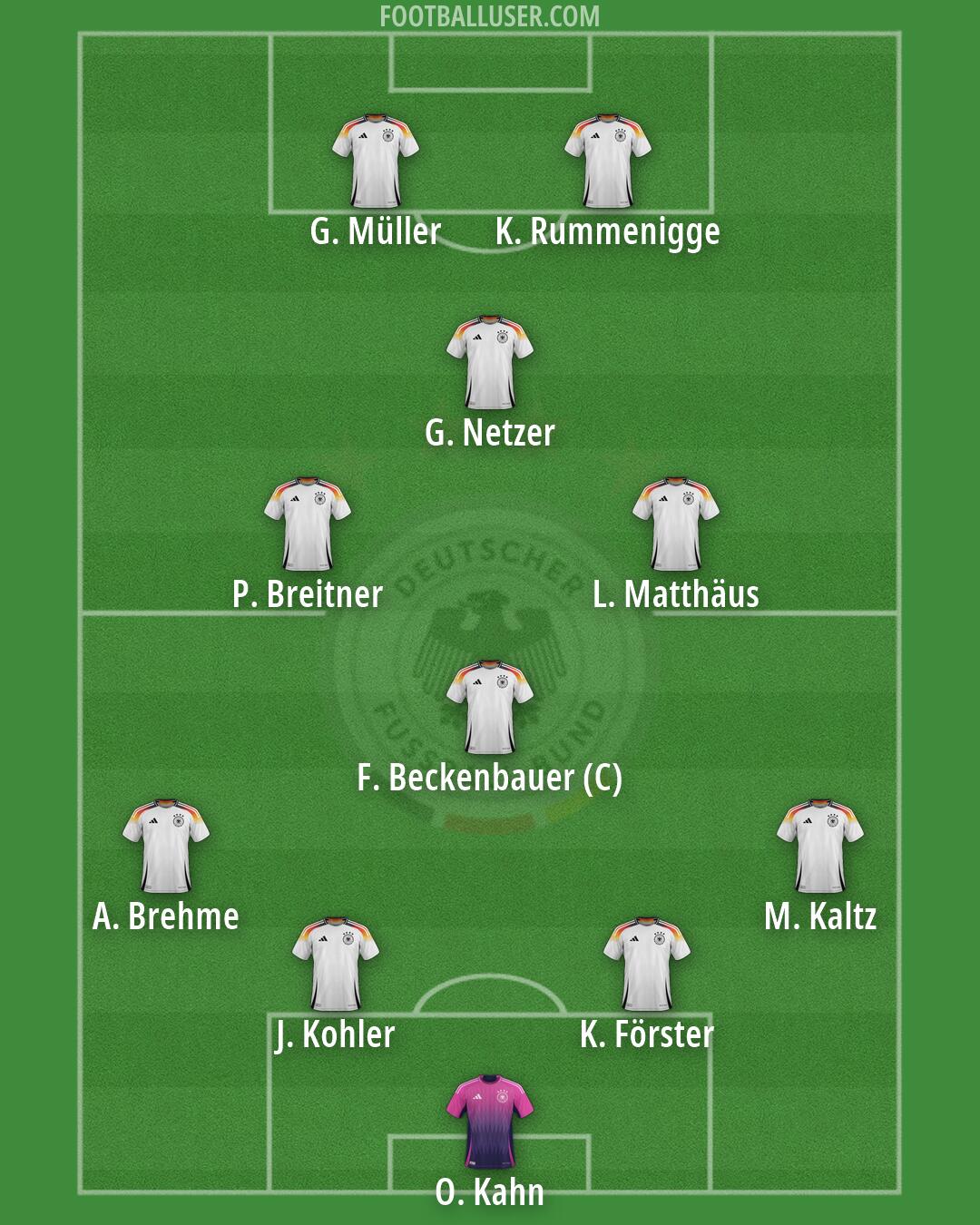

Germany National Football Team Formation
 May 9, 2026


Starting Lineup
O. Kahn · K. Förster · J. Kohler · M. Kaltz · A. Brehme · F. Beckenbauer (C) · L. Matthäus · P. Breitner · G. Netzer · G. Müller · K. RummeniggeGermany utilizes a 5-3-2 formation. This lineup is built to play a vertical style of football that relies on rapid transitions and strong central presence. The tactical identity revolves around a solid foundation that allows the team to defend deep and then quickly push forward to exploit space in the final third.
O. Kahn acts as the last line of defense in goal. The back line operates as a three man central unit consisting of K. Förster, F. Beckenbauer (C), and J. Kohler. As the captain, F. Beckenbauer (C) leads the defensive unit with his ability to read the game and his exceptional passing range from deep. M. Kaltz and A. Brehme act as wing backs to provide width. M. Kaltz pushes up the right flank to support the attack, while A. Brehme offers overlapping runs on the left. The three central defenders work together to cover space and win aerial duels.
The midfield operates as a central trio that connects the defense to the attack. G. Netzer plays as the attacking midfielder to create chances and find pockets of space between the lines. Ahead of the defensive screening, L. Matthäus and P. Breitner occupy the central roles. L. Matthäus uses his high pressing intensity to win the ball back, while P. Breitner helps to control the tempo and shift play across the pitch. This midfield unit works to shield the back three and drive the ball forward during transitions.
Germany uses two forwards to lead the line. G. Müller and K. Rummenigge operate as a strike partnership to pressure the opposition defense. G. Müller relies on his clinical finishing and movement inside the box to find scoring opportunities. K. Rummenigge uses his pace and strength to hold up the ball and run behind defenders. The formation is designed to create central overloads by having the strikers move in tandem with the attacking midfielder.
This formation offers significant tactical advantages. The team can achieve compactness when defending by sitting deep in a low block. The presence of wide wing backs allows for wide overloads when they push high up the pitch. Furthermore, the setup provides speed of transition, allowing the team to move from a defensive position to an attacking one in a matter of seconds.
This 5-3-2 formation provides a reliable balance between defensive stability and attacking threat. It is best suited for matches against teams that play with high defensive lines or those that struggle to handle rapid counter attacks.