
São Paulo Football Formation
 May 9, 2026


Starting Lineup
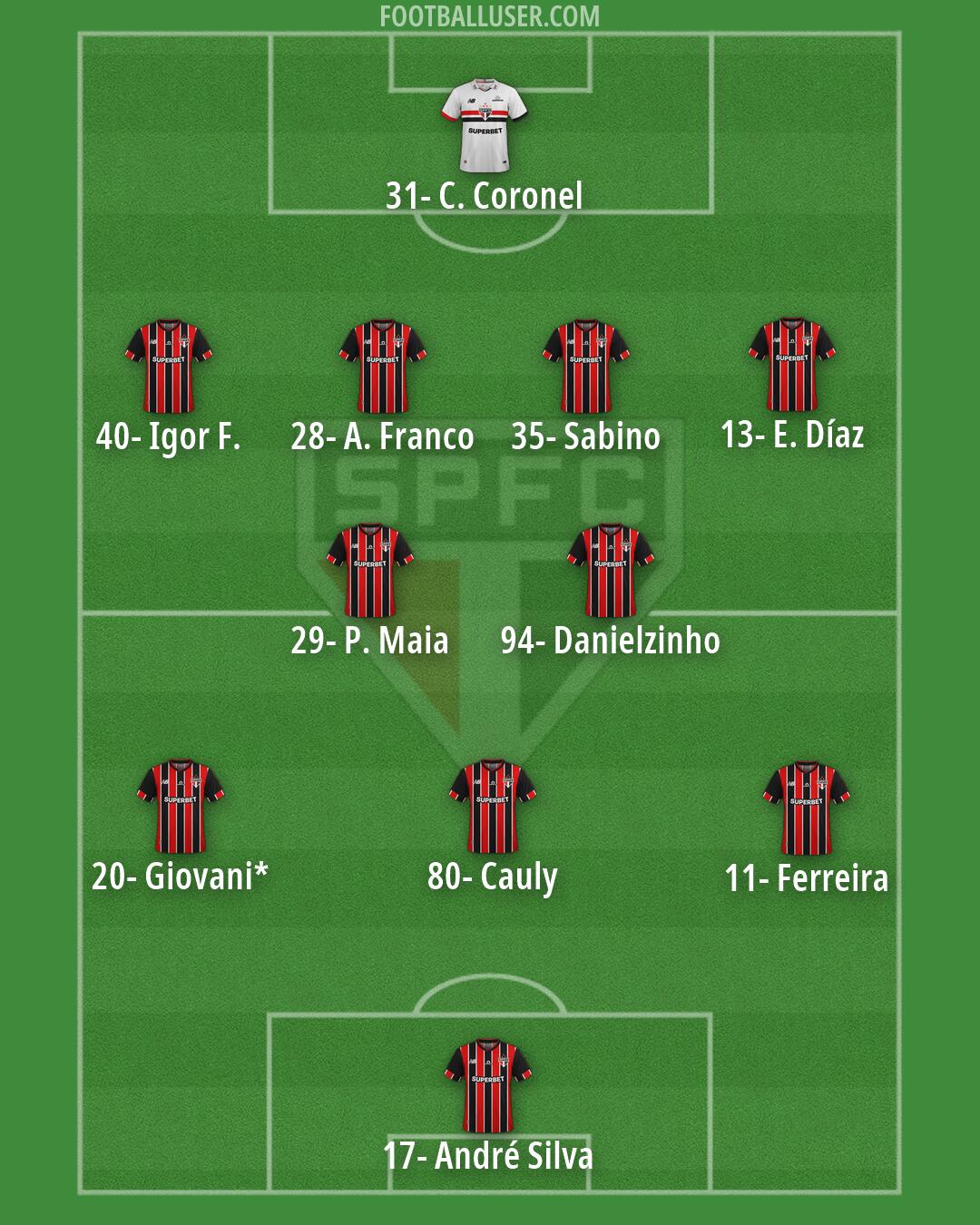
31- C. Coronel40- Igor F.
28- A. Franco
35- Sabino
13- E. Díaz
29- P. Maia
94- Danielzinho
20- Giovani*
80- Cauly
11- Ferreira
17- André Silva
São Paulo uses a 4-5-1 formation that focuses on a compact central block and quick transitions. This lineup is built to sit deep and absorb pressure before hitting teams on the break. The goal is to congest the middle of the pitch and force opponents to play wide where they can be contained.
C. Coronel acts as the last line of defense in goal. Behind the midfield, a flat back four maintains the defensive line. Sabino and A. Franco work as the central pair, with Sabino providing aerial strength and A. Franco looking to cover space behind the full backs. E. Díaz and Igor F. play as traditional full backs, staying deep to support the center backs but ready to overlap once the ball moves forward. The defensive unit stays close together to block passing lanes and deny space between the lines.
The midfield is a five man unit designed to dominate the central zone. P. Maia and Danielzinho act as a double pivot to shield the back four and intercept play. Ahead of them, Cauly and Ferreira operate in the half spaces to connect the defense to the attack, with Cauly using his passing range to switch play. Giovani plays as the left central midfielder, pushing up to support the press or dropping back to help the pivot. This grouping makes it very difficult for opponents to play through the center.
In the attacking phase, São Paulo relies on a lone striker, André Silva, to lead the line. André Silva must hold up the ball and bring the four midfielders into the game. The attack is built through the central midfielders finding gaps in the opposition line. While the midfielders push forward, the width comes from the full backs or the midfielders cutting inside to create overloads. The forwards press high to force mistakes, ensuring the team stays compact even when they do not have the ball.
This formation offers significant tactical advantages, especially through its density in the middle of the pitch. By using five midfielders, São Paulo creates a numerical superiority that makes it hard for teams to bypass the center. The team also benefits from a high level of compactness when defending, making it difficult to find gaps in the low block. This setup allows the team to transition quickly from a defensive stance to an attacking one once a turnover occurs.
This 4-5-1 formation provides a solid foundation for a team looking to control the tempo through central density. It is best suited for matches against teams that dominate possession and require a disciplined defensive block to nullify their threats.