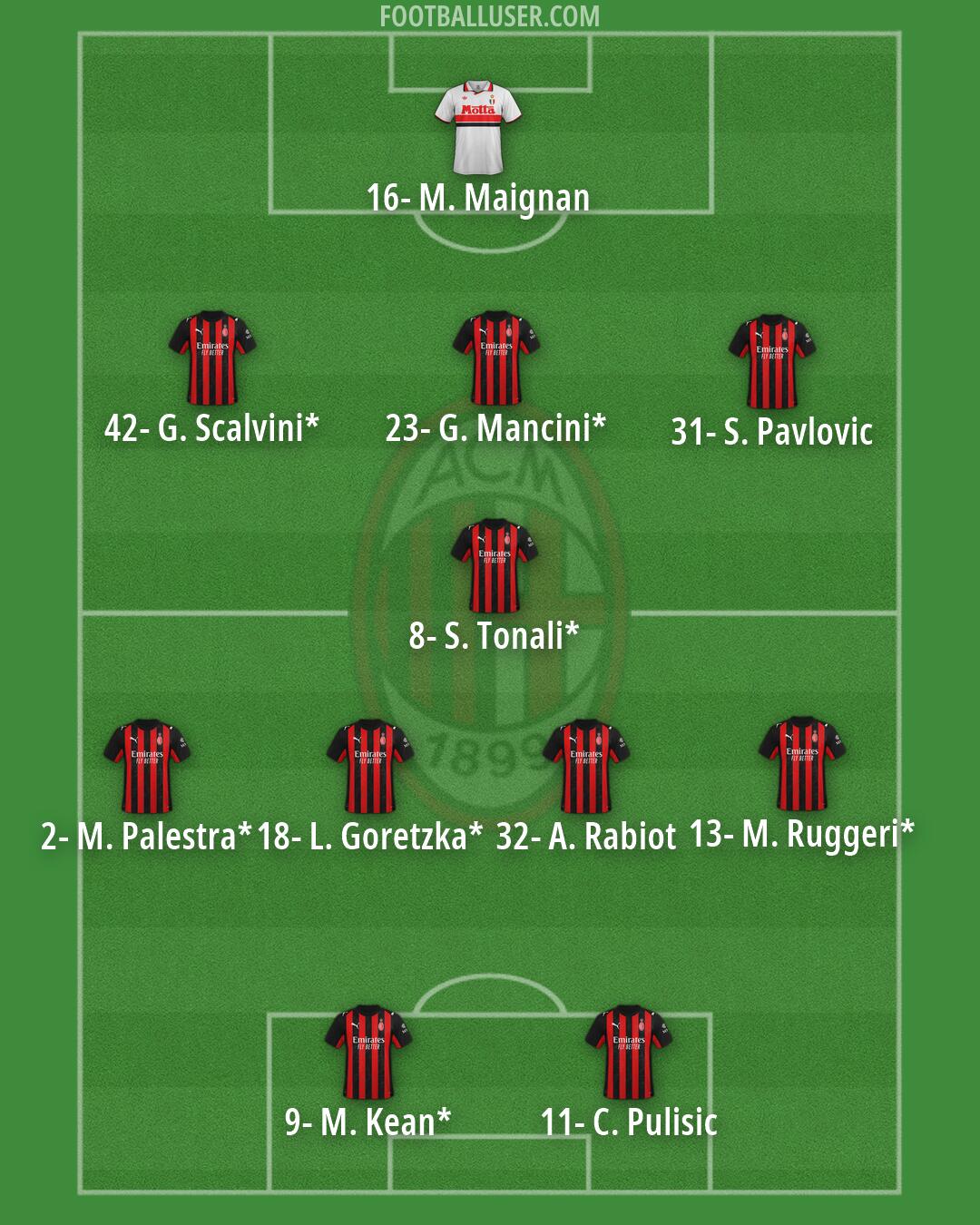

Milan Football Formation
 May 11, 2026


Starting Lineup
16- M. Maignan42- G. Scalvini*
23- G. Mancini*
31- S. Pavlovic
9- M. Kean*
11- C. Pulisic
8- S. Tonali*
13- M. Ruggeri*
18- L. Goretzka*
32- A. Rabiot
2- M. Palestra*
Milan plays with a 3-5-2 formation. This formation is built for a high press and fast transitions. The team seeks to dominate the middle of the pitch and use vertical passes to catch opponents out of position. Such a formation allows the team to stay compact while remaining ready to strike quickly on the break.
M. Maignan plays as the goalkeeper, using his sweeping ability and long passing to start attacks from the back. A defensive line featuring a back three consists of G. Scalvini, G. Mancini, and S. Pavlovic. G. Scalvini and S. Pavlovic act as ball playing defenders who step up to intercept, while G. Mancini stays central to cover and win aerial duels. M. Ruggeri and M. Palestra act as wingbacks who must cover the entire flank and track back to form a five man defensive block when the team sits deep.
The midfield works with a single pivot and two central midfielders. S. Tonali sits in front of the defense to shield the back three, using his tackling and passing range to control the tempo. L. Goretzka and A. Rabiot operate as the two central players who drive forward and break the line. These players link the defense to the attack by recycling possession and finding gaps in the opponent lineup through clever movement.
Two forwards, C. Pulisic and M. Kean, lead the line. C. Pulisic often cuts inside from the left to use his dribbling, while M. Kean works to hold up the ball and push the defenders back. Wingbacks M. Ruggeri and M. Palestra provide width through their overlapping runs and crosses. Both forwards press high to force turnovers in the final third and create chances.
A major strength for Milan is the ability to create numerical superiority in the central zone. The combination of S. Tonali, L. Goretzka, and A. Rabiot allows the team to win second balls and control the tempo. Additionally, the wingbacks allow for wide overloads, creating one on one situations for the attackers. The team can also press in coordinated waves to suffocate the opposition in their own half.
This formation relies on central strength and rapid shifts in play. It is most effective against opponents who struggle to track runners in the half spaces or those who play with a narrow midfield.