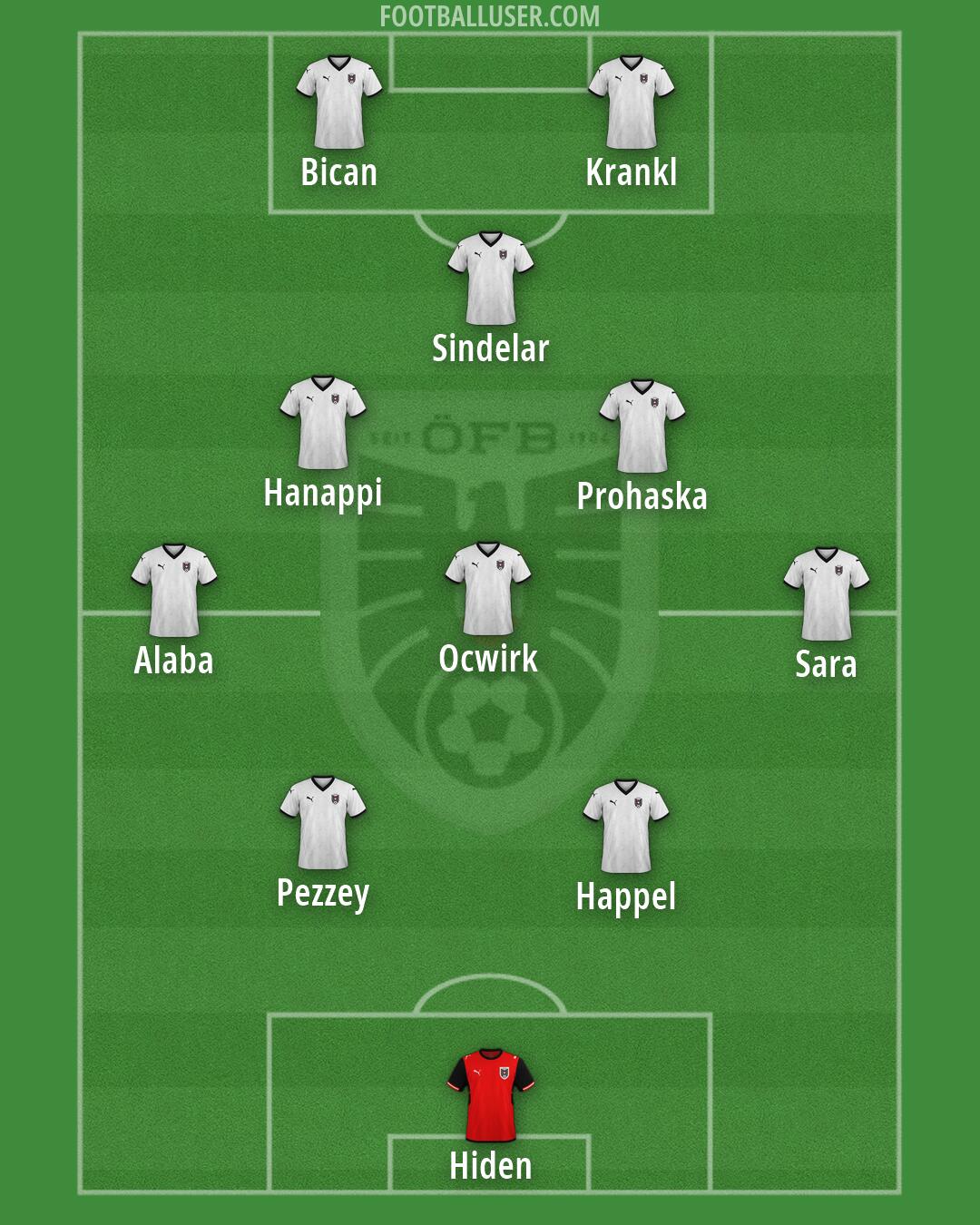

Austria National Football Team Formation
 May 13, 2026


Starting Lineup
Bican · Krankl · Sindelar · Ocwirk · Sara · Happel · Prohaska · Hanappi · Alaba · Pezzey · HidenAustria utilizes an unconventional 2-6-2 formation. This lineup is built for heavy midfield control and total dominance through the center of the pitch. The primary goal is to crowd the middle to control the ball and use a massive central block to suffocate the opposition.
Hiden stays between the posts to command the area. Ahead of him, Happel and Pezzey form a narrow back two that must act as a central defensive pair. These two center backs need to be dominant in the air and quick to cover the wide channels when the midfield is bypassed. Because there are no full backs, Happel and Pezzey must step up to intercept long balls and block direct runs into the box.
The midfield contains six players that form a massive central engine. Alaba sits in the deepest position to shield the defense and break the lines with his passing range. Sara and Ocwirk act as the engine room to protect the center and win back possession. Prohaska, Hanappi, and Sindelar push further forward to create chances and occupy the pockets of space between the lines. This deep block of six ensures that Austria can always find a passing option to move the ball from defense to attack.
The attack relies on two forwards to lead the line. Bican and Krankl work together as the main goal threats, often playing close to each other to hold up the ball and wait for the midfield to arrive. They press the opposing defenders high to force mistakes and create turnover opportunities. The formation relies on the wide midfielders to cut inside and support these two strikers, creating a central overload that is hard to mark.
One major advantage of this formation is the overwhelming numerical superiority in the middle of the park. By packing the center, the team can intercept passes and dominate possession through sheer volume of players. Another strength is the ability to press high in coordinated waves, using the six midfielders to trap the opponent in their own half. This makes it very difficult for the other team to find any space to play through the middle.
This 2-6-2 formation relies on extreme midfield congestion to control the rhythm of the match. It is best suited for games where the team wants to squeeze an opponent into a small area and dominate the ball.