
Celta Football Formation
 May 14, 2026


Starting Lineup
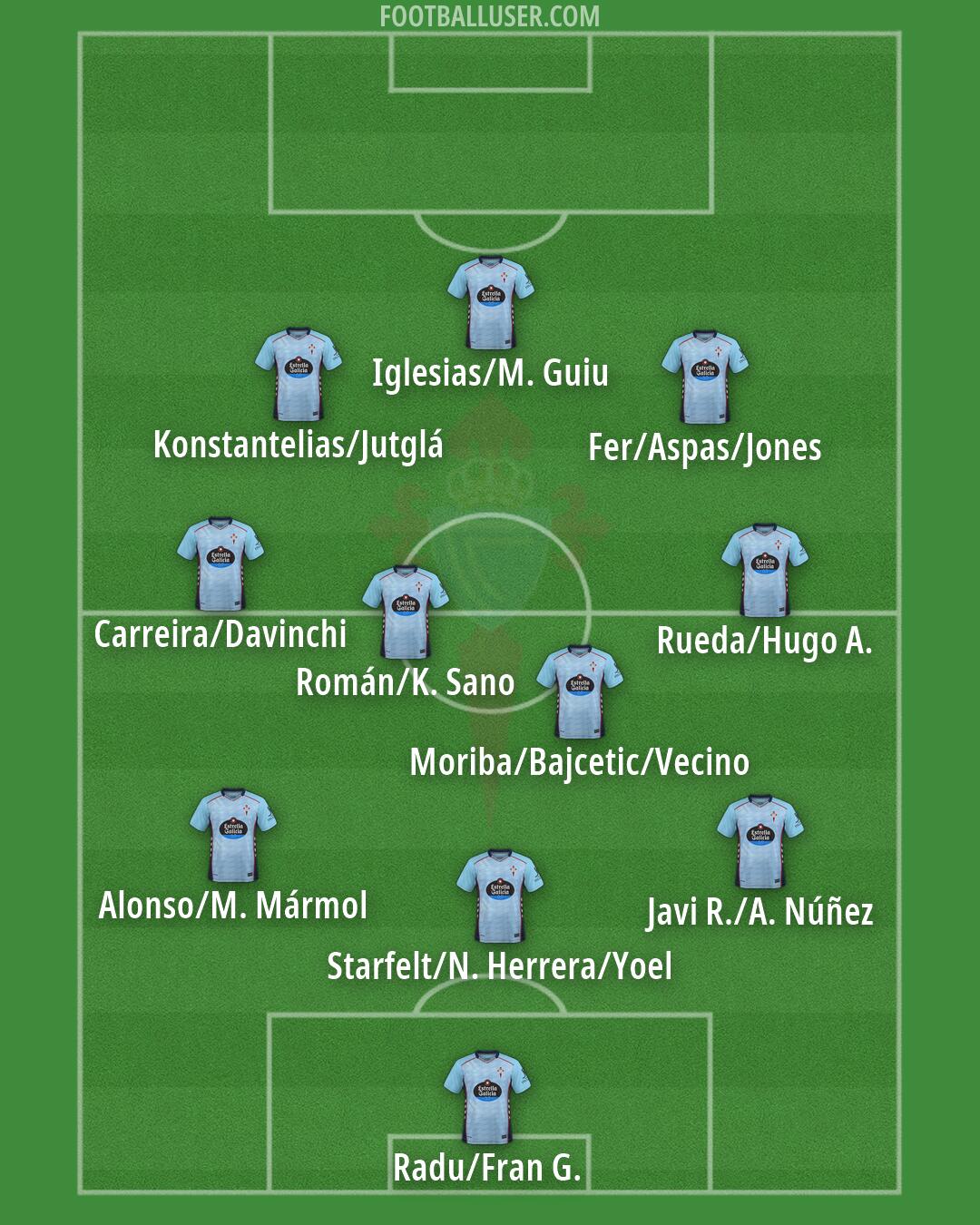
Radu/Fran G. · Starfelt/N. Herrera/Yoel · Alonso/M. Mármol · Javi R./A. Núñez · Moriba/Bajcetic/Vecino · Román/K. Sano · Iglesias/M. Guiu · Fer/Aspas/Jones · Konstantelias/Jutglá · Rueda/Hugo A. · Carreira/DavinchiCelta plays a 3-4-3 formation that relies on a high press and verticality. This lineup is built to pin opponents back and quickly break the lines through the middle or out wide. The team looks to control space in the middle third while keeping the forwards high up the pitch to force turnovers in the final third.
Radu acts as the last line of defense in goal. The defensive unit operates with a back three consisting of Starfelt, N. Herrera, and Yoel. Javi R. and A. Núñez sit as the right center backs to provide cover, while Alonso and M. Mármol occupy the left center back positions. The defenders must step up to manage the high line and use their aerial strength to clear crosses. This back line must remain compact to prevent opponents from finding space between the channels.
The midfield is composed of several roles designed to control the center of the pitch. Moriba, Bajcetic, and Vecino occupy the defensive midfield positions to shield the back three. Román and K. Sano operate as central midfielders to connect the defense to the attack. Rueda, Hugo A., Carreira, and Davinchi provide additional layers to ensure the team can pass through the lines. These players must track back quickly when possession is lost and push up to support the front line.
Celta uses three attackers to stretch the opposition. Fer, Aspas, and Jones operate on the right wing, while Konstantelias and Jutglá occupy the left side. Iglesias and M. Guiu lead the line as the lone striker. The wingers are expected to cut inside to create passing lanes, while the striker must hold up the ball to bring others into play. The forwards press in unison to force mistakes from the opposing defenders.
One major strength of this formation is the ability to create wide overloads when the midfielders push forward to support the wingers. The team also gains numerical superiority in the middle of the pitch through the depth of the midfield roles. This setup allows for rapid transitions, making it hard for opponents to react once the ball is won. The ability to press high in coordinated waves keeps the pressure constant on the opposition.
This 3-4-3 formation defines a team that wants to dominate through high intensity and vertical passing. It is best suited for matches against opponents who sit deep and struggle to cope with constant pressure in wide areas.