
Milan Football Formation
 May 15, 2026


Starting Lineup
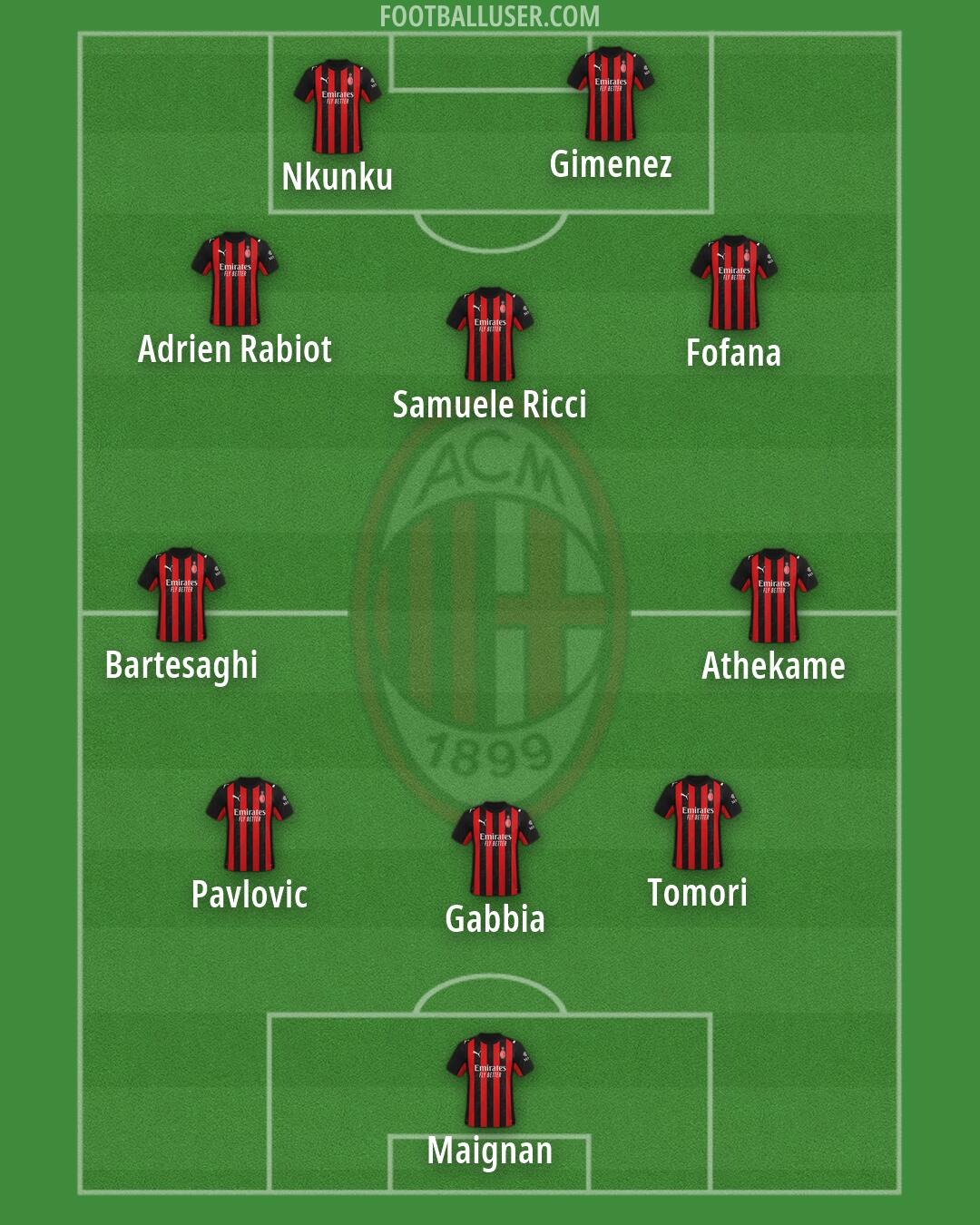
Nkunku · Gimenez · Adrien Rabiot · Samuele Ricci · Fofana · Athekame · Tomori · Gabbia · Pavlovic · Bartesaghi · MaignanMilan operates with a 5-3-2 formation designed to be defensively solid while maintaining a heavy presence in central areas. This lineup focuses on controlling the middle of the pitch and using quick vertical transitions to catch opponents out of position. The team seeks to win the ball in the center and immediately look for the two forwards to drive the play forward.
Maignan acts as the foundation in goal, providing security for the back line. The defensive unit uses a back three consisting of Gabbia, Pavlovic, and Tomori. Tomori uses his recovery speed to cover space, while Gabbia and Pavlovic provide aerial strength and physical presence to block crosses. Athekame and Bartesaghi act as wing backs, tasked with pushing high to provide width and track back to support the central defenders. This setup allows the team to sit deep or step up as a unit to compress the space between the lines.
The midfield works as a trio of central midfielders who control the rhythm. Fofana and Adrien Rabiot occupy the central roles to shield the defense and intercept passes. Samuele Ricci acts as the link, looking to receive the ball from the defenders and break the line with his passing. This midfield group works to occupy the central zones, making it difficult for opponents to play through the middle. They help the team transition from a defensive block into an attacking phase.
In the attacking phase, Milan utilizes two forwards to pressure the opposition defense. Nkunku and Gimenez play as a strike partnership, often moving between the channels to pull defenders out of position. Nkunku uses his movement to find space between the lines, while Gimenez works to hold up the ball and link with the oncoming midfielders. The wing backs, Athekame and Bartesaghi, provide the necessary width to stretch the opposition, allowing the forwards to operate in central areas.
One major advantage of this formation is the ability to create numerical superiority in the center of the pitch. The three central midfielders can easily outnumber most opponent double pivots. Another strength is the compactness when defending, as the five defenders and three midfielders can quickly shift to block passing lanes and deny space. This creates a hard block that is difficult to break down, especially when the team uses the width of the wing backs to exploit spaces on the counter.
This 5-3-2 formation provides a reliable platform for a team that wants to be hard to beat. It is best suited for facing opponents who dominate possession and rely on central play.